

Easy Trading Terms for Beginners: Simple Guide
There is a language of its own to trading. Without knowing the words, you won't know the market! This guide explains easy trading terminology for beginners in plain English.You will be familiar with the meaning of the terms pips, spreads, leverage and margin. You will understand bid and ask prices. You will know the difference between long and short positions.
Stop-loss and take-profit orders will make sense to you. Day trading terms like market orders, limit orders, support, and resistance are also covered. No complicated jargon. Just clear meanings that help you start trading with confidence. Read this guide. Learn the language. Start trading with understanding.
Trading Terminology PDF: Basic Words You Need
Before you start trading, you need to know the basic words. Here are the most common terms used in trading .
Ask and Bid Price
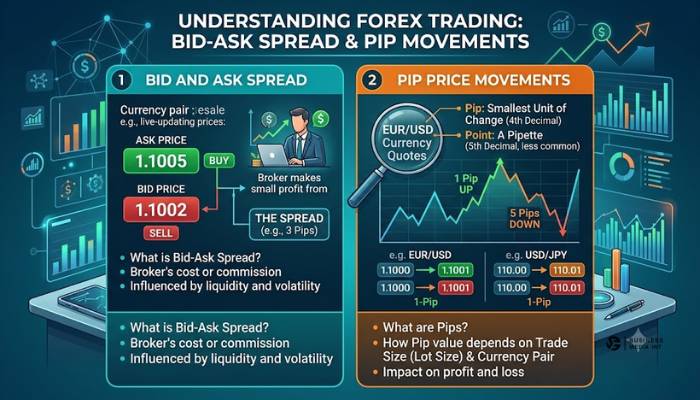
The ask price is the lowest price a seller will accept. The bid price is the highest price a buyer is willing to pay . When you buy, you pay the ask price. When you sell, you get the bid price.
Spread
Spread is the difference between the ask price and the bid price . A tight spread means the market is liquid. A wide spread means lower liquidity.
Pip
A pip is the smallest price movement in forex. For most currency pairs, 1 pip is 0.0001 . If EUR/USD moves from 1.2040 to 1.2045, it moved 5 pips.
Leverage
Leverage lets you control a large position with a small amount of money . With 1:100 leverage, 1,000 controls 100,000 worth of currency. Leverage multiplies both gains and losses .
Lot Size
Forex trades use standard sizes. One standard lot is 100,000 units of currency . There are also mini lots (10,000) and micro lots (1,000).
Long and Short Position
Going long means buying an asset expecting the price to rise . Going short means selling an asset expecting the price to fall .
Stop-Loss and Take-Profit
A stop-loss order automatically closes your trade when price hits a loss level you set . A take-profit order closes your trade when it reaches your profit target.
Bullish and Bearish
Bullish means you expect prices to rise . Bearish means you expect prices to fall. A bull market has rising prices. A bear market has falling prices .
Read More: Forex Trader Talk Terms for Beginners: A Simple Guide
Forex Trading Terminology PDF: Words for Currency Traders
If you are trading forex, these terms are important.
Currency Pairs
Forex trades happen in pairs. You buy one currency and sell another. In EUR/USD, EUR is the base currency and USD is the quote currency .
Major and Minor Currencies
Major currencies are traded frequently . These include US Dollar, Euro, Japanese Yen, British Pound, and Swiss Franc. Minor currencies are less frequently traded.
CFD (Contract for Difference)
A CFD lets you speculate on price movements without owning the asset . CFDs use leverage and carry high risk.
OTC (Over the Counter)
OTC trades happen directly between two parties . They do not go through a central exchange. Most forex trading is OTC .

Day Trading Terminology for Beginners
Day trading means buying and selling within the same day . Here are key day trading terms.
Market Order and Limit Order
A market order is executed immediately at the current price . A limit order is executed only at a price you set or better .
Margin
Margin is the money required to open a leveraged position . It is a deposit, not a fee.
Target Price
Target price is the price where you plan to sell for profit .
Short Selling
Short selling means selling shares you do not own. You must buy them back before the market closes . Traders do this when they expect prices to fall.
Trading Hours
In India, trading hours are from 9:30 AM to 4:00 PM on weekdays . After-hours trades happen outside these hours.
Day Trading Terminology: Technical Words
These terms help you read charts and understand price movements .
Support and Resistance
Support is a price level where buying stops the price from falling further . Resistance is a price level where selling stops the price from rising further.
Trend and Trendline
A trend shows the direction of prices . An uptrend has higher highs and higher lows. A downtrend has lower highs and lower lows. A sideways trend moves within a range .
Moving Average (MA)
A moving average calculates the average price over a specific period . A 50-day MA shows the average price over the last 50 trading sessions.
Candlesticks
Candlesticks show price movement over a time period . Each candle shows the opening, closing, high, and low prices.
Breakout
A breakout happens when price moves through a support or resistance level . This often signals a new trend.
Volatility
Volatility measures how fast and how much prices move . High volatility means more risk and more opportunity.
Volume
Volume is the number of trades during a specific timeframe . High volume confirms strong price moves.
You May Also Read: Trader Talk AI Trading Tools: Complete Guide for 2026

Quick Summary: Key Terms for Beginners
| Term | Simple Meaning |
|---|---|
| Pip | Smallest price movement, usually 0.0001 |
| Spread | Difference between buy and sell price |
| Leverage | Control large positions with small money |
| Margin | Money needed to open a leveraged position |
| Stop-Loss | Closes trade at a set loss level |
| Take-Profit | Closes trade at a set profit level |
| Long | Buy expecting price to rise |
| Short | Sell expecting price to fall |
| Bull | Expecting prices t rise |
| Bear | Expecting prices to fall |
| Support | Price level where buying stops falls |
| Resistance | Price level where selling stops rises |
FAQs
1. What is the difference between bid and ask price?
Bid is the price you can sell at. Ask is the price you can buy at. You buy at the ask and sell at the bid. The difference is the spread .
2. What does leverage mean in trading?
Leverage lets you control a large position with a small deposit. With 1:100 leverage, 1,000 controls 100,000. It multiplies both profits and losses .
3. What is a stop-loss order?
A stop-loss order automatically closes your trade at a price you set. It prevents you from losing more than you want .
4. What does going long and going short mean?
Going long means buying. You profit if price rises. Going short means selling. You profit if price falls .
5. What is the difference between day trading and investing?
Day trading means buying and selling within the same day . Investing means holding for months or years. Day trading uses leverage and carries higher risk .