

ETF Investing Guide for Beginners: Build Wealth with ETFs
Do you want to start investing but feel confused by all the choices? You are not alone. Many beginners think investing needs large amounts of money or expert knowledge. This is not true. ETFs make investing simple, affordable, and available to everyone.
An ETF (exchange-traded fund) is a fund that holds many different investments in one package. When you buy one ETF share, you own a small piece of every company or bond in that fund . Think of it like a ready-made basket of investments. You get diversification without picking individual stocks.
ETFs trade on stock exchanges just like regular stocks. You can buy and sell them throughout the day. Their prices change as the market moves .
This ETF investing guide for beginners covers everything you need. You will learn what ETFs are, how to choose them, how much to invest, and common mistakes to avoid. No complicated terms. Just clear steps that work.
What Is an ETF?
An ETF pools money from many investors. This pool buys a collection of assets like stocks, bonds, or commodities. The ETF then trades on an exchange, just like a company stock .
Most ETFs are passive. This means they track an index like the Nifty 50 or S&P 500. When the index goes up, the ETF goes up. When it goes down, the ETF goes down by roughly the same amount .
Read More: Best ETFs for Bear Market Investing: A Simple 2026 Guide
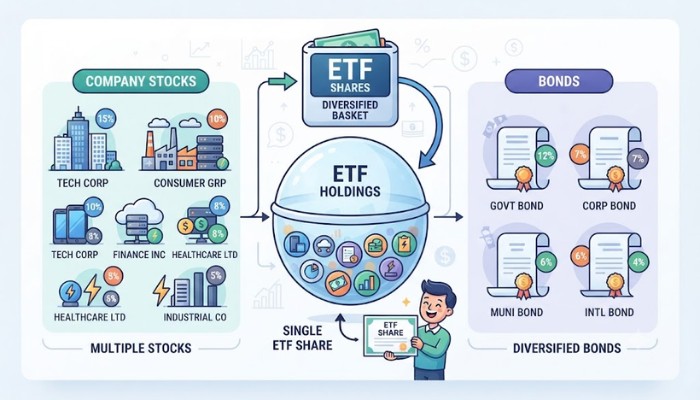
Key features of ETFs:
- Diversification: One ETF can hold hundreds or thousands of assets. This reduces your risk .
- Low cost: ETFs charge very small fees. The average ETF expense ratio was 0.34% in 2024. Many popular ETFs charge just 0.03% .
- Liquidity: You can buy or sell ETFs anytime during market hours .
- Transparency: ETF holdings are published daily. You know exactly what you own .
ETFs vs Mutual Funds: What's the Difference?
Many beginners confuse ETFs with mutual funds. Both pool money and invest in a basket of assets. But they work differently.
| Feature | ETFs | Mutual Funds |
|---|---|---|
| Trading | Trade throughout the day like stocks | Priced once at end of day |
| Minimum investment | As low as $1 with fractional shares | Often $500-$3,000 |
| Fees | Usually lower (0.03% - 0.34%) | Often higher (1%+) |
| Management | Mostly passive (index tracking) | Often active (manager picks stocks) |
The most important difference: ETFs trade like stocks. You can buy and sell them at any time during market hours. Mutual funds only trade at the end of each day .
Types of ETFs
There are many ETF types. Each serves a different purpose. Here are the main categories.
Stock ETFs
Stock ETFs invest in company shares. They can track broad indexes like the S&P 500 or focus on specific sectors .
Examples:
- Total market ETFs: Own stocks from the entire market
- Index ETFs: Track a specific index like Nifty 50
- Sector ETFs: Focus on one industry like technology or healthcare
Bond ETFs
Bond ETFs invest in government and corporate bonds. They provide income and stability. They tend to hold value when stocks fall .
Commodity ETFs
These track raw materials like gold, oil, or agricultural products. They help protect against inflation .
How to Invest in ETF for Beginners: Step-by-Step
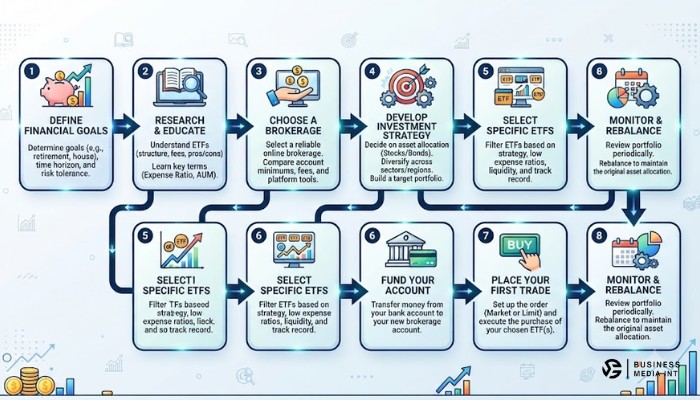
Here is your complete guide on how to invest in ETF for beginners.
Step 1: Define Your Investment Goals
Before buying anything, ask yourself: Why am I investing? What is this money for?
Common goals include:
- Retirement savings
- Home down payment
- Education fund
- Building general wealth
Your goals determine your investment strategy. Long-term goals allow more risk. Short-term goals need safer investments .
Step 2: Assess Your Risk Tolerance
Risk tolerance means how much volatility you can handle. Can you watch your portfolio drop 20% without panic selling? If yes, you can handle more stocks. If no, you need more bonds .
Risk levels:
- High risk: Mostly stocks, higher potential returns
- Medium risk: Mix of stocks and bonds
- Low risk: Mostly bonds and cash
Step 3: Determine Your Time Horizon
Time horizon is how long you plan to invest before needing the money .
- 10+ years: You can invest mostly in stocks
- 5-10 years: Balanced mix of stocks and bonds
- Under 5 years: Focus on bonds and cash
Your time horizon is the most important factor in how to invest in ETF for long-term success.
Step 4: Open a Brokerage Account
You need a brokerage account to buy ETFs. Opening one takes 10-15 minutes online. You will need your PAN card and Aadhaar for KYC .
What to look for in a broker:
- No account opening fees
- Low or zero trading commissions
- Fractional share trading
- Good mobile app
Step 5: Choose Your Asset Allocation
Asset allocation means dividing your money between stocks, bonds, and other assets. This is the most important investment decision you will make .
Sample allocations:
| Profile | Stocks | Bonds | Other |
|---|---|---|---|
| Aggressive Growth | 90% | 5% | 5% |
| Growth | 80% | 15% | 5% |
| Balanced | 60% | 35% | 5% |
| Conservative | 40% | 55% | 5% |
Step 6: Pick Your ETFs
Now choose specific ETFs. For beginners, broad index ETFs are best. They offer diversification at the lowest cost .
Recommended ETFs for beginners:
-
VOO (Vanguard S&P 500 ETF): Tracks 500 largest US companies. Expense ratio: 0.03%. In June 2026, it became the world's first $1 trillion ETF .
-
VTI (Vanguard Total Stock Market ETF): Owns the entire US stock market (3,500+ stocks). Expense ratio: 0.03% .
-
VXUS (Vanguard Total International Stock ETF): Owns 8,600 stocks outside the US. Expense ratio: 0.05%. Gives you global diversification .
-
BND (Vanguard Total Bond Market ETF): Owns 17,000 US bonds. Yield ~3.9%. Reduces portfolio volatility .
Step 7: Place Your Order
- Search for the ETF ticker in your broker app. Enter the amount you want to invest. Choose a market order (buys at current price) or limit order (sets max price). Submit your order .
- Most brokers now offer fractional shares. This means you can invest a fixed amount even if it does not equal a full share .
How Much to Invest in ETF Per Month?
The answer depends on your financial situation. There is no fixed rule. But here are guidelines.
Factors to consider:
- Income: How much can you afford after expenses?
- Emergency fund: Keep 3-6 months of expenses in savings first
- Goals: How much do you need and when?
- Risk tolerance: More aggressive investors invest more
Examples:
- With limited income: Start with 500 rupees per month
- With stable job: Invest 10-15% of monthly salary
- With high income: Invest 20% or more
The amount matters less than consistency. A person who invests 1000 rupees every month for 30 years builds significant wealth. Someone who invests a lump sum once and stops will not grow as much .
Power of consistency: At 10% average annual return, 300 invested monthly becomes 1,593,000 after 40 years .
You May Also Read: Can I Invest in ETFs Every Month? Complete Guide
How to Invest in ETF for Long-Term?
Long-term investing means holding ETFs for 10+ years. This is the best strategy for most beginners. Here is how to invest in ETF for long-term success.
Start with Broad Index ETFs
Choose funds like VOO or VTI. These are low-cost and well-diversified. They track the market's long-term growth. Over 20+ years, the stock market has always trended upward .
Use Dollar-Cost Averaging
Invest a fixed amount every month. This is called a Systematic Investment Plan (SIP). When prices are high, you buy fewer units. When prices are low, you buy more. This averages your purchase cost over time .
Do Not Panic Sell
Markets crash sometimes. This is normal. If you sell during a crash, you lock in your losses. Stay invested. Markets recover over time. If you have a long time horizon, you do not need to worry about short-term drops .
Rebalance Periodically
Over time, some investments grow faster than others. They become a larger part of your portfolio. Review your portfolio once or twice a year. Sell some winners and buy more of the laggards. This keeps your risk level where you want it .
Common Mistakes to Avoid
Mistake 1: Chasing Past Performance
What did well last year may not do well next year. Markets move in cycles. Do not buy what everyone is talking about. Stick to your plan .
Mistake 2: Ignoring Diversification
Owning multiple ETFs does not mean you are diversified. If you hold a Nifty ETF, a large-cap ETF, and a banking ETF, you still mostly own Indian stocks. You need different asset classes (stocks, bonds, gold) and different markets .
Mistake 3: Skipping Defensive Assets
Many beginners go all-in on stocks. They think bonds are unnecessary. But bonds protect your portfolio during market crashes. When stocks fall sharply, bonds often hold value or rise .
Mistake 4: Checking Prices Too Often
Frequent checking leads to emotional decisions. You panic and sell when prices drop. You buy too late when prices rise. Check your portfolio quarterly. Not daily .
Mistake 5: Overtrading
Frequent buying and selling increases costs. It also triggers taxes. Buy and hold is the proven strategy for long-term investors .
Benefits of Monthly ETF Investing
Investing a fixed amount every month offers several advantages .
- Dollar-cost averaging: You buy more when prices are low and fewer when high. This protects you from bad timing.
- Discipline: Monthly investing builds a habit. You do not need to decide whether to invest each month. It happens automatically.
- Long-term growth: Time in the market beats timing the market. Regular investing keeps you invested.
- Emotional control: You do not react to market news. You stick to your plan.
FAQs
1. What is the minimum amount to invest in ETFs?
You can start with as little as $1 with fractional shares . In India, many brokers let you start with 500 rupees per month. The amount is not important. Consistency matters more.
2. Is ETF investing safe for beginners?
ETFs carry market risk. Their value goes up and down. But broad index ETFs are safer than individual stocks. They are diversified across hundreds of companies. Over long periods, they have consistently delivered positive returns .
3. How to invest in ETF for long-term success?
Choose broad index funds like VOO or VTI. Use a monthly investment plan. Stay invested through market ups and downs. Rebalance once a year. Do not panic sell during crashes .
4. How much to invest in ETF per month?
There is no fixed rule. Start with what you can afford. Many beginners start with 500 or 1000 per month. Increase the amount as your income grows. The key is to start and stay consistent .
5. What is the best ETF for a beginner?
VOO (Vanguard S&P 500 ETF) is widely recommended. It tracks the 500 largest US companies. It has a 0.03% expense ratio. It gives you instant diversification at the lowest possible cost .
Your Action Plan
-
Open a brokerage account - Takes 15 minutes online
-
Set your monthly investment amount - Start with what you can afford
-
Choose one broad index ETF - VOO or VTI is a great start
-
Set up auto-invest - Automate your monthly purchase
-
Stay invested - Do not sell during market drops
-
Review quarterly - Check your progress
-
Rebalance annually - Keep your risk level where you want it