

How to Find Good Stocks for Trading: A Simple Beginner’s Guide
Finding good stocks for trading feels overwhelming. There are thousands of companies on the NSE. Checking each one takes forever. You do not know where to start. You might follow random tips and lose money. This guide shows you how to find good stocks for trading in simple steps. You do not need years of experience. You just need a system.
This guide covers how to pick the best stocks for trading with zero experience. You will learn about stock screeners. You will learn a simple stock selection formula. No complicated jargon just clear steps that work.
Start with a Stock Screener
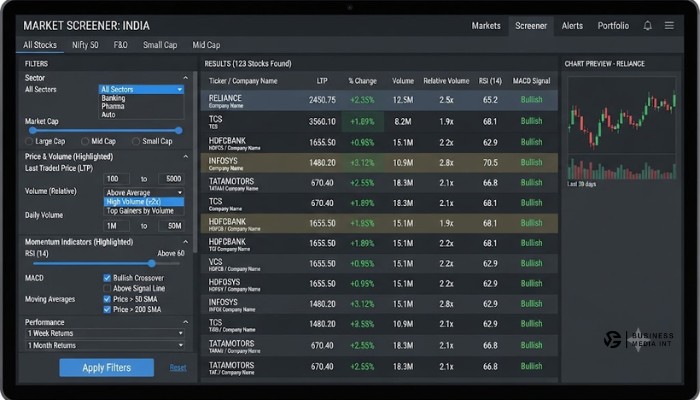
A stock screener is a tool that filters stocks based on rules you set. Think of it like a grocery list. You only look at items that match what you need . The NSE has its own free tool called Market Lens. It lets you screen over 2,000 stocks using filters and themes .
Market Lens has ready-made screens like "Growth at a Discount" and "Momentum + Breakout." These help you find stocks based on your trading style . If you want more control, Screener.in is another free option. It has a powerful query language for building custom screens .
Read More: Trader Talk Pullback Meaning: Simple Guide to Trading Pullbacks
What Makes a Stock Good for Trading?
Not every stock is good for trading. Here is what to look for.
- Liquidity. The stock must trade in high volume. You need to buy and sell easily. If volume is low, you get stuck. You cannot exit at a fair price.
- Volatility. The stock must move. If it barely moves, you cannot make money. You need price swings. But not too wild. You need controlled movement.
- Clear trends. The stock should move in one direction for a while. Up or down. Choppy stocks are hard to trade.
- Good spread. The difference between buy and sell price should be small. Wide spreads eat your profit.
The Stock Selection Formula
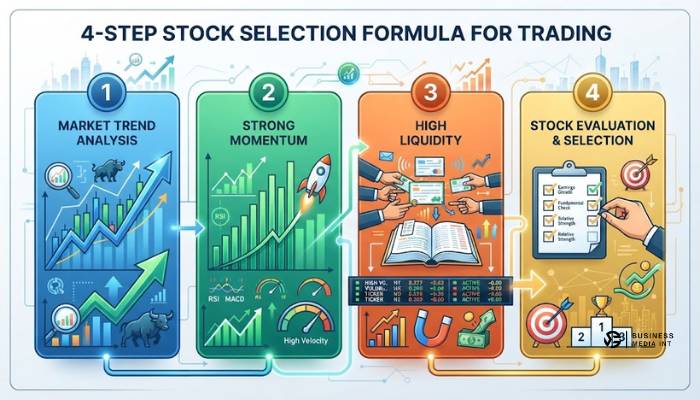
For trading, you need stocks that move. Slow stocks are hard to trade. Here is a simple formula to find good trading candidates.
- Step 1: Check Liquidity. You need stocks that trade in high volume. If volume is low, you cannot buy or sell easily. The price might move against you. Look for stocks with average daily volume above 500,000 shares .
- Step 2: Look for Momentum. Momentum stocks are already moving. You want to ride the trend. A tool called Relative Strength (RS) Rating helps here. It ranks stocks by how much they outperform the market. A stock with an RS Rating of 85 beats 85% of other stocks . Look for stocks with RS above 80.
- Step 3: Check the Trend. Is the stock in an uptrend? Does it make higher highs and higher lows? Is the price above its 50-day moving average? These are signs the trend is up. Trade with the trend, not against it.
- Step 4: Verify Fundamentals. Even for trading, you should avoid weak companies. Check revenue and profit growth. Look at debt levels. A company with too much debt can crash fast . Check Return on Equity (ROE). ROE above 15% shows management is efficient .
How to Find Good Stocks for Trading in India?
Here are practical ways to find stocks.
1. Use Stock Screeners
Stock screeners filter thousands of stocks. You set rules. The screener shows you matches. Popular free screeners include Screener.in, Tickertape, and Chartink.
For trading, set filters like:
- Volume above average
- Price above 50-day moving average
- RSI between 40 and 60
- Market cap above 1,000 crore
This gives you a list of liquid, trending stocks.
2. Check the Nifty 50 and Bank Nifty
The biggest stocks are the most liquid. They have tight spreads. They move enough for trading. Start with Nifty 50 stocks. They are safe for beginners. You can also trade index futures and options.
3. Look at Sector Leaders
When a sector is hot, its leaders move. If IT is rallying, look at TCS, Infosys, and Wipro. If banking is moving, look at HDFC Bank and ICICI Bank. Sector leaders are liquid and trend well.
4. Watch the News
News moves stocks. Earnings. Contracts. New products. Regulatory changes. Follow business news. See which stocks are in focus. But do not chase every news item. Trade only when the setup is right.
5. Use Volume Scanners
Volume scanners show stocks with unusual activity. High volume means something is happening. It could be institutional buying. It could be news. Either way, it creates trading opportunities.
How to Pick the Best Stocks for Trading with Zero Experience?
You do not need to be an expert. You just need to follow a process.
- Use NSE Market Lens. It is free. It is from the NSE. It has ready-made screens. Start with the "Momentum + Breakout" screen. This shows stocks that are moving up with volume .
- Check the chart. Look at the daily chart. Is the stock making higher highs? Is it above the 50-day moving average? If yes, it is a candidate.
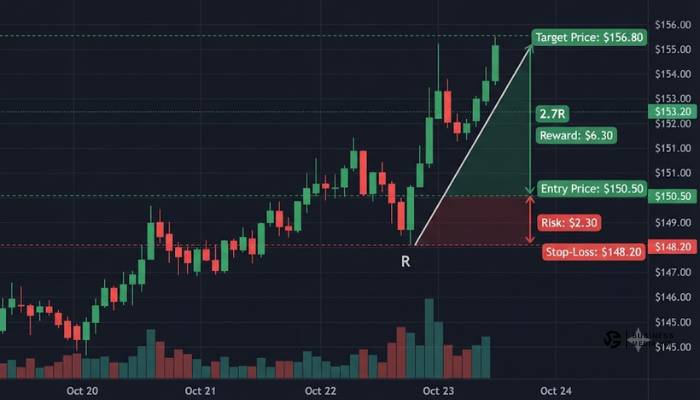
- Set a stop-loss. Before you buy, decide where you will sell if the trade goes wrong. A common rule is to risk only 1-2% of your capital on one trade. If you buy at 100, set a stop-loss at 98 .
- Use the 3:1 rule. Only take a trade if the potential profit is at least three times your potential loss. If your stop-loss is 2 away, your target should be at least 6 away .
You May Also Read: How to Use VWAP for Intraday Trading: Simple Guide
AI Stock Screeners in India
New tools use AI to help you find stocks. Share India has an AI Screener with natural language queries. You can type "find stocks with high momentum and low debt" and it will search for you . It also generates SWOT analysis for every stock .
These tools are helpful but not magic. AI predictions are probabilities, not guarantees. Always verify the stock yourself before trading .
Common Mistakes to Avoid
- Following social media tips. By the time a stock is viral, the price is often at its peak. You become exit liquidity for professionals .
- Ignoring volume. A stock with low olume is hard to trade. You might not be able to sell when you want .
- Overtrading. Frequent trading leads to high fees and emotional stress. Pick your trades carefully .
- Chasing momentum blindly. Momentum is a two-sided sword. Without fundamentals, you might buy a stock that crashes when the hype dies .
Quick Summary Table
| Step | What to Do |
|---|---|
| Screen | Use NSE Market Lens or Screener.in |
| Check Liquidity | Volume above 500,000 shares |
| Check Momentum | RS Rating above 80 |
| Check Trend | Higher highs, above 50-day MA |
| Check Fundamentals | Revenue growth, low debt, ROE > 15% |
| Set Stop-Loss | Risk only 1-2% per trade |
| Verify | Never trade on tips alone |
FAQs
1. How do I find good stocks for trading with zero experience?
Start with NSE Market Lens. Use ready-made screens like "Momentum + Breakout." Check the chart for higher highs and volume. Set a stop-loss. Do not trade on tips. Follow a simple process.
2. What is the best stock screener in India for beginners?
NSE Market Lens is free and from the exchange. It has ready-made screens for different strategies. Screener.in is also good for custom filters. Both are free.
3. What is a stock selection formula?
Check liquidity (high volume). Check momentum (RS Rating above 80). Check trend (higher highs, above 50-day MA). Check fundamentals (revenue growth, low debt, ROE above 15%). Then set a stop-loss.
4. How do I pick the best stocks for trading in India?
Use the NSE Market Lens screener. Look for stocks in uptrends with high volume. Check the RS Rating. Make sure the company has good fundamentals. Only trade with a stop-loss.
5. What is RS Rating and why does it matter?
RS Rating measures how much a stock outperforms the market. A score of 85 means it beats 85% of stocks. High RS stocks are leaders. They tend to keep leading .
6. Can AI help me find good stocks?
Yes. Tools like Share India AI Screener use AI to find stocks based on your queries. They can also generate SWOT analysis. But use them as research aids, not as guaranteed predictions .
7. How much money do I need to start trading?
You can start with 500. The goal is to build discipline and knowledge, not just returns. Start small. Learn the process first .