
Taxable Bonds vs Tax-Free Bonds: Simple Guide to Returns and Tax
Do you want regular income from bonds? You have two options. Taxable bonds and tax-free bonds. Both pay interest. But the tax treatment is very different. This difference changes your real returns. This guide explains taxable bonds vs tax free bonds in simple words.
You will learn how tax-free bonds work you will learn how to compare them using a calculator, you will also see the best tax-free bonds available today. No complicated terms just clear information to help you choose wisely. If you are in a high tax bracket, this guide can save you money.
What Are Taxable Bonds?
Taxable bonds are regular bonds. The interest you earn is added to your total income. Then it is taxed as per your income tax slab. This is how most bonds work .
If you are in the 30% tax bracket, your bond interest is taxed at 30%. If you are in the 20% bracket, it is taxed at 20%. The higher your income, the more tax you pay on the same interest. Examples of taxable bonds include government bonds, corporate bonds, and most fixed deposits.
Read More: How Rising Treasury Yields Affect Bonds: A Simple Guide for Investors
What Are Tax-Free Bonds?
Tax-free bonds are special. The interest you earn is completely exempt from tax. You pay no tax on the interest income .
These bonds are issued by government-backed companies. Companies like National Housing Bank, Power Finance Corporation, NTPC, and National Highways Authority of India issue them. They raise money for infrastructure projects . The interest is exempt under Section 10(15) of the Income Tax Act .
Taxable vs Tax-Free: The Real Difference
- The coupon rate on tax-free bonds is usually lower. But because you pay no tax, your after-tax return is higher. This is the key point.
- Let me give you an example from real data. Tax-free bonds currently yield around 4.4% to 4.7% . If you are in the 30% tax bracket, this is equal to a taxable yield of about 7.8% to 8.2%. Bank fixed deposits give 6.2% to 7% before tax. After tax, they give you much less .
So even though the tax-free bond coupon looks smaller, you keep all of it.
Tax-Free vs Taxable Bonds Calculator
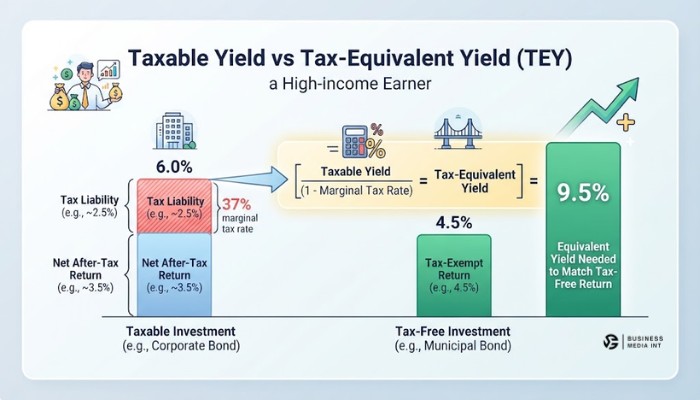
You can use a simple formula to compare. It is called the tax-equivalent yield .
Tax-Equivalent Yield = Tax-Free Bond Yield ÷ (1 – Your Tax Rate)
- Example: A tax-free bond gives 4.5%. You are in the 30% tax bracket.
- Tax-equivalent yield = 4.5 ÷ (1 – 0.30) = 6.43%.
This means a taxable bond must give you 6.43% to match the tax-free bond's return. If the taxable bond gives less, the tax-free bond is better for you.
You can find free calculators online. Broadridge offers a taxable vs tax-free bonds calculator . Some apps also do this calculation .
How Do Tax-Free Bonds Work?
- Tax-free bonds work like regular bonds. You invest a lump sum. You get interest every year. The interest is paid directly to your bank account. At maturity, you get your principal back.
- The tenure is usually 10, 15, or 20 years . There is no lock-in period for listed bonds. You can sell them on the stock exchange if you need money. But finding a buyer can be a challenge for less popular bonds .
You can hold them in Demat or physical form. PAN is mandatory .
Best Tax-Free Bonds in India 2026
Here are some tax-free bonds available in the market :
| Issuer | Maturity | Coupon Rate |
|---|---|---|
| National Housing Bank | Jan 2034 | 9.01% |
| Power Finance Corporation | Nov 2033 | 8.92% |
| NTPC Limited | Dec 2033 | 8.91% |
| National Highways Authority | Feb 2029 | 8.75% |
| Rural Electrification Corp | Sep 2028 | 8.71% |
These are older issues with high coupon rates. New tax-free bonds are not being issued frequently. Most available bonds are from previous years .

Tax-Free Municipal Bond Rates Today
- In the US, municipal bond yields have risen. The 20-year AAA municipal bond yield crossed 4.00% in 2026. The spread between 5-year and 20-year munis widened to over 145 basis points. This has happened less than 5% of the time in the past 15 years .
- For a 20-30 year portfolio rated A or better, federal tax-free yields are around 4.37%. For an investor in the 40.8% bracket, this equals a taxable yield of 7.39% .
- Top municipal bond ETFs include Vanguard Tax-Exempt Bond ETF (VTEB) yielding 3.51%, iShares National Muni Bond ETF (MUB) yielding 3.37%, and VanEck High Yield Muni ETF (HYD) yielding 4.48% .
You May Also Read: Secured vs Unsecured Bonds India: Key Differences Explained
Who Should Buy Tax-Free Bonds?
Tax-free bonds are best for high-income investors. If you are in the 30% or higher tax bracket, the tax-free advantage is significant .
If you are in a lower tax bracket, taxable bonds may be better. You pay less tax anyway. The lower coupon on tax-free bonds may not be worth it for you.
Quick Summary Table
| Feature | Taxable Bonds | Tax-Free Bonds |
|---|---|---|
| Interest Tax | Taxed as per slab | Fully exempt |
| Coupon Rate | Higher | Lower |
| After-Tax Return | Depends on slab | Higher for high earners |
| Best For | Low tax bracket | High tax bracket |
| Issuers | Government, corporates | Government-backed companies |
| Tenure | Varies | 10, 15, 20 years |
FAQs
1. What is the main difference between taxable and tax-free bonds?
Taxable bonds charge tax on interest as per your income slab. Tax-free bonds give you interest that is completely exempt from tax. The coupon on tax-free bonds is lower, but you keep all of it.
2. How do tax-free bonds work?
You invest a lump sum. You get interest every year. The interest is tax-free. At maturity, you get your principal back. The tenure is usually 10, 15, or 20 years.
3. How do I compare taxable and tax-free bonds?
Use the tax-equivalent yield formula: Tax-Free Yield ÷ (1 – Your Tax Rate). This tells you what a taxable bond must yield to match the tax-free bond.
4. What are the best tax-free bonds in India?
National Housing Bank (9.01%), Power Finance Corporation (8.92%), NTPC (8.91%), and National Highways Authority (8.75%) are among the top tax-free bonds available.
5. Who should invest in tax-free bonds?
High-income investors in the 30% or higher tax bracket benefit most. For them, the after-tax return beats fixed deposits. Low-income investors may not benefit as much.
6. Are tax-free bonds safe?
Yes. They are issued by government-backed companies. They have high credit ratings like AAA or AA+. They are considered safe investments.
7. What is the tax-free municipal bond rate today?
US municipal bond yields are around 3.5% to 4.5% for top-rated bonds. The 20-year AAA muni yield crossed 4.00% in 2026. Tax-equivalent yields can be 6% to 7.4% for high-bracket investors.
8. Can I sell tax-free bonds before maturity?
Yes. Listed tax-free bonds can be sold on the stock exchange. But liquidity can be a challenge. It is better to buy bonds from large public issues for easier selling.