

Latest SEBI News Affecting Investors: Key Rules and Changes
The Securities and Exchange Board of India has been busy. Several big decisions were taken at the board meeting on September 24, 2026. These changes affect how you invest, how mutual funds work, and how derivatives are settled. This guide gives you the latest SEBI news affecting investors in simple words.
You will learn about the widened accredited investor pool. You will learn about new portfolio management rules. You will also learn about F&O margin review and the settlement price issue. No complicated terms. Just clear information that helps you understand what changed and why it matters for your money.
What is SEBI?
Before we get into the news, let us understand what SEBI is.
SEBI stands for Securities and Exchange Board of India. It is the regulator for the Indian stock market. Think of it as the referee for everything related to shares, mutual funds, and bonds.
SEBI has three main jobs:
- Protect investors. SEBI makes rules so that companies and brokers do not cheat you. If someone promises guaranteed returns or runs a scam, SEBI can fine them or ban them.
- Develop the market. SEBI makes it easier for companies to raise money and for investors to buy and sell. It introduces new products like REITs and InvITs.
- Regulate the market. SEBI watches over stock exchanges like NSE and BSE. It also watches brokers, mutual funds, portfolio managers, and investment advisors.
SEBI was set up in 1988. It got legal powers in 1992. Since then, it has become the watchdog for the Indian securities market.
Read More: Latest Economic News Affecting Stocks: Key Market Updates Today

SEBI Widens Accredited Investor Pool
- SEBI has expanded the definition of accredited investors. Now individuals with securities market assets of 5 crore can qualify. Body corporates need 20 crore .
- This is a big change. Earlier, only people with high income or net worth could become accredited investors. The new rule adds a third route based on securities market exposure. SEBI estimates this could expand the pool to around 4 lakh eligible investors. The current base is only about 1 lakh .
Accreditation will be valid for three years. Managers of AIFs and portfolio managers can also accredit investors now. This simplifies the process .
New Portfolio Management Rules
SEBI approved the Portfolio Managers Regulations, 2026. This replaces the 2020 framework. The new rules are much simpler. The regulations shrank from 70 pages to 33 pages .
Portfolio managers can now invest in IPOs and primary market debt. They can also allocate up to 10% of client assets to unlisted debt with consent. Overseas investments in equities, debt, and ETFs are allowed too .
A new route called PRIM lets portfolio managers invest in direct plans of mutual funds. The minimum investment is 25 lakh. This could be a game-changer for investors who want professional management with lower costs .
SEBI Reviews F&O Margin Requirements
- SEBI Chairman Tuhin Kanta Pandey said the regulator is examining whether margin requirements for longer-term derivative contracts can be reduced .
- This comes as retail losses in F&O remain very high. SEBI's FY26 study found that 87.7% of individual equity-derivatives traders recorded net losses. Total net losses stood at 91,685 crore .
The idea is to encourage longer-term participation instead of speculative short-term trading. Pandey said ease of doing business and investor protection are not competing objectives .
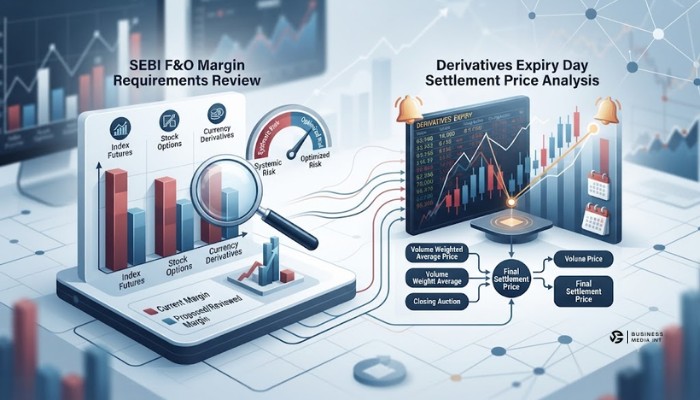
Settlement Price Review for Expiry Day
- SEBI is reviewing how derivatives settlement prices are determined on expiry day. A consultation paper was issued on September 12 .
- The proposals include delinking derivatives settlement prices from the cash market closing price. This follows feedback on the Closing Auction Session (CAS) introduced in August .
- SEBI introduced CAS to improve closing price discovery. But the first month saw sharp swings and divergences between NSE and BSE prices. Two firms were banned for alleged manipulation during the auction .
SEBI Penalizes Research Analyst for Assuring Returns
SEBI imposed a 10 lakh penalty on Investowryght Research Analytics. The company was found assuring clients that losses would be recovered and profits generated .
The regulator found WhatsApp messages where employees told clients to add funds and buy specific options. Messages included phrases like "loss recover ho jayega" and "profit deke jayega" .
SEBI also found KYC deficiencies and excess fee collection. The company charged fees above the prescribed limit. This is a warning for investors to only work with registered and compliant advisors.
FPIs Get Wider Commodity Access
- SEBI allowed FPIs to participate in non-agricultural commodity derivatives. This includes both cash-settled and physically settled contracts .
- FPIs must exit positions three days before expiry. They cannot increase positions during that period. This is to prevent delivery obligations .
- The move aims to deepen liquidity in India's commodity derivatives market. It gives foreign investors more opportunities while keeping safeguards in place.
Common Advertisement Code for Intermediaries
SEBI approved a common advertisement code for market intermediaries. This covers stock brokers, mutual funds, investment advisors, and portfolio managers .
Celebrities can now endorse brands or entities. But they cannot endorse specific financial products. Prior approval is required for celebrity ads. For other ads, only post-issuance reporting is needed .
This replaces multiple entity-specific advertising rules with one common framework.
You May Also Read: Latest Financial Market News India Today: Sensex, Nifty and Rupee
REITs and InvITs Get Depository Receipts Route

SEBI approved depository receipts for REITs and InvITs. These can be issued and listed in overseas jurisdictions, initially at IFSC .
Foreign investors, including NRIs, can invest in these DRs. This opens a new route for foreign capital into Indian real estate and infrastructure .
Quick Summary Table
| Decision | What It Means for Investors |
|---|---|
| Accredited investor pool widened | Easier access to AIFs and PMS for HNIs |
| New PMSregulations | Simpler rules, more investment options |
| F&O margin review | Longer-term contracts may get lower margins |
| Expiry settlement review | CAS-related price issues being addressed |
| 10 lakh penalty on analyst | Warning against guaranteed-return promises |
| FPI commodity access | More liquidity in commodity derivatives |
| Common ad code | Celebrity brand ads allowed, product ads restricted |
| REIT/InvIT depository receipts | New route for foreign capital |
FAQs
1. What is SEBI's new rule for accredited investors?
SEBI now allows individuals with securities market assets of 5 crore to become accredited investors. Body corporates need 20 crore. This widens the pool of sophisticated investors who can access AIFs and PMS .
2. What is the new Portfolio Managers Regulations, 2026?
It replaces the 2020 framework. Portfolio managers can now invest in IPOs and overseas securities. A new PRIM route lets them invest in mutual fund direct plans with a 25 lakh minimum. The rules are 53% shorter .
3. Why is SEBI reviewing F&O margins?
Retail losses in F&O are very high. 87.7% of individual traders lost money in FY26. SEBI wants to encourage longer-term participation instead of short-term speculation. Lower margins for longer contracts may help .
4. What is the Closing Auction Session issue?
CAS was introduced in August 2026 to improve closing price discovery. But it caused sharp price swings and manipulation concerns. SEBI is now reviewing how derivatives settlement prices are determined on expiry day .
5. Why did SEBI penalize Investowryght Research?
SEBI found the firm assured clients that losses would be recovered and profits generated. Employees told clients to add funds and buy specific options. The firm also had KYC issues and charged excess fees .
6. Can FPIs now trade in commodity derivatives?
Yes. SEBI allowed FPIs to trade in non-agricultural commodity derivatives. They must exit positions three days before expiry to avoid delivery obligations .
7. Can celebrities now endorse financial products?
Celebrities can endorse brands or entities, not specific products. Prior approval is required for celebrity ads. This is part of the new Common Advertisement Code .
8. What are depository receipts for REITs and InvITs?
SEBI approved a framework for REITs and InvITs to issue depository receipts overseas. This gives foreign investors a new way to invest in Indian real estate and infrastructure .