

Real Estate Investment Strategies for Beginners: Complete Guide
You want to invest in property, but the whole thing feels confusing. Where do you start? How much money do you need? What if you make a mistake? These are real fears. Every smart investor started with these same questions. The good news is that you do not need crores to begin.
The real estate investment strategies for beginners are simpler than you think. Some need very little money. Some need none at all. You can start with REITs or small flats. You can aim for steady rent or long-term growth. We explain real estate investment strategies core, core plus, value-add in plain words. We also answer how to invest in real estate in India and how to invest in real estate for passive income. By the end, you will know exactly where to start.
Why Start with a Strategy?
Many new investors buy a property because it looks good. They do not think about the numbers. They do not plan for vacancy. They do not check the area's growth potential. Later, they struggle.
A strategy gives you a plan. It tells you what to buy, where to buy, and how to make money. It helps you say no to bad deals. It keeps you focused when the market gets noisy.
There are three main strategy types in real estate. Each has a different risk level and return potential.
Read More: How to Calculate Rental Property Profit: ROI, Cash Flow and Yield
The Three Core Strategies
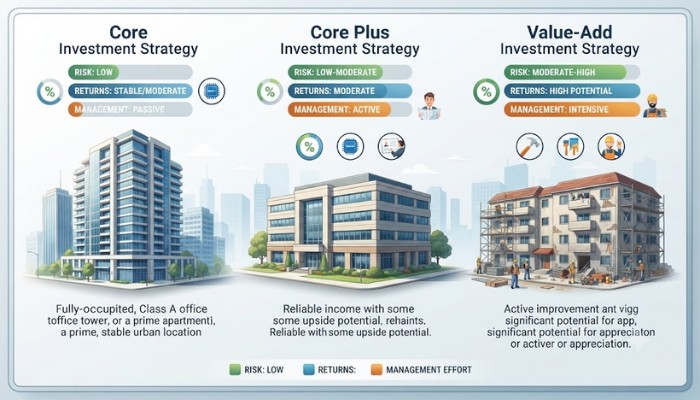
1. Core Strategy
This is the safest approach. Core investments are stable, income-producing properties. They are usually in prime locations. They have high-quality tenants. They generate steady rental income.
What it looks like:
- Fully occupied office buildings
- Grade A warehouses with long leases
- Residential properties in established areas
Risk level: Low
Return: Moderate, steady
Best for: Beginners who want stable income with minimal hassle
Core properties do not offer huge price jumps. But they do not crash easily either. The income is predictable. This makes them a good starting point if you are risk-averse.
2. Core Plus Strategy
This is a step up from core. These properties are also stable. But they need some light improvements. Maybe the building needs a fresh coat of paint. Maybe the lobby looks dated. Maybe the tenant mix could be better.
What it looks like:
- Older buildings in good locations
- Properties with minor deferred maintenance
- Assets that need better management
Risk level: Low to medium
Return: Moderate to high
Best for: Beginners who want better returns and are willing to do some work
Core plus gives you more upside than pure core. You buy at a slight discount. You fix the small issues. You raise rents. You increase value.
3. Value-Add Strategy
This is where you create value. You buy a property that has problems. It may be poorly managed. It may have high vacancy. It may need renovation. You fix these issues. You increase income. You sell or refinance at a higher value.
What it looks like:
- Distressed or underperforming properties
- Buildings with high vacancy
- Properties needing major renovation
Risk level: Medium to high
Return: High
Best for: Investors with some experience and a higher risk appetite
Value-add is not for everyone. It takes time, money, and skill. But it can generate the highest returns.
Comparison Table
| Strategy | Risk | Return | Effort Required | Best For |
|---|---|---|---|---|
| Core | Low | Moderate | Low | Beginners wanting stable income |
| Core Plus | Low-Medium | Moderate-High | Medium | Beginners wanting better returns |
| Value-Add | Medium-High | High | High | Investors with experience |
How to Invest in Real Estate in India?

If you are in India, you have several options. Some need a lot of money. Some need very little. Here is how to start.
1. Buy a Residential Property for Rent
This is the most common path. You buy a flat or house. You rent it out. You collect monthly rent.
What you need:
- Down payment (usually 20% to 30%)
- Home loan approval
- Registration and stamp duty
- Money for repairs and maintenance
What you get:
- Monthly rental income
- Long-term price appreciation
- Tax benefits on loan interest
What to watch:
- Vacancy periods
- Tenant issues
- Maintenance costs
- Property tax
In India, rental yields are often low. You may get 2% to 4% of the property value as annual rent. In cities like Bengaluru, Hyderabad, and Pune, demand is strong. But prices are also high.
2. Invest in REITs
REITs are Real Estate Investment Trusts. They are listed on stock exchanges. You buy units like shares. You get dividends from rental income.
Why it works for beginners:
- Low entry point (you can start with a few thousand rupees)
- No tenant management
- High liquidity (you can sell anytime)
- Diversified across many properties
What to watch:
- Share prices can go up and down
- Limited options in India
- Dividends are taxed
3. Fractional Ownership Platforms
These platforms let you buy a small share of a commercial property. You get a share of the rent. You do not manage anything.
Why it works:
- Very low entry point
- Professional management
- Access to premium properties
What to watch:
- Lock-in periods
- Platform risk
- Limited liquidity
4. Buy Land
Land is a popular investment in India. You buy a plot. You hold it. You sell it when the price goes up.
Why it works:
- No maintenance
- No tenants
- High appreciation in growing areas
What to watch:
- No income until you sell
- Legal issues (title, approvals)
- Liquidity is low
How to Invest in Real Estate for Passive Income?

Passive income means money comes in without you working for it every day. In real estate, true passive income is rare. Most investments need some effort. But some are more passive than others.
Most Passive Options
1. REITs
You buy units. You get dividends. You do nothing else. This is the most passive option.
2. Fractional Ownership
You invest in a platform. The platform manages the property. You get your share of rent.
3. Crowdfunded Real Estate
Similar to fractional ownership. You pool money with other investors. A manager handles the property.
Semi-Passive Options
4. Rental Property with a Property Manager
You buy a flat. You hire a property manager. They find tenants, collect rent, and handle repairs. You get the income minus the manager's fee.
5. Turnkey Rentals
You buy a property that is already set up for renting. A company manages everything. You just collect the money.
Not Passive at All
6. Self-Managed Rental
You find tenants. You collect rent. You fix leaks. This is a job, not passive income.
7. House Flipping
You buy, renovate, and sell. This is active work. It is not passive.
8. Short-Term Rentals (Airbnb)
You manage bookings, guests, and cleaning. This is very active.
You May Also Read: Difference Between Carpet Area and Built Up Area: Guide
Tips for Beginners
1. Start Small
Do not buy a big property on your first try. Start with something manageable. A small flat. A REIT. A fractional share. Learn the ropes before you scale up.
2. Focus on Cash Flow First
Do not buy a property only because you hope the price will go up. Prices can fall. Focus on the rent. If the rent covers your costs and gives you profit, you are safe.
3. Do Your Homework
Check the area. Check the builder. Check the legal papers. Check the rental demand. Do not trust anyone blindly. Verify everything yourself.
4. Keep Cash Reserves
Things break. Tenants leave. Markets change. Keep at least 6 months of expenses in reserve. This protects you from surprises.
5. Avoid Overleveraging
Do not take too much debt. If you borrow too much, a small problem can break you. Keep your loan payments manageable.
6. Get Professional Help
If you do not understand something, ask. Hire a lawyer for documents. Hire an accountant for taxes. Hire a property manager if you do not want to deal with tenants.
7. Think Long Term
Real estate is not a get-rich-quick scheme. It builds wealth slowly. Plan to hold for at least 5 to 10 years. This is when you see the best results.
FAQs
1. What is the best real estate investment strategy for beginners?
Start with core or core plus. Core means buying a property that already gives rent. Core plus means buying an older property and fixing small things to raise the rent. Both are safer than value-add. Value-add needs more money and skill. Do not try it on your first deal.
2. How do I invest in real estate in India with little money?
Try REITs. You buy units on the stock exchange and get dividends. You can start with a few thousand rupees. Fractional ownership is another option. You buy a small share of a big property and get rent. No tenant handling. No big down payment.
3. What is the difference between core, core plus, and value-add?
Core is the safest. Good property, good location, steady tenants. Core plus needs light work like painting or better management. Value-add is the riskiest. You buy a property with problems, fix it, and raise the rent. More risk, more return. More work too.
4. How can I earn passive income from real estate?
REITs are the most passive. Buy units, get dividends, do nothing else. Fractional ownership is also passive. For a physical flat, hire a property manager. They handle tenants and repairs. You get rent minus their fee. Self-managed rentals are not passive. That is a second job.
5. Is real estate a good investment in India?
Yes, but be patient. Wealth builds slowly. Rental yields are low, around 2% to 4%. Price growth can be good in growing areas. Tier-2 cities like Lucknow, Indore, and Jaipur are doing well. Metro cities are stable but costly. Focus on cash flow first.
6. How much money do I need to start?
For REITs, a few thousand rupees is enough. For fractional ownership, the entry is also low. For a physical property, you need 20% to 30% as down payment. Add stamp duty, registration, and repair costs. Keep six months of expenses as reserve.
7. What is the biggest mistake beginners make?
Two mistakes. First, buying only for price growth. Prices can fall. Check cash flow first. Second, skipping due diligence. Check the title deed, encumbrance certificate, and RERA registration. Visit the site. Do not trust the builder blindly.
8. Do I need a property manager?
Only if you buy a physical rental property and do not want to deal with tenants. They charge 8% to 12% of the rent. If you have time, manage it yourself. But learn landlord laws first. For REITs and fractional ownership, no manager is needed.