

Value Investing vs Growth Investing: Which Is Better?
You want to invest in stocks. But you keep hearing two terms. Value investing and growth investing. Which one is better? Which one should you pick? This guide explains value investing vs growth investing in simple words. You will learn what each style means.
You will see real examples you will also learn how each has performed over time. The data may surprise you. Read this guide. Understand both styles then decide what fits your goals and your risk appetite.
What Is Value Investing?
Value investing means buying stocks that are cheap. Not cheap in price. Cheap compared to what the company is actually worth. You look for companies trading below their intrinsic value .
These companies usually have low price-to-earnings ratios. Low price-to-book ratios. They are mature businesses. Stable industries. Utilities. Consumer staples. Financials. Energy .
Value stocks often pay dividends. They give you regular income. They do not grow fast. But they are steady. They give you a margin of safety. If the market falls, value stocks usually fall less .
Read More: Best Investing Strategy for Beginners: A Simple Guide

What Is Growth Investing?
Growth investing means buying companies that are growing fast. Their revenues are rising. Their earnings are rising. They are taking market share .
These companies often trade at high valuations. High P/E ratios. High P/B ratios. They do not pay dividends. They reinvest everything back into the business. They want to grow faster .
Growth stocks are often in technology. Biotech. Renewable energy. New industries. They are disruptors. They change how things work .

Value Investing vs Growth Investing Examples
Let me give you real examples.
- Value stock example: A utility company. It provides electricity. It has steady profits. It pays a 4% dividend. It trades at 12 times earnings. The market ignores it. But it keeps paying you every year.
- Growth stock example: A software company. It grows revenue 40% every year. It does not pay dividends. It trades at 50 times earnings. The market loves it. It could be huge in 10 years. Or it could crash if growth slows .
Value vs Growth Performance: What the Data Says
This is where it gets interesting. The data is mixed. It depends on the time period.
The Long-Term View
Over very long periods, value has a slight edge. Nobel Prize winner Eugene Fama and Kenneth French studied data from 1927 to 2019. They found that over 15-year rolling periods, value stocks outperformed growth 93% of the time .
The Recent View
But the last decade has been different. Growth has crushed value. The Vanguard Growth ETF returned 17.2% per year over 10 years. The Vanguard Value ETF returned 11.5% .
That is a huge difference. Growth outperformed value in 8 of the last 10 years .
The Indian Data
In India, growth has also outperformed. A study of 60 Indian stocks from 2005 to 2025 found that growth stocks gave 18.35% annual returns. Value stocks gave 12.84% .
Growth stocks also had lower volatility. Lower downside risk. This goes against the traditional idea that value is safer .
But value still matters. In 2026, value has been outperforming. Value is up 6.4% while growth is down 4.4% . This shows that cycles change.
Growth vs Value Historical Performance
The market goes through cycles. Sometimes growth wins. Sometimes value wins.
- Late 1990s: Growth dominated. Dot-com boom. Then crash.
- Early 2000s: Value won. After the dot-com crash, value stocks recovered faster .
- 2010s: Growth dominated. Low interest rates. Tech boom.
- 2022: Value won. Inflation and rate hikes hurt growth stocks .
- 2023-2025: Growth dominated again. AI boom. Tech stocks soared.
- 2026: Value is making a comeback. Tech is struggling .
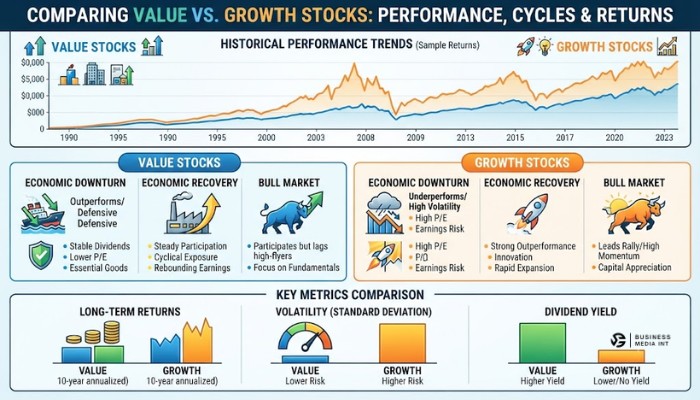
When Does Each Style Work?
Growth works when:
- Interest rates are low
- The economy is strong
- Investors are optimistic
- Innovation is booming
Value works when:
- Interest rates are rising
- The economy is uncertain
- Investors are scared
- Markets are volatile
Should You Pick One?
No. Most experts say own both. Value gives you stability and dividends. Growth gives you upside and potential. A balanced portfolio has both .
Some investors combine both strategies. This is called a blended approach. It smooths your returns over time .
You May Also Read: How to Invest in the AI Infrastructure Boom: Simple Guide
Quick Summary Table
| Feature | Value Investing | Growth Investing |
|---|---|---|
| What You Buy | Cheap stocks | Fast-growing stocks |
| Valuation | Low P/E, low P/B | High P/E, high P/B |
| Dividends | Usually yes | Usually no |
| Risk | Lower | Higher |
| Best When | Rates rising, uncertainty | Rates low, optimism |
| Recent Performance | Lagging | Leading (but changing) |
FAQs
1. What is the main difference between value and growth investing?
Value investing buys stocks that are cheap compared to their worth. Growth investing buys companies expected to grow faster than average. Value focuses on current value. Growth focuses on future potential .
2. Which is better - value or growth investing?
Neither is always better. It depends on the time period and market conditions. Over the last decade, growth has won. Over very long periods, value has a slight edge. Owning both is the safest approach .
3. What are examples of value stocks?
Mature companies in stable industries. Utilities. Consumer staples. Financials. Energy. They usually pay dividends and trade at low valuations .
4. What are examples of growth stocks?
Technology companies. Biotech. Renewable energy. Companies that reinvest profits to grow fast. They often trade at high valuations and pay no dividends .
5. Why has growth outperformed value recently?
Low interest rates and the tech boom. Growth stocks benefit when money is cheap. AI has also driven tech stocks higher .
6. When does value outperform growth?
Value tends to win during economic uncertainty, rising interest rates, and market volatility. It also wins early in economic recoveries .
7. Should I invest in both value and growth?
Yes. Most experts recommend owning both. Value provides stability and income. Growth provides upside potential. A blended approach balances risk and return .
8. What does the Indian data say about value vs growth?
A study of Indian stocks from 2005 to 2025 found that growth stocks gave higher returns (18.35% vs 12.84%) with lower volatility. But value still has a role in a diversified portfolio .