
Gap Up and Gap Down Trader Talk Meaning: Simple Guide
You might have heard traders say "gap up" or "gap down" while looking at charts. These are common terms in trader talk. They describe a simple but important event in the market.
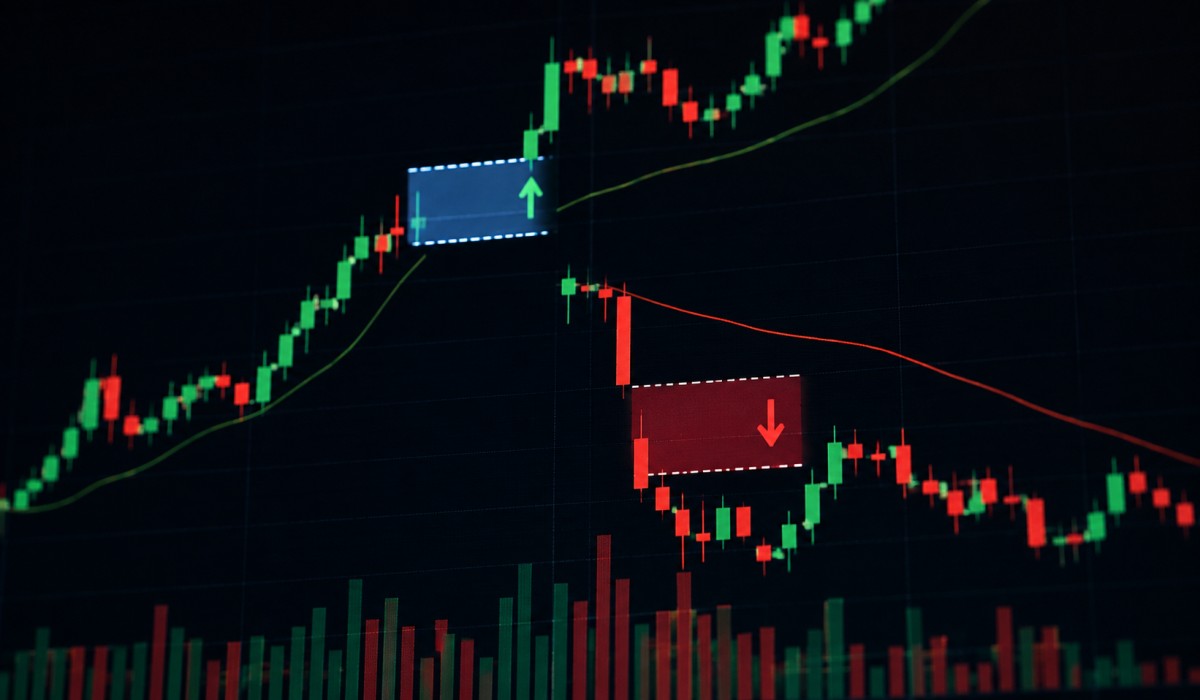
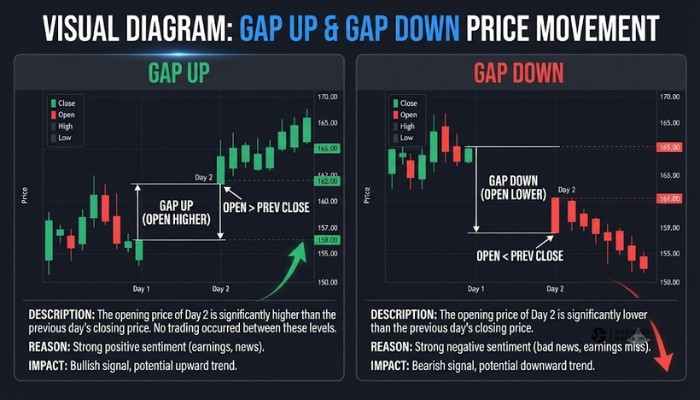
A gap up happens when a stock opens at a higher price than its previous close. A gap down happens when it opens at a lower price. This creates a blank space on the price chart where no trading happened. These gaps tell you something important: there was a sudden change in how traders feel about the stock while the market was closed .
This guide explains gap up and gap down trader talk meaning in simple words. No complicated terms. Just clear explanations that help you understand trading.
Gap Up and Gap Down Trader Talk Meaning
When a stock gaps up, it means demand is strong. Traders are willing to buy at higher prices before the market even opens. This happens when people are excited about a company. The opposite is a gap down, which means fear or worry. Traders are rushing to sell, even at lower prices .
Think of it this way: Imagine the stock market closed at 5 PM. During the night, the company announces a huge profit. When the market opens the next day, everyone wants to buy. The price jumps up. That blank space on the chart between yesterday's close and today's open is the gap .
Read More: Easy Trading Terms for Beginners: Simple Guide
Why Do Gaps Happen?
Gaps happen because news or events change how people value a stock while the market is closed. Here are the main reasons :
| Reason | Gap Up | Gap Down |
|---|---|---|
| Earnings Reports | Better than expected profit | Worse than expected profit |
| News | Product launch, big contract | Scandal, lawsuit, bad news |
| Market Sentiment | Bullish mood overall | Bearish mood overall |
| Global Events | Positive global cues | Negative global cues |
In India, gaps often happen because US and European markets move while Indian markets are closed. Global events can cause sudden changes when Indian markets reopen .
Types of Gaps Traders Talk About
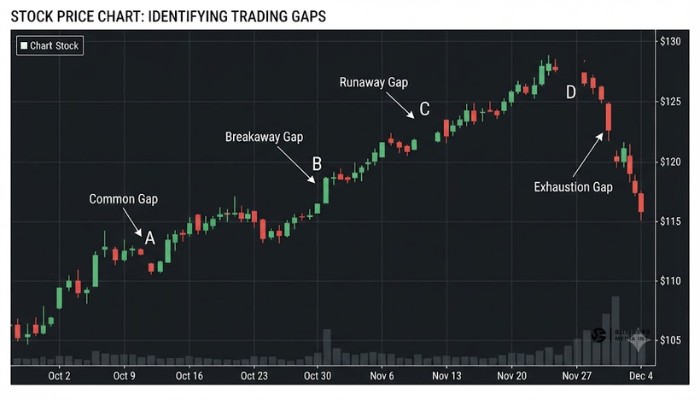
Not all gaps are the same. Experienced traders look at four types of gaps .
1. Common Gaps
These are small gaps with low volume. They happen often and usually get filled quickly. The gap might close within the same trading session. These are not very important for making trading decisions .
2. Breakaway Gaps
This is an important gap. It marks the start of a new trend. The stock breaks out of a price range. Volume is usually high. A breakaway gap signals a change in market psychology .
Example: If a stock has been stuck between 100 and 120 for months and then gaps up to 130 on high volume, it could be a breakaway gap. The stock might now start moving higher .
3. Runaway (Continuation) Gaps
These gaps happen in the middle of a strong trend. They confirm the trend is still strong. They are also called measuring gaps. The gap is usually smaller than breakaway or exhaustion gaps .
Example: A stock in a strong uptrend from 100 to 200. At 150, it gaps up to 155. This confirms buyers are still in control .
4. Exhaustion Gaps
These gaps happen near the end of a trend. They are often on very high volume. The price makes one last move in the direction of the trend. But then it reverses and fills the gap quickly. This signals the trend is about to end .
Example: A stock has been rising for a long time. It gaps up again, but on very high volume. The price then drops back to fill the gap. This suggests the uptrend is over .
Quick Summary
| Gap Type | When It Happens | What It Means | Usually Fills? |
|---|---|---|---|
| Common | Any time, low volume | Not important | Yes, quickly |
| Breakaway | Start of new trend | New trend begins | Rarely |
| Runaway | Middle of trend | Trend continues | Rarely |
| Exhaustion | End of trend | Trend ends | Yes, quickly |
Gap Fill and Gap and Go Strategies
Gap Fill
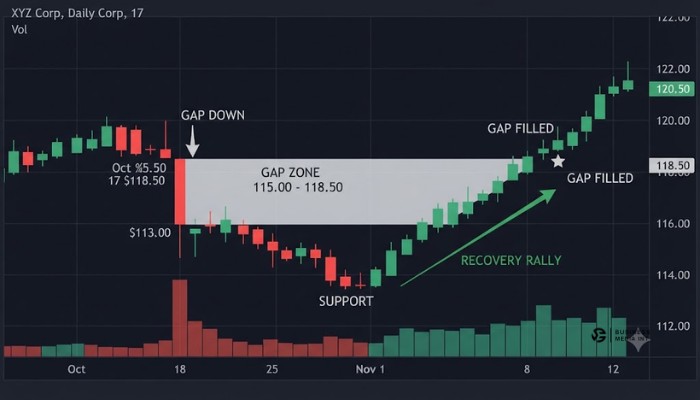
Many gaps are "filled." That means the price returns to the pre-gap level .
- Example: A stock closes at 100. It gaps up to 110. Over the next few days, the price falls back to 100. The gap has been filled.
- Why does this happen? There is a gap in trading. There are no buyers or sellers at those prices. So the price can move quickly back to the old level. Common and exhaustion gaps are usually the quickest to be filled .
Gap and Go
Sometimes the gap is not filled. The price continues moving in the direction of the gap .
- Example: The same stock gaps up to 110. But instead of falling, it keeps rising to 115, then 120.
- What makes the difference? The type of gap and volume matter. Breakaway and runaway gaps often keep moving. High volume suggests the gap is real. Low volume suggests it might fill .
You May Also Read: Forex Trader Talk Terms for Beginners: A Simple Guide
Gap Up and Gap Down Strategy
If you want to trade gaps, here are some simple strategies .
For a Gap Up
- Ask: Why did it gap up? If the reason is a genuine breakthrough, the trend might continue.
- Look at volume: High volume suggests real interest. Low volume might mean it will fade quickly.
- Check support: Is the stock near resistance? If it gaps into resistance, it might fill.
Consider the market: Are other stocks also gapping? A broad gap up in the market is different from a single stock gapping up on news.
For a Gap Down
- Ask: Why did it gap down? Is the reason temporary or long-term?
- Look for overreaction: Sometimes good stocks gap down on temporary bad news. This can be a buying opportunity.
- Check support: Is the stock near strong support? A gap down to support might not go lower.
- Consider the trend: A gap down in a downtrend is different from a gap down in an uptrend.
Risk Management
Gap trading can be risky because prices can move fast. Always use a stop-loss. Never risk more than 1 to 2 percent of your trading capital on one trade . Do not trade every gap. Wait for clean setups .
FAQs
1. What does gap up and gap down mean in trader talk?
A gap up means a stock opens higher than its previous close. A gap down means it opens lower. These gaps are caused by news or events that happen while the market is closed .
2. What is the difference between a gap and a circuit?
A gap is a price jump from one session to the next. A circuit is the maximum price a stock can move in one session before trading stops. A gap up can hit the upper circuit if the jump is very large .
3. Can gaps happen in forex trading?
Yes, forex gaps happen over weekends when the market is closed for 48 hours. Important news during the weekend can cause a gap when the forex market reopens on Sunday .
4. What does it mean when a gap is "filled"?
A gap is filled when the price returns to the level before the gap occurred. For example, if a stock closes at 100 and gaps up to 110, the gap is filled when the price falls back to 100 .
5. Is buying a gap up stock a good idea?
Not always. It depends on the type of gap. Breakaway and runaway gaps can be good buying opportunities. But buying a gap up blindly can be dangerous. The gap might fill quickly and you could lose money .
6. What tools help traders trade gaps?
Traders use VWAP (Volume Weighted Average Price) and Opening Range. VWAP shows the average price for the day. Price above VWAP is bullish. Price below is bearish. The first 15 minutes of trading is the Opening Range. Breakout from it can signal the day's trend .