

How Bond Maturity Value Is Calculated: A Simple Guide
You buy a bond. You wait for it to mature. But how much will you actually get back? Many investors do not know. They just assume they will get what they put in. That is partly true. But there is more to it. This guide explains how bond maturity value is calculated in simple words.
You will learn the difference between face value and maturity value. You will learn the bond valuation formula and also learn how interest and taxes affect your actual return. No complicated jargon. Just clear steps that work. Read this guide. Know exactly what you will get at maturity.
What Is Bond Maturity Value?
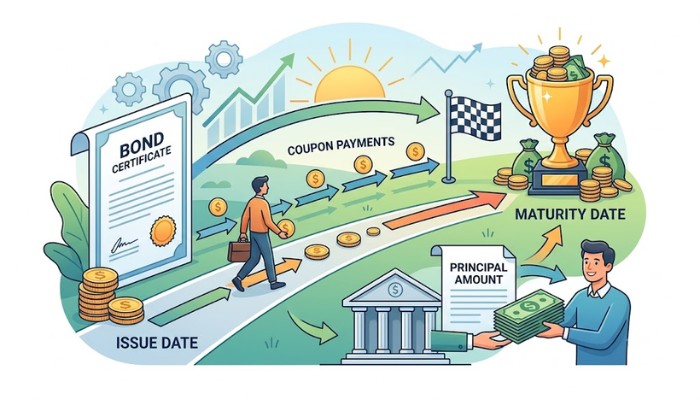
Bond maturity value is the amount you receive when the bond reaches its maturity date. For most bonds, this is the face value or par value. If you bought a bond at 1,000 face value, you get 1,000 back at maturity .
But this is not always the full picture. If you bought the bond at a discount or premium, your actual return is different. The maturity value is just one part of your total return. The other part is the interest you received along the way.
Read More: Taxable Bonds vs Tax-Free Bonds: Simple Guide to Returns and Tax
How Bond Maturity Value Is Calculated?
The basic calculation is simple. At maturity, you get the face value of the bond. That is it.
Maturity Value = Face Value of the Bond
Example: You buy 10 bonds with a face value of 1,000 each. At maturity, you get 10,000 back.
But here is what most people miss. Your total profit is not just the maturity value. It is the maturity value plus all the interest you earned minus what you paid for the bond.
Total Profit = (Maturity Value + Total Interest Received) – Purchase Price
Example: You buy a bond for 950. Face value is 1,000. Interest is 80 per year for 5 years. At maturity, you get 1,000. Total interest = 400. Total profit = (1,000 + 400) – 950 = 450.
Bond Valuation Formula
Bond valuation is different from maturity value. Valuation tells you what the bond is worth today. Maturity value tells you what you get at the end.
The bond valuation formula discounts all future cash flows back to today's value.
Bond Price = Present Value of Coupons + Present Value of Face Value
The formula looks like this:
Price = C × [1 – (1+r)^-n] / r + FV / (1+r)^n
Where:
- C = annual coupon payment
- r = required rate of return (yield)
- n = number of years to maturity
- FV = face value
You do not need to calculate this by hand. Financial calculators and Excel do it for you. But understanding the formula helps you see why bond prices change when interest rates change.
Intrinsic Value of Bond Formula
Intrinsic value is the true worth of a bond. It is what the bond should be worth based on its future cash flows. It is calculated using the same formula as bond valuation.
Intrinsic Value = Present Value of All Future Cash Flows
If the intrinsic value is higher than the market price, the bond is undervalued. If it is lower, the bond is overvalued.
Example: A bond has a face value of 1,000. Coupon rate is 8%. Maturity is 5 years. Your required return is 10%. The intrinsic value would be less than 1,000 because the coupon is lower than your required return. You would only buy it at a discount.
How Bond Maturity Value Is Calculated India?
In India, bond maturity works the same way. You get the face value back at maturity. But there are some India-specific points.
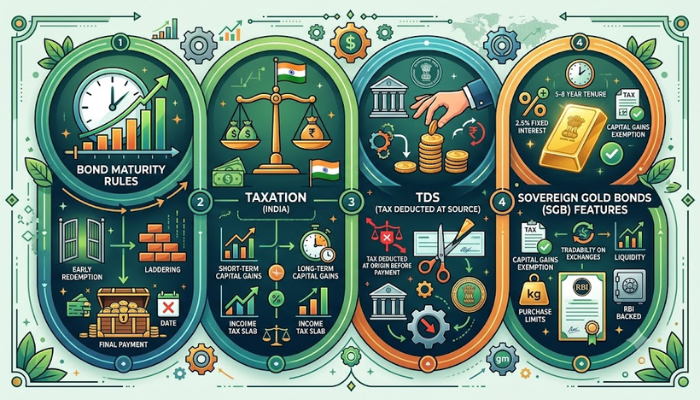
- Tax on maturity: For most bonds, the interest is taxed as per your income slab. If you bought at a discount and held to maturity, the gain may be taxed as capital gains. For listed bonds held over 12 months, the tax is 12.5% .
- TDS: If your interest income from a bond exceeds 10,000 in a year, TDS may apply. But for most retail investors, this is not an issue .
- Sovereign Gold Bonds: These are different. At maturity, you get the prevailing gold price, not the face value. If gold prices rise, you get more. If they fall, you get less. But you also get 2.5% interest every year .
- RBI Floating Rate Bonds: These pay interest every six months. At maturity, you get the face value back. The interest rate resets every six months based on the NSC rate .
What Affects Your Actual Maturity Amount?
Several things affect what you actually get at maturity.
- Purchase price: If you bought at a discount, your profit is higher. If you bought at a premium, your profit is lower. The maturity value is still the face value.
- Reinvestment of interest: If you reinvest the interest you receive, your total return is higher. If you spend it, your total return is just the interest plus the face value.
- Taxes: Taxes reduce your actual return. The interest you earn is taxable. Plan for this.
- Call features: Some bonds can be called back before maturity. This means the company repays early. You get your money back sooner. But you may have to reinvest at lower rates.
You May Also Read: How Rising Treasury Yields Affect Bonds: A Simple Guide for Investors
Quick Summary Table
| Term | What It Means |
|---|---|
| Face Value | The amount you get at maturity |
| Coupon Rate | The interest rate paid on face value |
| Maturity Value | Face value returned at maturity |
| Total Profit | Maturity value + interest – purchase price |
| Bond Valuation | Present value of all future cash flows |
| Intrinsic Value | True worth based on future cash flows |
FAQs
1. What is bond maturity value?
Bond maturity value is the amount you get when the bond matures. For most bonds, it is the face value of the bond. If you bought at 1,000 face value, you get 1,000 back.
2. How is bond maturity value calculated?
It is simply the face value of the bond. But your total profit includes the interest you received. Total profit = maturity value + total interest – purchase price.
3. What is the bond valuation formula?
Bond Price = Present Value of Coupons + Present Value of Face Value. The formula is: Price = C × [1 – (1+r)^-n] / r + FV / (1+r)^n. C is coupon, r is yield n is years, FV is face value.
4. What is the intrinsic value of a bond?
Intrinsic value is the true worth of a bond based on its future cash flows. It is calculated using the same formula as bond valuation. If intrinsic value is higher than market price, the bond is undervalued.
5. How is bond maturity value calculated in India?
The same way. You get the face value at maturity. Interest is taxed as per your slab. For listed bonds held over 12 months, capital gains tax is 12.5%.
6. Do I get interest at maturity?
No. Interest is paid periodically. It could be monthly, quarterly, half-yearly, or annually. At maturity, you get only the face value.
7. What happens if I sell before maturity?
You get the market price, not the face value. The price depends on interest rates, credit rating, and time left to maturity. You may get more or less than face value.
8. Are Sovereign Gold Bonds different?
Yes. At maturity, you get the prevailing gold price, not the face value. You also get 2.5% interest every year. If gold prices rise, you get more.