

What Is Market Capitalization in Stocks? Formula, Examples and Types
Market capitalization is one of the first things every investor should understand. It tells you the total value of a company in the stock market. It helps you compare companies of different sizes. It also tells you how risky a stock might be. This guide explains what is market capitalization in stocks in simple words.
You will learn the formula, you will see real examples and you will also learn what is a good market cap and how outstanding shares affect it. No complicated jargon. Just clear information that helps you invest better.
What Is Market Capitalization?
Market capitalization is the total value of a company's shares in the open market. It is calculated by multiplying the current share price by the total number of outstanding shares.
Formula: Market Cap = Share Price × Outstanding Shares
- Simple. If a company has 1 crore shares and each share trades at 500, its market cap is 500 crore.
- Market cap changes every day. It changes when the share price moves. It also changes when the company issues new shares.
Read More: How to Read Stock Market Trends: A Simple Guide for Beginners

What Is Market Capitalization in Stocks Example
Let me give you a real example.
- Suppose a company called ABC Ltd has 10 lakh shares. The current price is 1,000 per share.
- Market Cap = 10,00,000 × 1,000 = 100 crore.
- Now imagine the price rises to 1,500. The market cap becomes 150 crore. The number of shares did not change. Only the price changed.
- Now imagine the company issues 5 lakh new shares. Total shares become 15 lakh. If the price stays at 1,000, the market cap becomes 150 crore. So both price and share count affect market cap.
What Is Outstanding Shares in Market Capitalization?
Outstanding shares are the total number of shares a company has issued and that are held by investors. This includes shares held by promoters, institutions, and the public.
It does not include treasury shares. Treasury shares are shares the company bought back from the market. These are not counted in market cap.
Outstanding Shares = Issued Shares – Treasury Shares
When a company issues new shares, the outstanding count goes up. This dilutes existing shareholders. When a company buys back shares, the count goes down. This increases the value of remaining shares.
How Market Capitalization Works?
Market cap tells you the size of a company. It also tells you how the market values it.
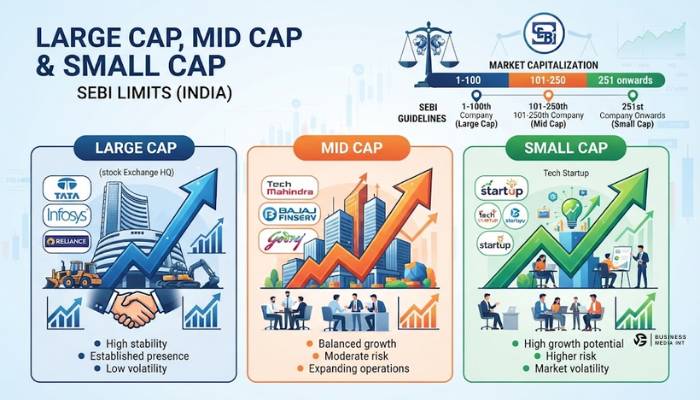
- Large-cap companies are the biggest and most stable. They have market caps above 20,000 crore in India. Examples include Reliance, TCS, and HDFC Bank. These are safer but grow slower.
- Mid-cap companies are medium-sized. Their market caps range from 5,000 crore to 20,000 crore. They offer more growth potential but also more risk.
- Small-cap companies are smaller. Their market caps are below 5,000 crore. They can grow fast but are very volatile. They can also fall fast.
SEBI has specific rules for how mutual funds can invest in each category. This protects retail investors.
What Is a Good Market Cap?
There is no single answer. A good market cap depends on your goals.
- For safety: Large-cap stocks are better. They have stable earnings. They survive market crashes better. They pay dividends.
- For growth: Small-cap and mid-cap stocks can give higher returns. But they carry higher risk. You need a longer time horizon.
- For balance: A mix of large, mid, and small caps works best. Most experts suggest 60-70% in large caps, 20-30% in mid caps, and 10% in small caps.
A good market cap also depends on the industry. A 10,000 crore market cap might be large for a small sector. It might be small for a huge sector like banking.
Why Market Cap Matters for Investors?
- It tells you the risk level. Large caps are safer. Small caps are riskier.
- It helps you compare companies. You can compare two companies in the same sector by market cap. The bigger one is usually more stable.
- It affects index inclusion. Companies with higher market caps are included in indices like Nifty 50. This brings more buyers.
- It helps you diversify. You can spread your money across different market caps. This balances risk and return.
You May Also Read: PE Ratio vs PB Ratio Stocks: Key Differences Every Investor Should Know
Quick Summary Table
| Category | Market Cap (India) | Risk Level | Best For |
|---|---|---|---|
| Large Cap | Above 20,000 crore | Low | Safety, income |
| Mid Cap | 5,000 - 20,000 crore | Medium | Growth with some safety |
| Small Cap | Below 5,000 crore | High | High growth, high risk |
FAQs
1. What is market capitalization in simple words?
Market cap is the total value of a company's shares. It is share price multiplied by total outstanding shares. It tells you how big a company is.
2. What is market capitalization in stocks with example?
A company has 10 lakh shares. Each costs 1,000. Market cap is 100 crore. If price rises to 1,500, market cap becomes 150 crore.
3. What are outstanding shares in market capitalization?
Outstanding shares are all the shares held by investors. Market cap uses these shares. Treasury shares are not counted.
4. What is a good market cap?
Depends on your goal. Large caps for safety. Mid caps for growth with some safety. Small caps for high growth but high risk. A mix works best.
5. How does market cap affect stock risk?
Bigger companies are safer. They survive crashes better. Smaller companies grow fast but fall fast too. Market cap tells you the risk.
6. Can market cap change without price changing?
Yes. If the company issues new shares, share count goes up. Market cap rises even if price stays same. Buybacks reduce market cap.
7. What is the difference between market cap and enterprise value?
Market cap counts only equity shares. Enterprise value includes debt and cash. Enterprise value gives a fuller picture.
8. Why do indices use market cap?
Indices use market cap to pick companies. Bigger copanies get more weight. That is why large caps dominate Nifty 50.