
Nifty ETF vs Nifty Index Fund: Which One Should You Choose?
You want to invest in Nifty 50. But you see two options: Nifty ETF and Nifty Index Fund. Both track the same 50 companies. Both are low-cost. So which one is better for you? The answer depends on how you want to invest. Both give almost identical returns over time.
But the way you buy and sell them is different. This guide explains the Nifty ETF vs Nifty index fund debate in simple words. You will learn about costs, convenience, and tax rules. No complicated terms. Just clear information to help you pick the right option for your needs.
What Is the Difference?
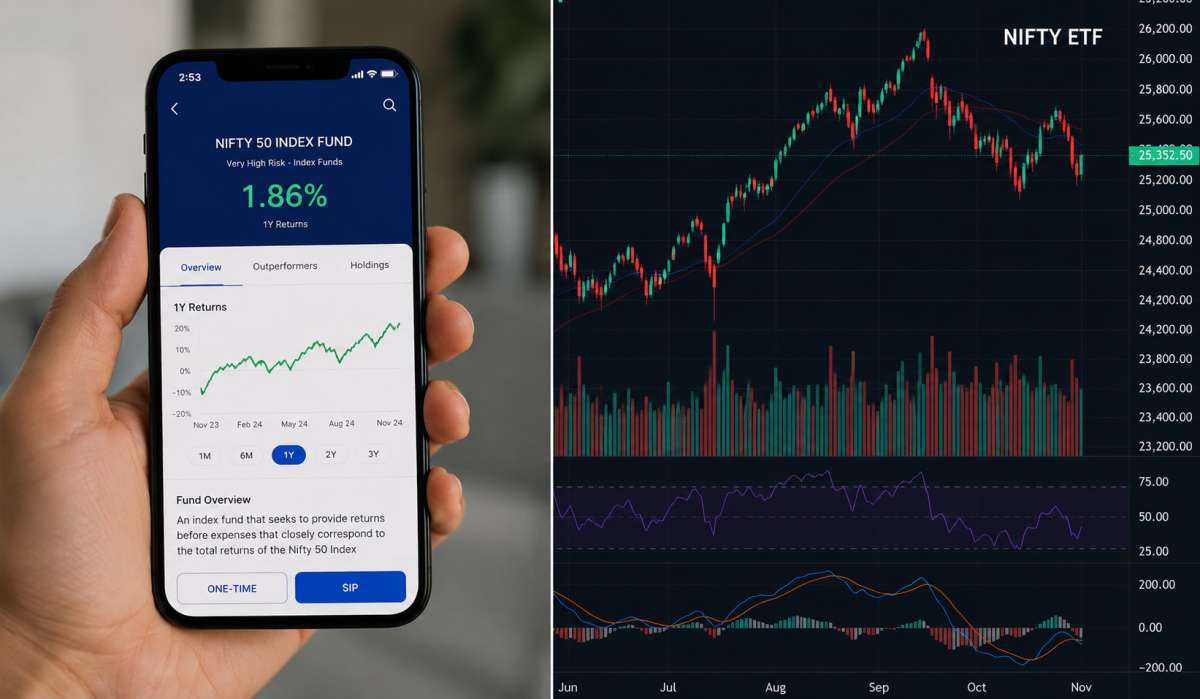
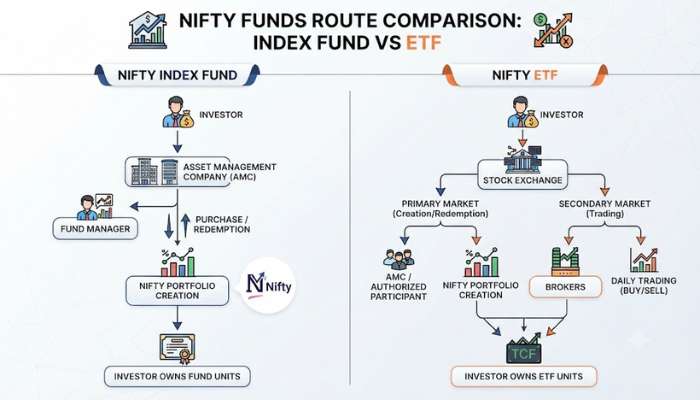
Nifty Index Fund is a mutual fund. You invest directly with the fund house. You get units at the end of the day's NAV. You do not need a demat account. You can start a SIP with as little as 100 .
Nifty ETF trades on the stock exchange like a share. You need a demat and trading account to buy it. The price changes throughout the day. You can buy and sell anytime during market hours .
| Feature | Index Fund | ETF |
|---|---|---|
| Where to buy | AMC or mutual fund platform | Stock exchange |
| Demat account needed | No | Yes |
| Pricing | One end-of-day NAV | Real-time market price |
| SIP possible | Yes, from 100 | No direct SIP |
| Expense ratio | 0.1% to 0.4% | 0.02% to 0.07% |
Read More: ETF Investing Guide for Beginners: Build Wealth with ETFs
The Cost Difference: ETF Cheaper, But...
ETFs have much lower expense ratios. ICICI Prudential Nifty 50 ETF charges just 0.02%. SBI Nifty 50 ETF charges 0.04%. Nifty index funds typically charge 0.2% to 0.35% .
But ETF investors pay brokerage and transaction charges on every buy and sell . For small monthly investments, these charges can eat into the cost advantage.
An index fund investor pays no brokerage. The only cost is the expense ratio.
Real-World Test: Which Actually Gave Better Returns?
A study compared SBI Nifty ETF and SBI Nifty Index Fund over 10 years. Both investors put 10,000 every month. The index fund finished ahead by roughly 21,000 .
- The same experiment with UTI products showed the index fund ahead by around 15,000 .
- The difference was small. But in both cases, the index fund slightly outperformed.
Why? ETFs trade at market prices. Sometimes the ETF trades slightly above its real value. Small inefficiencies add up over time .
The Liquidity Issue
ETFs need buyers and sellers on the exchange. If trading volumes are low, you might not get a fair price. There is a bid-ask spread to pay .
Financial advisors sometimes prefer index funds for this reason. Ravi Saraogi, cofounder of Samasthiti Advisors, says: "We prefer index funds to ETFs because the total cost of ownership of an ETF can actually be higher than that of an index fund. ETF investors must be very careful about the bid-ask spread and actual price" .
Index funds have no such issue. You transact directly with the fund house at NAV.
Which One Is Better for You?
Choose Index Fund if:
- You want a simple, set-it-and-forget investment
- You want to start a SIP with small amounts
- You do not have a demat account
- You prefer end-of-day pricing without watching the market
Choose ETF if:
- You already have a demat account
- You want real-time pricing and intraday flexibility
- You are investing a large lump sum
- You are comfortable executing trades on the exchange
Tax Rules: Both Are Treated the Same
Both Nifty ETFs and index funds are equity-oriented. Tax rules are identical :
- Hold less than 12 months: 20% tax on gains
- Hold more than 12 months: 12.5% tax on gains above 1.25 lakh per year
ETFs also attract Securities Transaction Tax (STT) on the sell side, which index funds do not have .
You May Also Read: Best ETFs for Bear Market Investing: A Simple 2026 Guide
Quick Summary
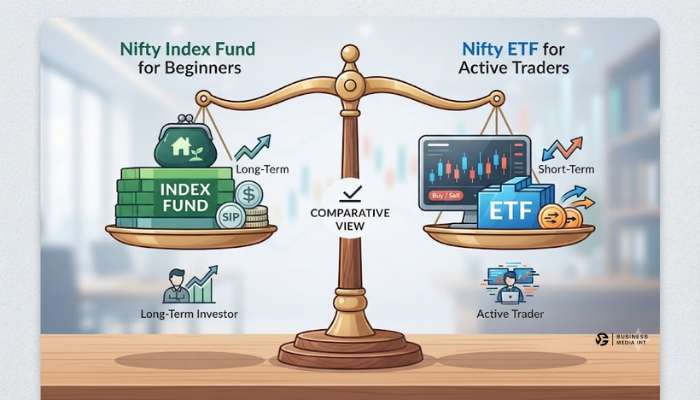
| Factor | Index Fund | ETF |
|---|---|---|
| Expense ratio | Higher | Lower |
| Brokerage costs | None | Yes |
| SIP convenience | Very easy | Not available directly |
| Demat account needed | No | Yes |
| Tracking error risk | Low | Low, but liquidity can affect price |
| Best for | Long-term SIP investors | Active investors with demat account |
Conclusion
Both Nifty ETFs and index funds are good choices. They track the same 50 companies and give almost identical returns. The right one depends on your needs.
Choose the index fund if you want simplicity. You can start a SIP with 100. You do not need a demat account. The process is automatic.
Choose the ETF if you already have a demat account and want lower costs. ETFs charge just 0.02% compared to 0.2% or more for index funds.
For small SIP amounts, the index fund often works out cheaper because there are no brokerage charges. For large lump sums, the ETF makes more sense.
Both are better than most active mutual funds. The most important thing is to start investing regularly and stay invested. Do not overthink this choice. Pick what is convenient for you and begin your investment journey today.
FAQs
1. What is the main difference between Nifty ETF and Nifty Index Fund?
Nifty ETF trades on the stock exchange like a share. You need a demat account to buy it. Nifty Index Fund is a mutual fund. You buy it directly from the fund house. You do not need a demat account.
2. Which has lower expense ratio?
ETF has lower expense ratio. It charges just 0.02% to 0.07%. Index funds charge 0.2% to 0.4%. The difference looks big but actual impact on returns is small.
3. Can I do SIP in Nifty ETF?
No. You cannot do SIP directly in ETFs. You have to buy manually eery month from the exchange. Some brokers offer auto-invest features but it is not the same as a mutual fund SIP.
4. Which is better for long-term investment?
Both are good for long-term. Studies show the difference in returns is very small. Index funds slightly outperformed ETFs in some 10-year comparisons because there were no brokerage costs.
5. Do I need a demat account for Nifty Index Fund?
No. You can buy index funds directly from the fund house or through mutual fund platforms. You do not need a demat account.
6. Which is cheaper for small monthly investments?
Index fund is cheaper for small SIP amounts. ETFs charge brokerage and transaction fees on every trade. These costs eat into the lower expense ratio benefit.
7. Are tax rules different for ETFs and Index Funds?
No. Both are treated as equity-oriented investments. Short-term gains (under 12 months) are taxed at 20%. Long-term gains (above 12 months) are taxed at 12.5% above 1.25 lakh per year.
8. Which gives better liquidity?
ETFs have better intraday liquidity. You can buy and sell anytime during market hours. Index funds only transact at end-of-day NAV. But if the ETF has low trading volume, you might not get a fair price.
9. Can I switch between ETF and Index Fund?
Yes. You can sell your ETF units on the exchange and buy an index fund. Or you can redeem your index fund units and buy an ETF. But each transaction has costs and tax implications.
10. Which one should a beginner choose?
Beginners should choose the index fund. It is simpler. You can start a SIP with 100. You do not need a demat account. The process is automatic and hassle-free. Once you understand investing better, you can consider ETFs.