

ETF Liquidity: A Simple Guide for Indian Investors
You want to buy an ETF but you are not sure if you can sell it when you need money. This is the liquidity question. It is one of the most important things to check before you invest. This guide explains ETF liquidity in simple words.
You will learn why it matters for your cost and flexibility. You will learn how to check ETF liquidity on NSE using bid-ask spread, order book depth, and volume. You will also see some of the best liquid ETFs in India. No complicated terms. Just clear information that helps you trade with confidence. Read this guide avoid illiquid ETFs. Protect your money.
What Is ETF Liquidity?
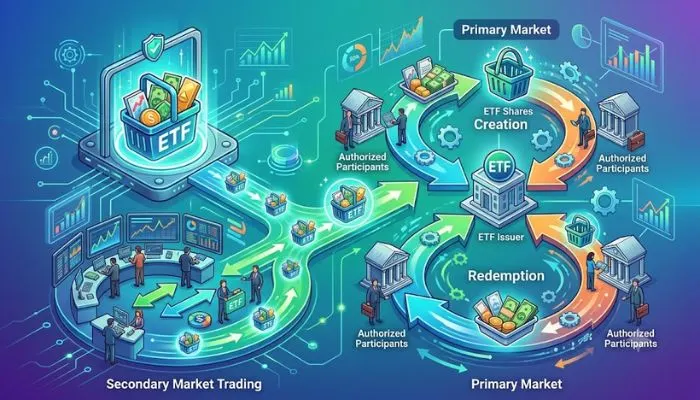
Liquidity means how easily you can buy or sell something without changing its price. For ETFs, it is about how quickly you can get in and out of a trade at a fair price. A liquid ETF has many buyers and sellers. You can trade it easily. An illiquid ETF is hard to trade. You might not find a buyer. Or you might have to sell at a lower price.
But here is the important part. On-screen trading volume is not the whole story. A low-volume ETF can still be liquid if it holds highly liquid underlying assets and has market makers .
Why ETF Liquidity Matters?
Liquidity affects two things. Your cost and your flexibility.
- Cost: The bid-ask spread is the gap between the buying price and the selling price. A narrow spread means low cost. A wide spread means high cost. If the spread is 2%, you lose 2% the moment you buy and sell .
- Flexibility: If an ETF is illiquid, you might not be able to sell when you need money. You might have to wait. Or you might have to accept a lower price.
Read More: Best Nasdaq ETFs for Long Term Investing in 2026
How to Check ETF Liquidity on NSE?
You do not need special tools. You can check liquidity on the NSE website and your broker app.
1. Check the Bid-Ask Spread
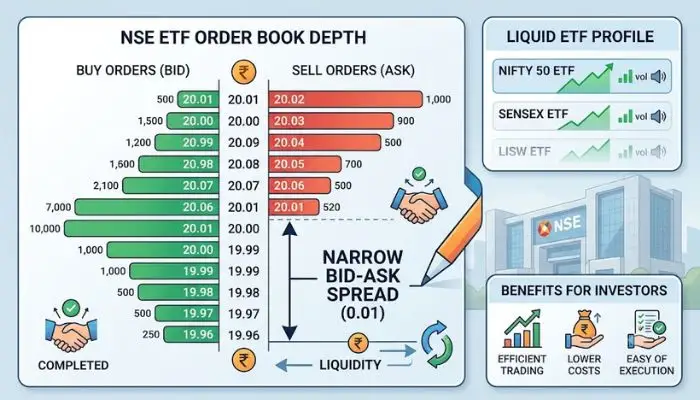
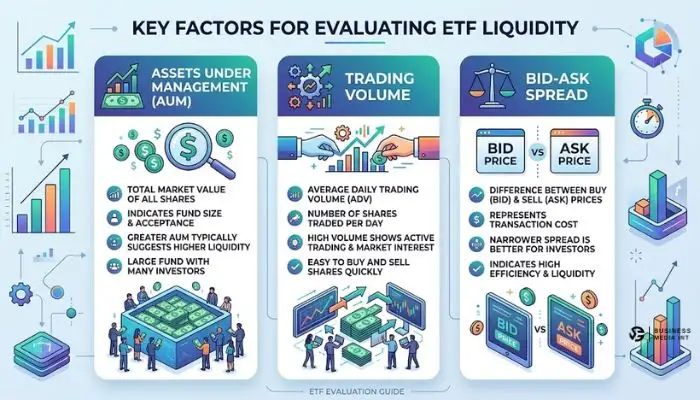
This is the most direct measure. Look at the bid price and the ask price. The difference is the spread. A narrower spread means better liquidity. Aim for spreads below 0.1% for large ETFs .
If the spread is wide, the ETF is illiquid. Avoid trading during market open and close. Spreads are wider then. Trade during the middle of the day for better prices.
2. Check the Order Book Depth
The order book shows how many buyers and sellers are at each price. If there are many orders at the best bid and ask, the ETF is liquid. If there are only a few, it is thin. Thin order books mean your order might move the price against you .
3. Check Average Daily Volume
Volume shows how many units trade each day. Higher volume means more activity. But remember, volume alone does not tell the full story. An ETF with low volume but liquid holdings can still be tradeable .
A useful benchmark: look for ETFs with average daily trading value above 5 crore. This shows consistent activity .
4. Check the AUM (Assets Under Management)
A large AUM usually means a mature fund. Larger funds tend to have better liquidity. They attract more investors and market makers .
5. Check the Underlying Assets
This is the key point. An ETF holds a basket of securities. If those securities are highly liquid, the ETF itself can be liquid even if its own volume is low. Nifty 50 ETFs hold large-cap stocks. These stocks trade heavily. So the ETF can be liquid even with modest volume .
ETFs holding illiquid assets (like real estate or small-cap stocks) are harder to trade. Avoid these if liquidity is your concern.
Best Liquid ETF in India
Here are some of the most liquid ETFs in India based on trading volume and AUM.
| ETF Name | Average Volume | AUM ( Cr) | Expense Ratio |
|---|---|---|---|
| Nippon India ETF Gold BeES | 2,934,469 | 58,629 | 0.81% |
| Nippon India ETF Nifty 50 BeES | 1,541,624 | 67,095 | 0.04% |
| Tata Gold ETF | 6,519,711 | 6,172 | 0.35% |
| Zerodha Nifty 1D Rate Liquid ETF | 4,407,859 | 10,184 | 0.28% |
| Tata Silver ETF | 3,680,054 | 5,440 | 0.39% |
For liquid ETFs (for parking idle cash), the Nippon India ETF Nifty 1D Rate Liquid BeES is popular with high volume .
ETF Liquidity Chart
A liquidity chart shows the bid-ask spread over time. Narrow spreads mean good liquidity. Wide spreads mean poor liquidity.
You can find this data on NSE or your broker platform. Look at the average spread over the last 30 days. If it is consistently narrow, the ETF is liquid.
You May Also Read: Best ETFs to Diversify a Portfolio: Simple Guide for Beginners
High Liquidity ETF in India
The highest liquidity ETFs are usually the ones with the largest AUM and volume. These include:
- Nippon India ETF Nifty 50 BeES – Tracks the Nifty 50. High volume. Low cost .
- Nippon India ETF Gold BeES – Tracks gold. Very high volume. Large AUM .
- CPSE ETF – Tracks central public sector enterprises. High volume .
For a beginner, these are safe choices. They trade easily. You can buy and sell without much trouble.
Quick Summary Table
| What to Check | What It Means |
|---|---|
| Bid-Ask Spread | Narrow = liquid. Aim for below 0.1% |
| Order Book Depth | Many orders = liquid. Few orders = thin |
| Daily Volume | High volume = active. Look for 5 crore+ |
| AUM | Large fund = more liquid |
| Underlying Assets | Liquid holdings = liquid ETF |
FAQs
1. What is ETF liquidity in simple words?
Liquidity means how easily you can buy or sell an ETF without changing its price. A liquid ETF has many buyers and sellers. You can trade it quickly at a fair price.
2. How do I check ETF liquidity on NSE?
Check the bid-ask spread. Narrow spread means good liquidity. Check the order book depth. heck average daily volume. Also check the AUM and the liquidity of underlying assets.
3. What is a good bid-ask spread for an ETF?
A spread below 0.1% is good for large ETFs. A spread above 0.5% is a warning sign. Wide spreads mean higher trading costs.
4. Which is the best liquid ETF in India?
Nippon India ETF Gold BeES and Nippon India ETF Nifty 50 BeES are among the most liquid. They have high volume and large AUM .
5. Can a low-volume ETF still be liquid?
Yes. On-screen volume is not the whole story. If the ETF holds highly liquid assets and has market makers, it can be tradeable even with low volume .
6. What happens if I buy an illiquid ETF?
You might face wide spreads. Your order might move the price. You might not be able to sell when you want. Avoid illiquid ETFs.
7. What is the difference between volume and liquidity?
Volume is the number of units traded. Liquidity is how easily you can trade without affecting price. Volume is one factor, but not the only one .
8. Should I avoid ETFs with low volume?
Not always. Check the underlying assets and market-making arrangements. If the ETF holds large-cap stocks and has market makers, it can still be liquid. But for beginners, stick to high-volume ETFs.