

REIT vs Rental Property Investment: Which One Is Better?
You want to invest in real estate. But you are confused about which path to take. Should you buy a physical flat and rent it out? Or should you buy units in a Real Estate Investment Trust (REIT)? This is the big question many new investors face.
Both options let you make money from property. But they work in very different ways. One gives you control and tangible assets. The other gives you ease and diversification. Your choice depends on your money, your time, and your risk appetite.
This guide breaks down the REIT vs rental property investment comparison. We cover the reit vs rental property investment pros and cons clearly. We also look at how a reit vs rental property investment calculator works. Finally, we share some of the best REITs to invest in for 2026.
What is a REIT?
A Real Estate Investment Trust is a company that owns and operates income-generating properties . Think of it like a mutual fund for real estate. You buy shares of the company. The company owns offices, malls, warehouses, or hotels. You get a share of the rental income as dividends .
REITs were created to let regular people invest in big commercial properties. You do not need crores of rupees. You can buy a unit for a few hundred rupees . In India, REITs must distribute 90% of their income to investors as dividends .
REITs are listed on the stock exchange. You can buy and sell them like any other share .
Read More: Best Suburbs for Real Estate Investment in India 2026

What is a Rental Property Investment?
This is the traditional way. You buy a physical property, like a flat or a house. You rent it out to tenants. You collect rent every month. You hope the property value goes up over time .
You own the asset directly. You can see it and touch it. You decide who lives there. You decide how much rent to charge. You handle the maintenance and repairs .
REIT vs Rental Property: The Key Differences
Let us compare both options side by side. This will help you see which fits your life .
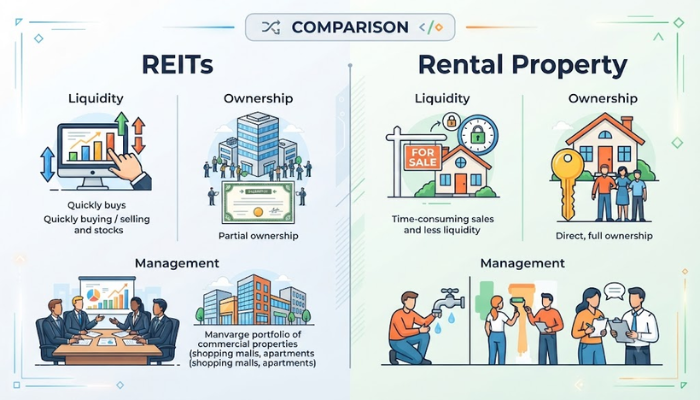
| Feature | REITs | Rental Property |
|---|---|---|
| Ownership | You own shares in a company | You own the physical property |
| Money Needed | Low (can start with 10,000-15,000) | High (down payment + registration + repairs) |
| Liquidity | Very liquid (sell on stock exchange) | Illiquid (selling takes months) |
| Management | None (professionally managed) | Full responsibility (tenants, repairs, maintenance) |
| Income | Dividends from rental income | Rent after expenses |
| Diversification | High (many properties and locations) | Low (one property in one location) |
| Tax Benefits | Limited direct deductions | Depreciation, mortgage interest deductions |
| Control | No control over decisions | Full control |
The Pros and Cons of REITs
Pros of REITs
1. Low Entry Barrier
You do not need a lot of money. You can start with a small amount and invest in large commercial properties .
2. Passive Income
You do not have to do any work. The management team handles everything. You just collect your dividends .
3. High Liquidity
You can sell your units anytime. The stock market is open five days a week .
4. Diversification
Your money is spread across many properties. If one tenant leaves, it does not hurt you much .
5. Professional Management
REITs are managed by experienced teams. They know the market and handle operations efficiently .
Cons of REITs
1. No Control
You have no say in which properties are bought or sold .
2. Market Volatility
REIT share prices can go up and down with the stock market. They are not as stable as physical property .
3. Limited Options in India
There are only a few REITs available in India right now .
4. Interest Rate Sensitivity
When interest rates rise, REIT returns can be affected because borrowing costs go up .
The Pros and Cons of Rental Property
Pros of Rental Property
1. Direct Control
You are the boss. You decide everything about the property .
2. Regular Cash Flow
You get rent every month. If you choose the right tenant, the income is steady .
3. Property Appreciation
Property values usually go up over time. This gives you long-term capital gains .
4. Tax Benefits
You can claim deductions on mortgage interest, property taxes, and depreciation .
5. Tangible Asset
You own something physical. It feels real. You can pass it down to your children .
You May Also Read: Best Suburbs for Real Estate Investment in India 2026
Cons of Rental Property
1. High Initial Investment
You need a big amount for the down payment, stamp duty, and registration. Repairs and renovations add more cost .
2. Management Headaches
You have to find tenants, collect rent, handle complaints, and fix things. It takes time and effort .
3. Illiquidity
Selling a property takes time. You cannot get your money quickly .
4. Vacancy Risk
If the tenant leaves, your income stops. You still have to pay the loan and maintenance .
5. Concentration Risk
All your money is tied to one property. If the area goes down, your investment goes down .
Understanding the Returns: REIT vs Rental Property
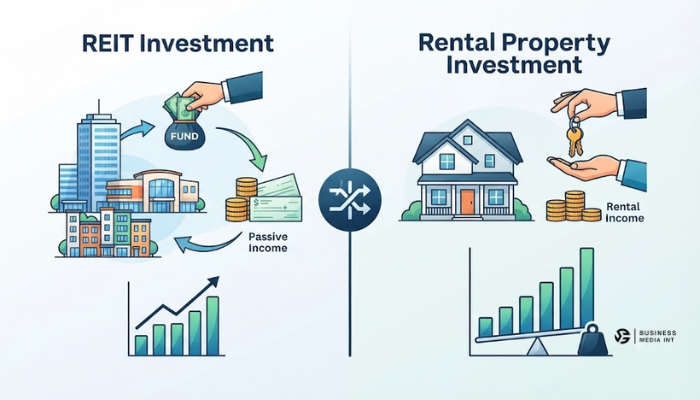
This is where the reit vs rental property investment calculator comes in. The numbers tell an interesting story .
Let us take an example. You have 1 lakh to invest. You look at two options:
- REIT: Gives 8% annual total return
- Rental Property: You use 1 lakh as down payment. You borrow 4 times that amount (4 lakh). The property gives 6% appreciation and 5% rentalyield.
After 10 years:
- REIT value: 2.16 lakhs (1.16 lakhs gain)
- Rental property value: 8.58 lakhs (7.58 lakhs gain)
The rental property wins on pure numbers because of leverage. You borrowed money to buy a bigger asset. But this cuts both ways .
If the property value goes down by 3%, your loss is multiplied. If property appreciation turns negative, leverage can wipe out your deposit. REITs are less volatile. They give steady returns but do not offer the same leverage advantage .
When to Choose REITs?
You should choose REITs if:
- You have limited money to invest
- You want a hands-off investment
- You need liquidity and easy access to your money
- You want diversification across many properties
- You are new to real estate and do not want the hassle
When to Choose Rental Property
- You should choose rental property if:
- You have enough money for a down payment
- You are willing to manage tenants and maintenance
- You want direct control over your investment
- You understand the local market
- You are comfortable with the risks of leverage
Best REITs to Invest In
If you decide to go the REIT route, here are some of the best REITs to invest in:
W.P. Carey
This is one of the largest diversified REITs. It owns over 1,680 properties across the US and Europe. It focuses on net lease properties with high-quality tenants. It has a strong track record of paying dividends .
Broadstone Net Lease
This REIT owns around 770 properties in the US and Canada. Its portfolio is mostly industrial and retail. It has been shifting strategy to focus on higher-quality assets. It offers an attractive and growing dividend .
Global Net Lease
This REIT owns over 820 properties in the US, Canada, and Europe. Its portfolio is mostly industrial, retail, and office. It has been selling non-core assets to strengthen its balance sheet. It offers high yields but comes with more risk .
CapitaLand Integrated Commercial Trust
This is one of Singapore's largest REITs. It owns properties like Plaza Singapura, Raffles City, and CapitaSpring. Its portfolio is valued at S$27.4 billion. It offers a stable distribution yield of around 4.9% .
FAQs
1. What is the main difference between REITs and rental property?
REITs are shares in a company that owns properties. You earn dividends. Rental property means you own a physical building and earn rent. The main differences are control, liquidity, and investment size .
2. Which gives higher returns, REITs or rental property?
Rental property can give higher returns because of leverage. You borrow money to buy a larger asset. But this also increases risk. REITs give more stable, moderate returns .
3. What is a REIT vs rental property investment calculator?
It is a tool that compares the returns of REITs and rental properties. It factors in leverage, returns, and holding period. It helps you see which option gives better numbers .
4. How much money do I need to start with REITs?
You can start with as little as 10,000 to 15,000. You buy units on the stock exchange .
5. What are the tax benefits of owning a rental property?
You can deduct mortgage interest, property taxes, repairs, and depreciation. These deductions can reduce your taxable income .
6. Can I invest in REITs in India?
Yes. There are a few REITs listed on Indian stock exchanges. They invest in commercial properties like offices and malls .
7. Is it better to invest in REITs or rental property for beginners?
REITs are better for beginners. They need less money. They are managed by professionals. They are easier to buy and sell .
8. What is the best REIT to invest in?
Some of the best diversified REITs are W.P. Carey, Broadstone Net Lease, and Global Net Lease. In Singapore, CapitaLand Integrated Commercial Trust is a strong option .