

How to Diversify an Investment Portfolio in India
Do you put all your money in one place? That is risky. If that one investment fails, you lose everything. This is why you need to learn how to diversify an investment portfolio. Diversification means spreading your money across different types of investments. This reduces your risk. If one investment performs badly, others can balance it out.
Research shows that asset allocation explains more of long-term portfolio outcomes than picking individual stocks . The decision about how to divide capital across equities, bonds, gold, and real assets matters more than which stocks you choose. This is the foundation of how to diversify an investment portfolio.
In this guide, I explain how to diversify your investment portfolio India in simple words. No jargon. Just clear steps that work.
What is Portfolio Diversification?
Portfolio diversification is the practice of spreading your investments across different asset classes to reduce risk. The idea is simple: do not put all your eggs in one basket. When one investment loses value, others may gain or stay stable. This smooths out your returns over time.
A diversified portfolio is better positioned to absorb shocks and deliver more stable returns across market cycles . It reduces the impact of any single investment's poor performance on your overall wealth.
Read More: How to Invest in AI Technology Companies: A Simple Guide
How to Diversify an Investment Portfolio with Example
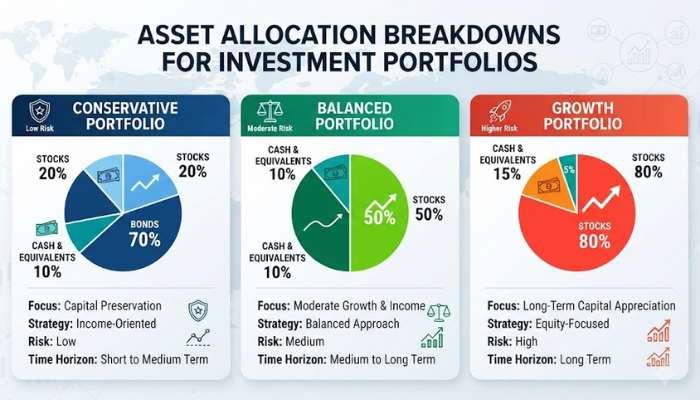
Here is how to diversify an investment portfolio with example allocations. The right mix depends on your age, goals, and risk tolerance.
Conservative Portfolio Example
This is for investors who want safety and stable returns. It is suitable for those nearing retirement or with a short time horizon.
- Equities: 40%
- International equities: 10%
- Fixed income: 35%
- Precious metals: 15%
Balanced Portfolio Example
This sits in the middle. It accepts more volatility than a cautious portfolio in exchange for more exposure to shares. This is often used by investors with a medium-term horizon .
- Cash: 10%
- Bonds: 40%
- Shares: 50%
Growth Portfolio Example
This is for aggressive investors with a long time horizon. It concentrates in shares to maximize growth potential but comes with higher short-term drops .
- Cash: 5%
- Bonds: 15%
- Shares: 80%
Why Each Asset Class Matters in a Diversified Portfolio?
To understand how to diversify your investment portfolio, you need to know what each asset class does.
Equities (Stocks)
Equities are ownership in businesses. Long-run equity returns are driven by economic growth and corporate profitability. They are volatile but over periods of fifteen years or more, equities have consistently outpaced inflation in India and globally .
Role in portfolio: Growth engine. Provides long-term capital appreciation.
Bonds (Fixed Income)
Bonds are loans to governments or companies. They pay interest and return the principal. They have predictable cash flows, lower volatility, and tend to hold value when equities are falling .
Role in portfolio: Stability and income. Balances equity risk.
Gold
Gold has no cash flows. Its value comes from collective scarcity. It tends to rise when confidence in financial systems erodes, when inflation runs hot, and when currencies depreciate . In India, gold has a track record through every economic cycle .
Role in portfolio: Hedge against inflation and currency risk. Safe haven during uncertainty.
Real Assets (Property, REITs, Infrastructure)
Real assets provide income and inflation linkage. Returns are not purely a function of financial market sentiment .
Role in portfolio: Inflation protection and diversification from financial assets.
How to Diversify an Investment Portfolio India: India-Specific Considerations
When learning how to diversify your investment portfolio India, you need to consider local factors.
PPF and EPF as Your Foundation
For many Indians, saving starts with provident fund (EPF or PPF). It is steady, tax-efficient, and safe. But it is built for stability, not strong growth. Returns are consistent but may not beat inflation over the long run .
Action: Keep provident fund as your stability base. Add other investments for growth.
SIPs as the Core
Systematic Investment Plans (SIPs) in equity mutual funds are consistently positioned as the anchor of early portfolios. Their strength lies in consistency rather than market timing . SIPs are the most effective mechanism for early wealth creation .
Action: Start a SIP in a diversified equity mutual fund. This builds the core of your portfolio.
Gold Allocation for Indian Investors
Gold is broadly viewed through a stabilisation lens. Most allocation frameworks place it in a defensive role. Indicative allocations are around 8-10% in diversified portfolios . Gold ETFs and Sovereign Gold Bonds are efficient ways to hold gold without storage issues.
Action: Add 8-10% gold exposure through gold ETFs or Sovereign Gold Bonds.
Real Estate Through REITs and InvITs
Real Estate Investment Trusts (REITs) and Infrastructure Investment Trusts (InvITs) give you real estate exposure without buying property directly. They provide income and diversification.
Action: Consider small allocations to REITs or InvITs for real estate exposure.
You May Also Read: How to Start Investing with Little Money in India
Core-Satellite Approach: A Smart Diversification Strategy

The core-satellite approach divides your portfolio into two parts .
Core Portfolio (60-70%)
This is your financial bedrock. It should be made up of stable, large companies (bluechip stocks) or diversified index funds. These companies have been around for decades and are largely stable .
Purpose: Stability and steady growth. Provides psychological insurance during market volatility.
Satellite Portfolio (20-30%)
This is where you take calculated risks for higher returns. Invest in smaller, faster-growing companies or specific sectors with growth potential .
Purpose: Higher returns. But you must be careful. Check management and business scalability before investing.
Example of core-satellite mix :
-
Core (70-80%): Multi-asset ETF-based plan + bond mutual fund
-
Satellite (20-30%): Emerging markets equity fund + technology stocks
Diversified Portfolio Example from Morningstar
Morningstar developed a diversified portfolio of 11 asset classes that outperformed the traditional 60/40 allocation by 5 percentage points in 2025 .
The diversified portfolio :
- 20% Large-cap domestic stocks
- 10% Developed market equities
- 10% Emerging market equities
- 10% Treasurys
- 10% U.S. core bonds
- 10% Global bonds
- 10% High-yield bonds
- 5% U.S. small-cap stocks
- 5% Commodities
- 5% Gold
- 5% Real estate investment trusts (REITs)
Key takeaway: Adding international exposure and multiple asset classes improved performance. The weakening U.S. dollar helped international equities and gold .
However, the 60/40 split of domestic equities and bonds still beats diversified portfolios over most 20-year periods . The key is adding international exposure, which is not included in a "plain vanilla" 60/40 .
Time Horizon: The Most Important Variable
The right allocation depends on when you need the money .
- Long-term (10+ years): You can afford more equities. Short-term volatility is less relevant. Equities win over long periods.
- Medium-term (5-10 years): Balanced mix with some bonds for stability.
- Short-term (under 5 years): Focus on bonds and cash. Do not risk money you need soon.
A 27-year-old investing for retirement has thirty-plus years. A 40% equity drawdown that recovers is a feature, not a flaw. That same 27-year-old investing for a home purchase in four years should be in an entirely different allocation .
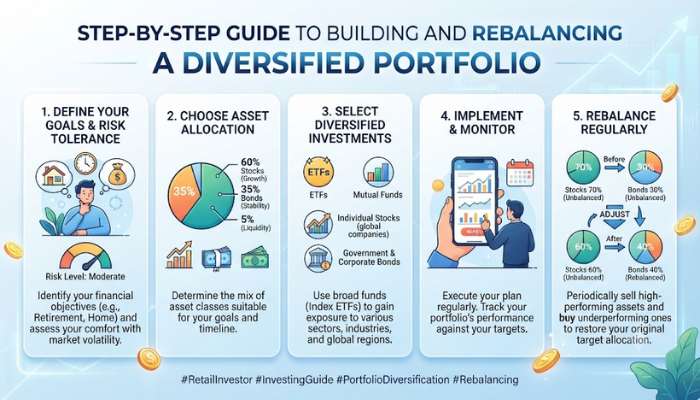
How to Diversify an Investment Portfolio: Step-by-Step Plan?
Step 1: Assess Your Risk Tolerance
How much of a drop in value can you hold without selling? If a 20% paper loss would push you to exit, a growth mix may not be a good match .
Step 2: Determine Your Time Horizon
When do you need this money? Longer horizon = more equities. Shorter horizon = more bonds and cash.
Step 3: Choose Your Asset Allocation
Pick a mix of equities, bonds, gold, and other assets based on your risk and time horizon. Use the examples above as references.
Step 4: Select Specific Investments
Within each asset class, diversify further:
- Equities: Large-cap, mid-cap, small-cap, international
- Bonds: Government, corporate, short-term, long-term
- Gold: ETFs or Sovereign Gold Bonds
Step 5: Invest Regularly
Use SIPs for equity mutual funds. This builds discipline and averages your purchase cost.
Step 6: Rebalance Periodically
Rebalancing means taking profits from winners and moving money back to your core holdings. This locks in gains and maintains your target allocation .
Common Mistakes to Avoid
Mistake 1: Over-Diversification
Spreading small amounts across too many instruments can weaken compounding effectiveness despite higher diversification on paper .
Mistake 2: Not Adding International Exposure
International exposure improves diversification. Correlations for international markets have been trending down, making the case stronger for investing outside your home market .
Mistake 3: Ignoring Gold
Gold is a proven hedge against equity volatility and macroeconomic uncertainty. In India, gold has a track record through every economic cycle .
Mistake 4: Chasing Past Performance
Do not assume recent outperformers will remain strong without deeper evaluation of valuation or cycle risks .
Mistake 5: No Rebalancing
If one stock grows 500%, it may now make up half your portfolio. While this feels great, it is dangerous. Rebalance regularly .
FAQs
1. How to diversify your investment portfolio India?
Start with a core of equity SIPs for growth. Add gold (8-10%) for stability. Include debt or fixed income for safety. Consider REITs for real estate exposure. Keep provident fund as your stability base. Rebalance regularly.
2. How to diversify an investment portfolio with example?
A balanced portfolio example: 50% equities, 40% bonds, 10% cash. A growth example: 80% equities, 15% bonds, 5% cash. Add 8-10% gold and consider 5-10% international exposure.
3. What is a diversified portfolio example?
Morningstar's diversified portfolio: 20% large-cap stocks, 10% each in developed and emerging market equities, Treasurys, core bonds, global bonds, and high-yield bonds, plus 5% each in small-caps, commodities, gold, and REITs .
4. What is the portfolio diversification formula?
Portfolio return is the weighted average of individual asset returns: μP = wA × μA + wB × μB. Portfolio variance considers weights, individual variances, and correlations between assets . For most investors, this is calculated automatically by portfolio tracking tools.
5. How much should I allocate to gold in a diversified portfolio?
Experts recommend 8-10% gold allocation in diversified portfolios . Gold acts as a hedge against equity volatility and macroeconomic uncertainty.
Your Action Plan
-
Assess your situation - How much risk can you take? When do you need the money?
-
Set your target allocation - Use the examples above as a guide
-
Start with SIPs - Build the equity core of your portfolio
-
Add gold - 8-10% through ETFs or Sovereign Gold Bonds
-
Add debt - PPF, EPF, or bond funds for stability
-
Consider international exposure - 5-10% for diversification
-
Review quarterly - Check if you are on track
-
Rebalance annually - Lock in gains and maintain your target mix