

Can I Invest in ETFs Every Month? Complete Guide
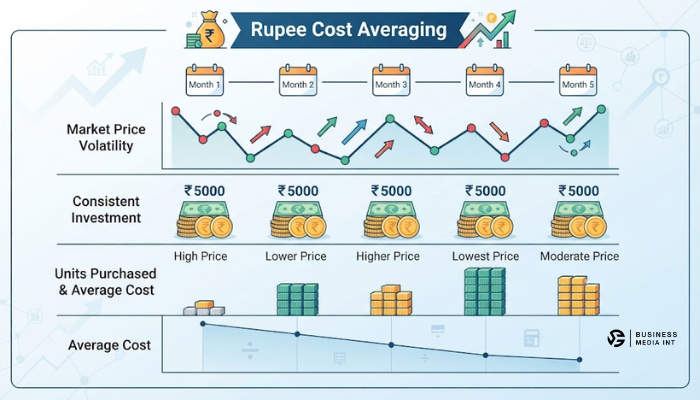
Yes, you can invest in ETFs every month. This is called rupee cost averaging. You put a fixed amount each month into an ETF. When prices are high, you buy fewer units. When prices are low, you buy more units. Over time, your average cost comes down. This is a simple and safe way for beginners to build wealth.
You do not need to time the market. You do not need big money. You just need consistency. Many people ask can I invest in ETFs every month. The answer is always yes. This method works in India and abroad. Start with 500 rupees. Stay regular. Watch your money grow over time.
How Monthly ETF Investing Works?
When you invest in ETFs every month, you buy units regularly. The price changes daily. Some months you buy at a high price. Some months you buy at a low price. Over time, this averages out your purchase cost . This is called rupee cost averaging. It protects you from making bad decisions based on market movements.
For example, you invest 5000 rupees every month in a Nifty 50 ETF . The ETF trades at 200 rupees. You get 25 units. Next month it drops to 180 rupees. Your 5000 rupees buys 27.7 units. The month after it rises to 220 rupees. You get 22.7 units. You buy more when prices are low and fewer when prices are high. This smooths out your average purchase price .
Read More: Best ETF for Retirement: Top Funds to Buy and Hold
How Much to Invest in ETF Per Month?
There is no fixed rule. The amount depends on your income, goals, and expenses . Many investors start with 15 percent of their salary. Others pick a fixed amount like 2000 or 5000 rupees per month. The amount matters less than consistency. A person who invests 1000 rupees per month for 30 years can build significant wealth .
You can start as low as 500 rupees per month in India . Most brokers allow this amount. Some even let you start with 100 rupees. The important thing is to begin and stay consistent.
How to Invest in ETF for Beginners?
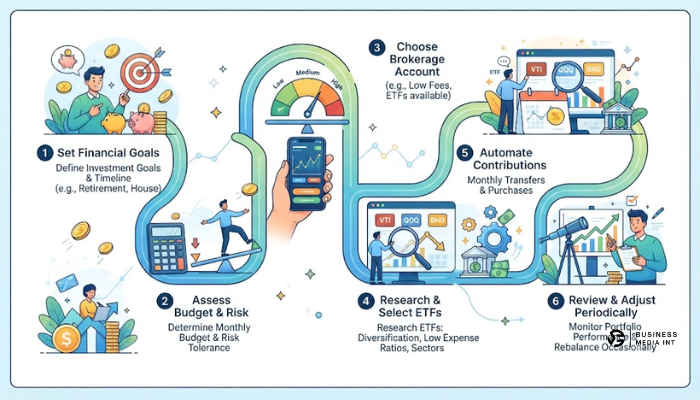
Step 1: Open a Demat and Trading Account
You need these accounts to buy ETFs. They are like your digital locker and your transaction account . Opening one takes 10 to 15 minutes online. You need your PAN card and Aadhaar for KYC. Many brokers open both accounts together .
Step 2: Choose Your ETF
Pick an ETF that matches your goals. Beginners should start with broad market ETFs . These track indices like Nifty 50 or Sensex. They are diversified and low-cost. The expense ratio on these ETFs is often below 0.1 percent. Compare expense ratios because even small fees eat into returns over time .
Step 3: Set Your Monthly Amount
Decide how much to invest each month. Start small if you are unsure. You can always increase later. Pick a date for your monthly purchase. Make sure you have enough money in your account on that date .
Step 4: Place Your Order
On your chosen date, log in to your broker app. Search for your ETF by its ticker symbol. Enter the amount you want to invest. Place a market order to buy at the current price . Most brokers now offer fractional shares. This means you can invest a fixed amount even if it does not equal the full share price.
Step 5: Track Your Investment
Check your portfolio once a quarter. Do not check every day. Frequent checking leads to panic selling. Rebalance your portfolio once or twice a year if needed.
Which ETF to Invest in 2026?
Here are good options for beginners in 2026:
For U.S. investors :
- Vanguard Total Stock Market ETF (VTI) - Owns the entire U.S. stock market. Expense ratio 0.03 percent
- Vanguard S&P 500 ETF (VOO) - Tracks 500 largest U.S. companies. Expense ratio 0.03 percent
- Vanguard Total Bond Market ETF (BND) - Adds safety to your portfolio. Yield around 3.9 percent
For Indian investors :
- Nifty 50 ETFs - Track the top 50 companies in India
- Sensex ETFs - Track 30 large companies
- Nifty Next 50 ETFs - Track the next 50 companies
A simple portfolio could be 80 percent in an equity ETF and 20 percent in a bond ETF. Adjust this based on your age and risk tolerance .
You May Also Read: Top ETFs to Invest in This Year for Long-Term Growth and Wealth
Benefits of Monthly ETF Investing
Rupee Cost Averaging
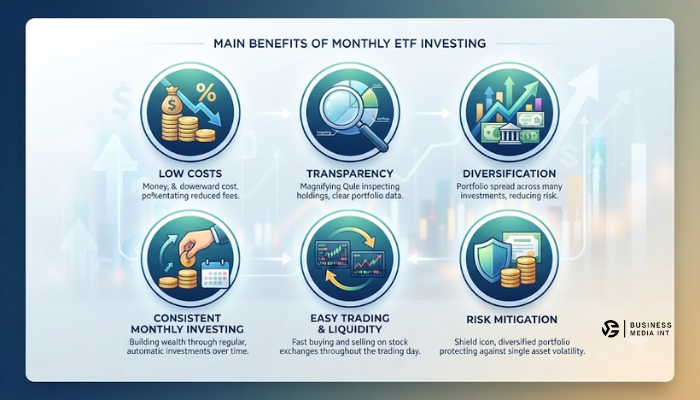
You buy more units when prices fall and fewer when prices rise. This lowers your average cost over time . You do not need to guess the right time to invest.
Low Cost
ETFs have low expense ratios. Active mutual funds charge 1.5 to 2 percent. ETFs charge 0.03 to 0.1 percent. This difference adds up over decades .
Transparency
You know exactly what you own. If it is a Nifty 50 ETF, you own the 50 companies in that index. No surprises. No fund manager making risky bets .
Flexibility
ETFs trade throughout the day like stocks. You can buy or sell anytime the market is open. Mutual funds only trade at the end of the day. This gives you more control .
Common Mistakes to Avoid
Overtrading
ETFs trade like stocks. That does not mean you should trade them frequently. Every trade has costs and tax consequences. Buy and hold for the long term .
Chasing Hot Trends
Do not buy the ETF everyone is talking about. What is hot today might crash tomorrow. Stick to broad, low-cost index ETFs .
Ignoring Fees
Two ETFs tracking the same index can have different expense ratios. Always check the cost. Over 20 years, a 0.5 percent difference can reduce your returns significantly .
Panic Selling
Markets fall. This is normal. If you sell during a dip, you lock in your loss. Stay invested. Markets recover over time .
Conclusion
So can I invest in ETFs every month? Yes. Monthly ETF investing is one of the easiest ways to build wealth. You do not need a large amount. You do not need to be an expert. You just need to be regular.
Here is what you learned from this guide:
- You can start with just 500 rupees per month
- Buying every month gives you a lower average price over time
- You buy more units when prices are low and fewer when they are high
- This protects you from bad timing
- Broad index ETFs like Nifty 50 are best for beginners
- Keep costs low by choosing ETFs with low expense ratios
- Do not sell when markets crash
- Stay invested for the long run
The amount you invest does not matter as much as the habit. Someone who puts 1000 rupees every month for 30 years will end up with more money than someone who invests once and stops.
Open your demat account today. Pick a simple index ETF. Decide your monthly amount. Start this month. Stay consistent. Your future self will be happy you started.
FAQs
1. Can I invest in ETFs every month in India?
Yes. You can set up a monthly investment in ETFs through most brokers. You will need a demat and trading account. Some brokers offer automatic SIP features. Others require you to buy manually each month on your chosen date .
2. What is the minimum amount to start monthly ETF investing?
You can start with 500 rupees per month in India . Some platforms let you start even lower. The amount is not important. The habit of consistency matters more .
3. Is investing in ETFs every month safe?
ETFs carry market risk. Their value goes up and down. But broad market ETFs are less risky than individual stocks. They are diversified across many companies. Long-term investors who stay invested through ups and downs usually do well .
4. How do I choose which ETF to invest in every month?
Start with a broad index ETF like Nifty 50 or S&P 500. These are low-cost and well-diversified. Check the expense ratio and liquidity. Once you understand the basics, you can add sector or thematic ETFs .
5. Can I sell my ETFs anytime even if I invest monthly?
Yes. ETFs trade like stocks on the exchange. You can sell them anytime during market hours. You get the current market price. There is no lock-in period .