
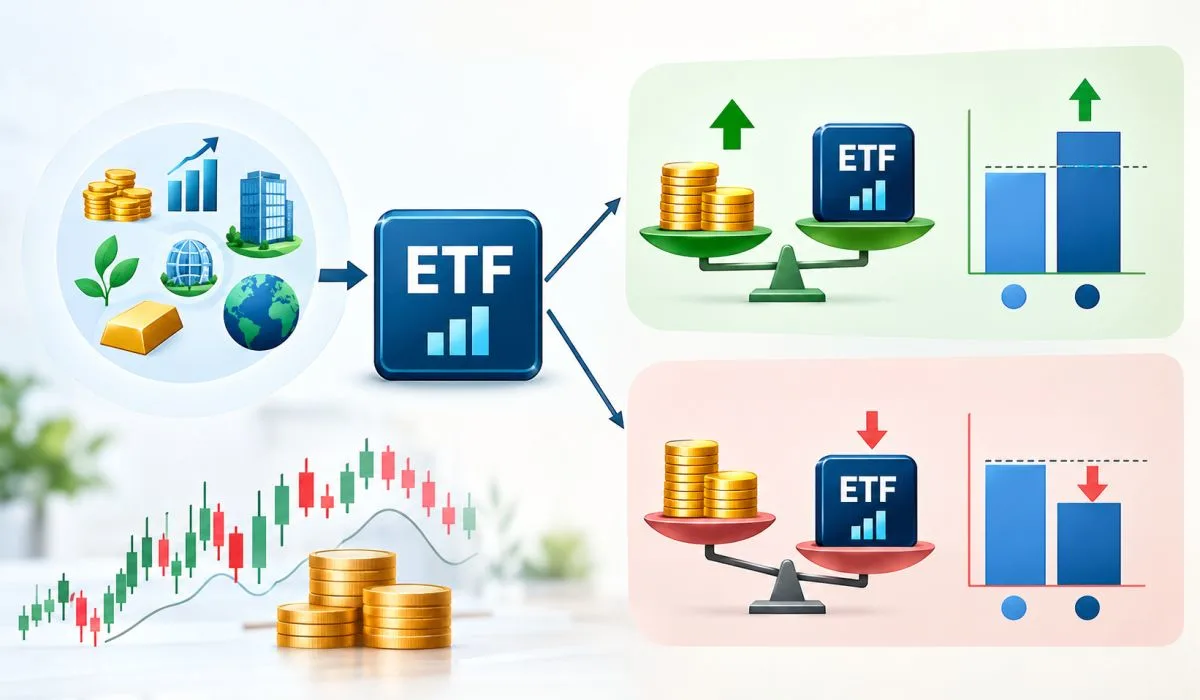
ETF Premium to NAV Explained: How to Avoid Overpaying
You buy an ETF expecting to own a slice of the underlying assets. But what if you end up paying more than what those assets are actually worth? This happens when an ETF trades at a premium to its Net Asset Value. Understanding this gap is crucial.
It can quietly eat into your returns without you even noticing. ETF premium to NAV explained simply means the market price is higher than the fair value of the fund's holdings. Nifty 50 ETFs rarely see large premiums. But silver and international ETFs often trade at steep premiums. This guide explains why this happens and how to avoid overpaying.
What is Premium to NAV?
Every ETF has two prices. The first is the Net Asset Value (NAV). This is the fair value of the underlying assets held by the fund, divided by the number of units . Think of it as the "true worth" of one ETF unit.
The second is the market price. This is what you actually pay on the stock exchange. It moves based on demand and supply throughout the trading day . When the market price is higher than the NAV, the ETF trades at a premium. When it is lower, it trades at a discount .
Read More: Nifty ETF vs Nifty Index Fund: Which One Should You Choose?
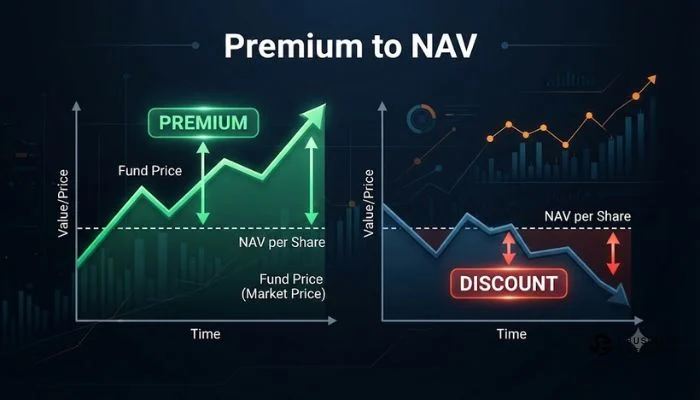
Premium to NAV Formula and Example
The formula to calculate the premium or discount is simple :
Premium/Discount (%) = [(Market Price – NAV) / NAV] × 100
Example: An ETF has a NAV of 100. But strong demand pushes its market price to 105. You buy it at 105. This means you paid a 5% premium .
Now, imagine the underlying index rises 10%. The NAV moves from 100 to 110. But if the premium disappears by the time you sell, the market price returns to the NAV level of 110. You earn 5 profit. That is a 5% return, while the index actually gained 10%. You lost half your potential return to the premium .
What is a Good NAV Premium?
For most domestic equity ETFs, a premium or discount should be very small, often under 0.5% . Anything above 0.5% to 1% is a warning sign for a buyer .
- 0% to 0.5%: Normal and acceptable. The ETF is efficiently priced.
- 0.5% to 2%: Caution. You are paying noticeably more than fair value.
- Above 2% to 5%: High premium. Avoid buying unless you have a strong reason.
- Above 5%: Very high. This is common in international and commodity ETFs due to structural issues .
ETF Premium to NAV Explained: Nifty 50 ETFs
Nifty 50 ETFs are among the most liquid in India. Because they trade heavily and have a robust arbitrage mechanism, they rarely trade at large premiums or discounts .
According to market data, almost all Nifty 50 ETFs trade within a narrow 0.1% to 0.6% discount to NAV . This reflects efficient pricing. For a long-term investor in Nifty 50 ETFs, the premium or discount issue is usually not a major concern. The gap is too small to meaningfully impact returns.
ETF Premium Discount Example: Silver ETFs
Silver ETFs tell a very different story. They frequently trade at large premiums due to strong retail demand and limited supply .
In early 2026, some silver ETFs traded at premiums over 10% . For instance, one silver ETF traded at a 14% premium. Over the next week, silver prices rose 18%. But the investor who bought at that inflated price earned only about 1%. The missing return was simply the premium collapsing back to NAV .
This shows how dangerous buying at a premium can be. Even when the underlying asset performs well, your returns can be wiped out.

Why Do Premiums and Discounts Happen?
Several factors cause ETFs to trade away from their NAV :
- Liquidity: ETFs with low trading volumes can have wider gaps. Thin trading means fewer buyers and sellers, so prices can drift .
- Supply and demand imbalance: If many investors want to buy an ETF but new units cannot be created, demand pushes the price above NAV .
- Overseas investment limits: In India, international ETFs often trade at high premiums because the RBI's overseas investment limit is exhausted. Fund houses cannot create new units, so the arbitrage mechanism that normally keeps prices in check stops working .
- Market stress: During volatile periods, trading costs rise and liquidity dries up. This can widen premiums and discounts .
How to Avoid Overpaying?
- Check the iNAV before you buy. The Indicative NAV (iNAV) is a real-time estimate of the ETF's fair value. Compare the market price to the iNAV, not the previous day's NAV, which can be stale .
- Use limit orders. Do not buy at market price. Place a limit order close to the iNAV. This protects you from overpaying during sudden spikes .
- Avoid ETFs with persistent high premiums. If an ETF consistently trades at a premium above 1-2%, find another option. Consider an index fund instead, which always transacts at NAV .
You May Also Read: ETF Investing Guide for Beginners: Build Wealth with ETFs
Quick Summary
| Concept | Meaning |
|---|---|
| NAV | Fair value of underlying assets per unit |
| Market Price | Price you pay on the exchange |
| Premium | Market price > NAV |
| Discount | Market price < NAV |
| Good Premium | Under 0.5% for domestic ETFs |
| Warning Level | Above 0.5% to 1% |
| Danger Level | Above 5% (common in international/silver ETFs) |
FAQs
1. What does premium to NAV mean in simple words?
Premium to NAV means the ETF's market price is higher than the actual value of its underlying assets. You are paying more than what the ETF is worth.
2. What is a good NAV premium for an ETF?
For domestic equity ETFs, a premium under 0.5% is good. Anything above 1% is a warning sign. For international and ommodity ETFs, premiums can be higher but you should avoid buying at steep premiums.
3. Why do international ETFs trade at high premiums?
Because of RBI's overseas investment limit. When the limit is exhausted, fund houses cannot create new units. Demand stays high but supply is frozen, pushing prices above NAV .
4. How to calculate premium to NAV?
Use this formula: [(Market Price – NAV) / NAV] × 100. For example, if NAV is 100 and market price is 105, the premium is 5% .
5. Do Nifty 50 ETFs trade at a premium?
No. Nifty 50 ETFs are highly liquid and trade within a narrow range of 0.1% to 0.6% of NAV. They rarely see large premiums or discounts .
6. Why do silver ETFs trade at a premium?
Silver ETFs see strong retail demand. When demand exceeds supply and new units cannot be created quickly, prices rise above NAV. These premiums can be over 10% .
7. How can I avoid paying a premium?
Check the iNAV before buying. Compare it with the market price. Use limit orders. Avoid ETFs with persistent high premiums. Consider index funds as an alternative .
8. What happens to my returns if I buy at a premium?
If the premium collapses, you lose that amount even if the underlying asset performs well. For example, buying at 5% premium and selling when premium is zero means you lose 5% of your return .