
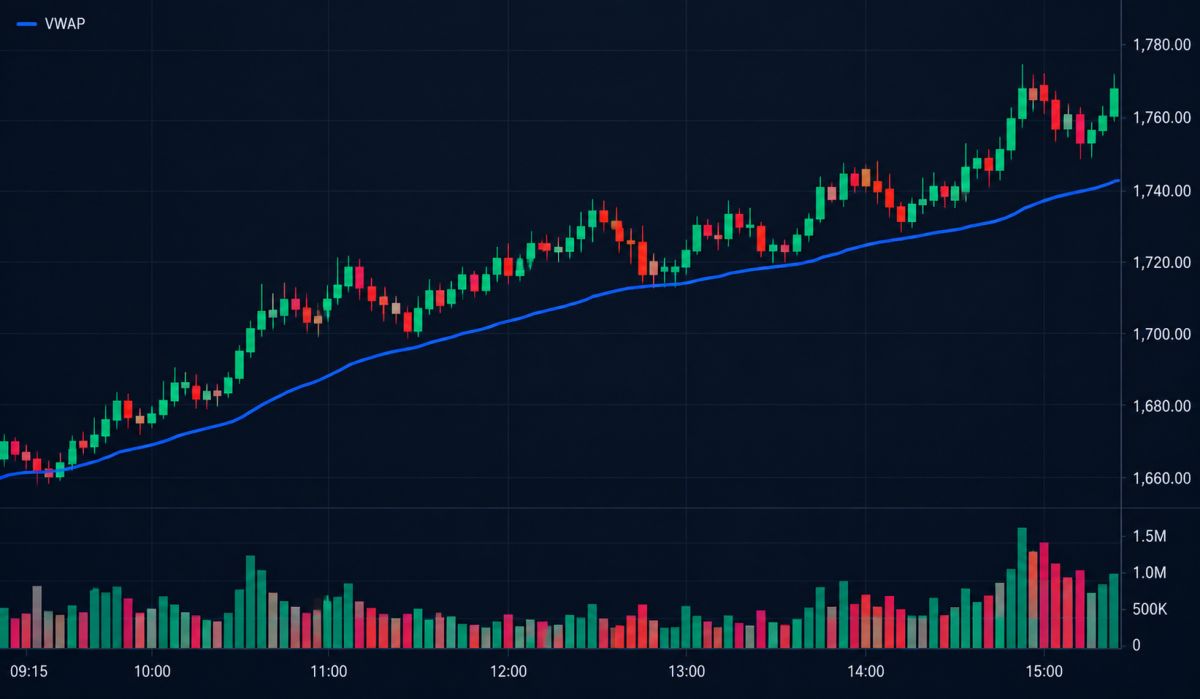
How to Use VWAP for Intraday Trading: Simple Guide
Do you want to trade like the big players? Institutional traders use a tool called VWAP every single day. VWAP stands for Volume Weighted Average Price. It shows you the true average price of a stock, weighted by how many shares were traded at each price. This is not a simple average. It gives more weight to prices where more trading happened .
If you learn how to use VWAP for intraday trading, you can spot the real trend. You can find good entry and exit points. You can trade with the institutions instead of against them. This guide explains VWAP in simple words. No complicated jargon. Just clear steps that work.
What is VWAP?
VWAP is the volume weighted average price for a single trading day. It resets at the start of each session. It updates continuously as the day goes on .
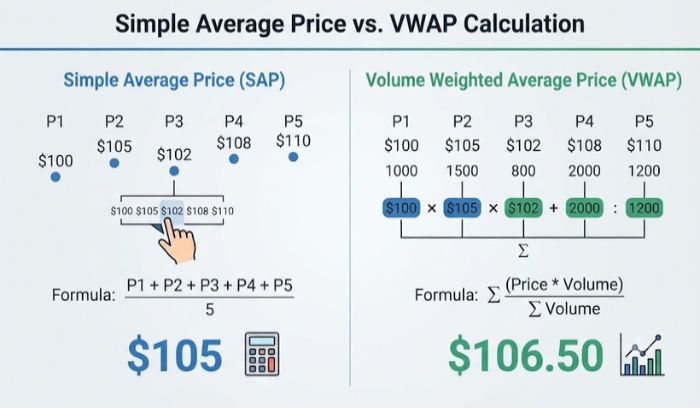
Think of it this way. A stock trades 100 shares at 100 and 500 shares at 102. A simple average would be 101. But VWAP is closer to 102 because most trading happened there. VWAP tells you where the real business was done .
The formula is simple:
VWAP = Sum of (Price × Volume) ÷ Total Volume
You do not need to calculate this yourself. Your trading platform does it automatically .
Read More: Gap Up and Gap Down Trader Talk Meaning: Simple Guide
Why VWAP Works – The Institutional Angle?
Big players like mutual funds and hedge funds cannot buy millions of shares at once. That would push the price up too fast. So they spread their orders throughout the day. Their goal is to buy below VWAP or sell above VWAP. This gives them a better average price .
Because institutions watch VWAP, the price often reacts at this level. Retail traders like you can watch the same level. You can plan your entry and exit around the activities of big players .
How to Use VWAP for Intraday Trading
1. VWAP as a Trend Indicator
The simplest way to use VWAP is to check the trend .
- Price above VWAP: This is bullish. Buyers are in control. Look for long trades .
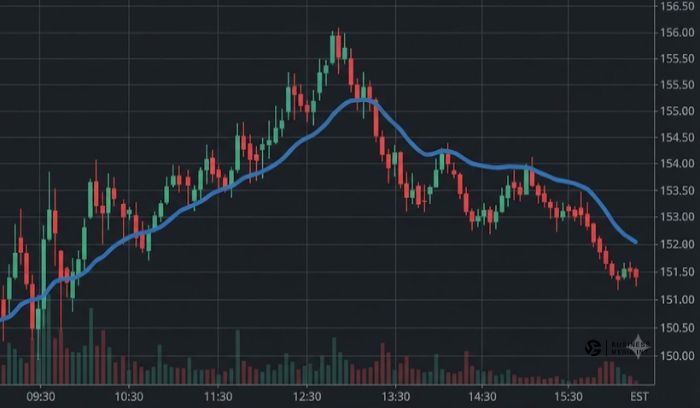
- Price below VWAP: This is bearish. Sellers are in control. Look for short trades .
In a trending market, price may stay above or below VWAP for long periods. Pullbacks toward VWAP can be continuation zones .
2. VWAP Crossovers
When price crosses above VWAP, it signals a potential buying opportunity. When price crosses below VWAP, it signals a potential selling or shorting opportunity .
These crossovers are confirmation signals. Do not trade them blindly. Use them with other indicators or price action .
3. VWAP as Support and Resistance
VWAP acts as a dynamic support and resistance level throughout the day .
- Support: When price approaches VWAP from below, it may bounce back up. This means VWAP is providing support .
- Resistance: When price approaches VWAP from above, it may reverse downward. This means VWAP is acting as resistance .
Traders use these levels for entries, exits, and stop-loss placement .
4. VWAP Re-tests
If price breaks above VWAP and then pulls back to it, watch how it behaves. If the price holds at VWAP and bounces, it confirms the trend. This is a good entry point. If the price breaks below VWAP, it signals a possible reversal .
VWAP Settings for Intraday Trading
The standard VWAP setting uses one-minute bars. The anchor point is the market open .
Standard Day Trading Settings:
- Calculation period: 1-minute bars
- Standard deviation bands: 1.5 and 2.5
- Anchor: Market open
Scalping Configuration:
- 15-second or 30-second bars
- Deviation bands: 0.5, 1.0, and 1.5
- Add a 9-period EMA for momentum confirmation
For volatile markets, widen the deviation bands to reduce false signals. For low volatility, use tighter bands .
You May Also Read: Easy Trading Terms for Beginners: Simple Guide
Combining VWAP with Other Indicators
VWAP works better when combined with other tools. Here are two popular combinations.
VWAP + 50-Period Moving Average
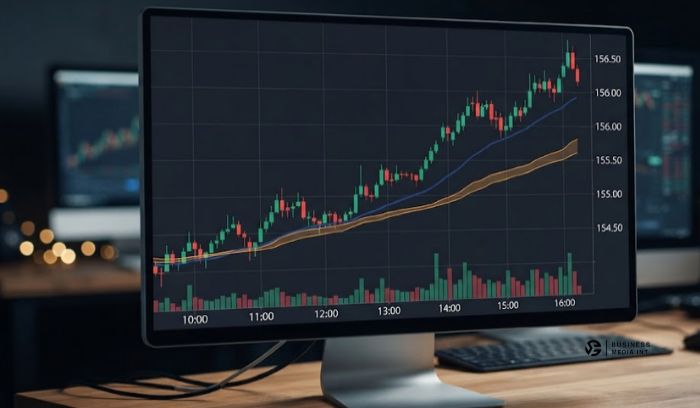
- Go long when VWAP is above the 50-period SMA. Go short when VWAP is below it. This filters market noise and identifies trend direction .
- Look for wide range candles as entry signals. Validate price position with support and resistance levels. Check for volume expansion in the direction of the trade .
VWAP + Trendline + Option Open Interest
- Mark a trendline on a 5 to 15-minute chart. Look for price to respect VWAP and trendline together. Check the option chain for open interest confirmation. Enter on candle confirmation. Set stop-loss below trendline or VWAP .
- This setup works best between 9:30 AM and 11:30 AM, and after 1:30 PM .
Common Mistakes to Avoid
- Treating VWAP as a standalone signal. VWAP is a context tool, not a prediction tool. It shows what has happened, not what will happen .
- Ignoring volume. VWAP is only as good as the volume behind it. Low volume makes VWAP less reliable .
- Trading late in the session. VWAP loses relevance late in the day if volume drops .
- Forgetting that VWAP resets daily. It is an intraday-only tool. It does not work for swing trading in its standard form .
Quick Summary
| Use Case | Action |
|---|---|
| Trend | Above VWAP = bullish, below = bearish |
| Crossover | Price above VWAP = buy signal, below = sell signal |
| Support/Resistance | Price bounces at VWAP = trade in bounce direction |
| Entry | Wait for pullback to VWAP and hold |
| Stop-Loss | Place just beyond VWAP |
| Best Time | First 2 hours and afer 1:30 PM |
FAQs
1. What is VWAP in simple words?
VWAP is the average price of a stock for the day, weighted by how many shares traded at each price. It shows where most trading happened. It resets every morning .
2. How do I use VWAP for intraday trading?
Check if price is above or below VWAP. Above means buy. Below means sell. Use VWAP as support and resistance. Wait for price to pull back to VWAP for entries .
3. What are the best VWAP settings for intraday trading?
Standard settings use 1-minute bars with deviation bands at 1.5 and 2.5. For scalping, use 15-second or 30-second bars with bands at 0.5, 1.0, and 1.5 .
4. Can I use VWAP for swing trading?
Standard VWAP resets daily, so it is not ideal for swing trading. However, anchored VWAP can be used for swing trading. You can anchor it from a specific event like earnings or a major high .
5. What is the importance of VWAP in intraday trading?
VWAP shows where institutions are trading. It acts as a benchmark for fair value. It helps you align your trades with the big players. It also helps manage risk with stop-loss placement .
6. Does VWAP work in all market conditions?
VWAP works best in liquid stocks and indices. In trending markets, price stays above or below VWAP. In ranging markets, price oscillates around VWAP. Adjust your strategy based on market conditions .
7. What is the difference between VWAP and a moving average?
VWAP weights prices by volume. A moving average treats all prices equally. VWAP resets daily. A moving average uses a rolling window. VWAP is better for intraday. Moving averages are better for multi-day trends .