
Difference Between Bond Price and Bond Yield: Simple Guide
Do you know the difference between bond price and bond yield? This question confuses many investors. Some people think they are the same thing. They are not. Bond price is the amount you pay to buy a bond. Bond yield is the return you earn on that bond. They are connected in a very important way.
When bond price goes up, bond yield goes down. When bond price goes down, bond yield goes up. They move in opposite directions. This is called an inverse relationship. This guide explains the difference between bond price and bond yield with examples. No complicated jargon. Just simple words that help you understand how bonds really work.
What Is Bond Price?
Bond price is the current market value of a bond. It is the amount you pay to purchase the bond . The price can be higher, lower, or equal to the face value of the bond .
Bond prices change every day. They change based on supply and demand. They also change based on interest rates in the market .
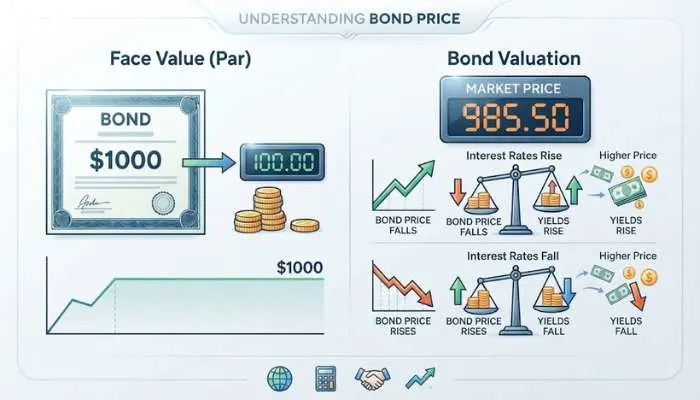
Face value vs market price: When a bond is issued, it has a face value (also called par value). This is the amount the issuer promises to return at maturity. But in the secondary market, the bond can trade at a different price:
- At par: Price equals face value
- At a premium: Price is higher than face value
- At a discount: Price is lower than face value
- Example: A bond with 100 face value can trade at 110 (premium) or 90 (discount) depending on market conditions.
- Bond price formula: Bond price is calculated by discounting all future cash flows (coupon payments and principal) back to the present value .
text
Bond Price = Present value of all coupon payments + Present value of principal
Read More: Best Bonds to Invest in 2026: Complete Investment Guide
What Is Bond Yield?
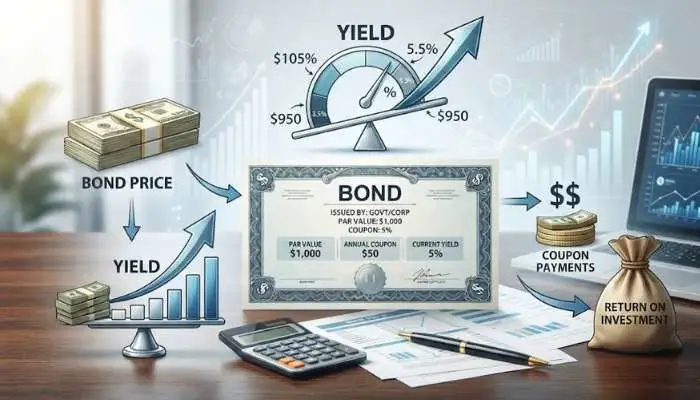
Bond yield is the return you earn from a bond. It is expressed as a percentage. Yield is based on both the bond's price and the coupon payments you receive .
Simple yield formula:
text
Bond Yield = (Coupon Amount / Market Price of Bond) × 100
If a bond pays 200 annually and its market price is 5000, the yield is 4% .
- Key point: Yield changes when bond price changes. The coupon rate stays fixed. But the yield changes because the price changes.
- Yield to Maturity (YTM): This is the most commonly quoted yield. It is the total return an investor will earn if they hold the bond until maturity. It takes into account all coupon payments and the difference between purchase price and face value .
The Inverse Relationship: Why It Matters
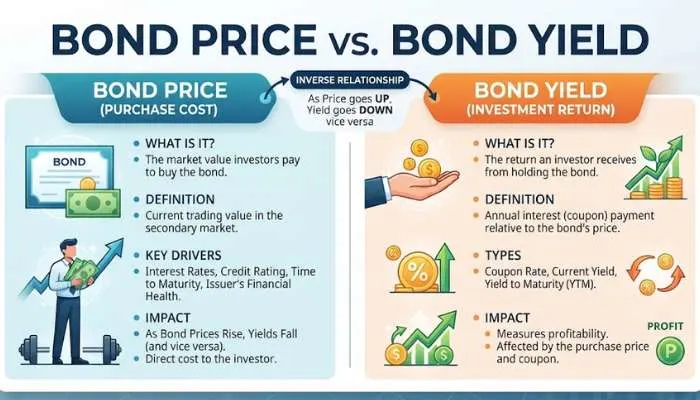
Bond price and bond yield have an inverse relationship . This is the most important thing to understand about bonds.
When interest rates rise:
- New bonds offer higher coupon rates
- Existing bonds with lower coupons become less attractive
- Their prices fall
- Their yields rise to match the new market rates
When interest rates fall:
- New bonds offer lower coupon rates
- Existing bonds with higher coupons become more attractive
- Their prices rise
- Their yields fall
Difference Between Bond Price and Bond Yield with Example
Let me show you the difference between bond price and bond yield with example.
Scenario 1: When Price Goes Up
Take a bond with these features:
- Face value: 100
- Coupon rate: 5% (pays 5 every year)
- Current market price: 110 (bought at a premium)
What happens to yield?
text
Yield = (5 / 110) × 100 = 4.55%
The yield is lower than the coupon rate because you paid more than face value. The coupon amount is still 5, but you paid 110 to get it .
Scenario 2: When Price Goes Down
Now the same bond but the price has fallen:
-
Current market price: 90 (bought at a discount)
What happens to yield?
text
Yield = (5 / 90) × 100 = 5.55%
The yield is higher than the coupon rate because you paid less than face value .
Summary of the example:
| Condition | Price | Yield | Relationship |
|---|---|---|---|
| Price rises to 110 | Higher | 4.55% | Yield falls |
| Price at 100 (par) | Equal | 5% | Yield equals coupon |
| Price falls to 90 | Lower | 5.55% | Yield rises |
Bond Price and Yield Formula
Here is the bond price and yield formula you need to know.
Bond Price Formula:
For a bond with annual coupon payments:
text
Price = C × [1 - (1+r)^-n] / r + FV / (1+r)^n
Where:
- C = annual coupon payment
- r = required rate of return (yield)
- n = number of years to maturity
- FV = face value
Bond Yield Formula:
text
Yield = (Coupon Amount / Market Price) × 100
This is the current yield. For yield to maturity, the calculation is more complex and usually done using a financial calculator or Excel.
Why Does This Inverse Relationship Happen?
The bond price and yield formula shows why the inverse relationship exists. Let me explain in simple words.
Bond coupon payments are fixed. When you buy a bond, you know exactly how much interest you will get each year. The coupon rate does not change .
When market interest rates go up, investors can get better returns from new bonds. To sell an old bond with a lower coupon, the seller must lower the price. This makes the old bond's yield go up to match the new market rates .
When market interest rates go down, old bonds with higher coupons become more valuable. Investors are willing to pay a higher price for them. This makes the old bond's yield go down .
This is why bond prices and yields move in opposite directions.
You May Also Read: Bond Investing for Beginners: Best Platforms in India
Bonds at Premium, Par, and Discount
Here is a simple rule:
- If the coupon rate > market interest rate → Bond trades at a premiu (price > face value)
- If the coupon rate = market interest rate → Bond trades at par (price = face value)
- If the coupon rate < market interest rate → Bond trades at a discount (price < face value)
Real-World Example: Bond Price and Bond Yield UPSC
The difference between bond price and bond yield UPSC topic is often tested in competitive exams. Here is a simple way to remember it.
In India's bond market, the 10-year government bond yield is a key benchmark. The bond price moves opposite to the yield. When the Reserve Bank of India raises interest rates, bond prices typically fall. Yields rise. When the RBI cuts rates, bond prices typically rise. Yields fall .
FAQs
1. What is the difference between bond price and bond yield?
Bond price is the money you pay to buy a bond. Bond yield is the return you get on that bond. When price goes up, yield comes down. When price goes down, yield goes up. They move in opposite ways.
2. Why do bond prices drop when yields increase?
When market rates go up, new bonds give higher interest. Old bonds with lower interest become less attractive. People will only buy them if the price is lower. This makes the yield go up.
3. Is bond yield same as coupon rate?
No. Coupon rate is fixed when the bond is issued. Yield changes with the bond price. If you pay more than face value, yield is lower than coupon. If you pay less, yield is higher.
4. How to calculate bond yield?
Use this formula: (Annual coupon amount ÷ Current market price) × 100. If a bond pays 200 and you pay 5000, the yield is 4%.
5. What happens to bond price when interest rates fall?
When interest rates drop, old bonds with higher coupons become more valuable. People pay more for them. So bond prices go up.