

Forex Trader Talk Terms for Beginners: A Simple Guide
There is a language of trading Forex. The first step to understanding the market is to understand the words. This tutorial helps you understand the forex trader talk terms for beginners in easy-to-understand language. You will understand what pips, spreads, leverage and margin are. You'll have an understanding of bid and ask prices. You will know the difference between long and short positions.
The concept of stop-loss and take-profit orders will be understood. This is a guide to the basic terminology in trading forex and its definitions. No jargon. No complicated explanations. Basic vocabulary to get you comfortable trading with confidence. Read this guide. Learn the language. Begin trading with knowledge.
What Is Forex Trading Terminology?
Forex trading terminology is the specialized language that traders use to describe the market, their positions, and their strategies . You will see these terms on trading platforms, in news reports, and in conversations with other traders. Understanding this language is the first step to becoming a successful trader. It helps you read charts, place orders, and manage your risk correctly .
Read More: Trader Talk AI Trading Tools: Complete Guide for 2026
Basic Terms Used in Forex Trading and Their Meanings
Currency Pairs
- Forex trading is always about pairs. You buy one currency and sell another at the same time. The first currency is the base currency. The second is the quote currency .
- Example: In EUR/USD, EUR is the base and USD is the quote. If EUR/USD is 1.1000, it means 1 Euro equals 1.10 US Dollars.
Bid and Ask Price
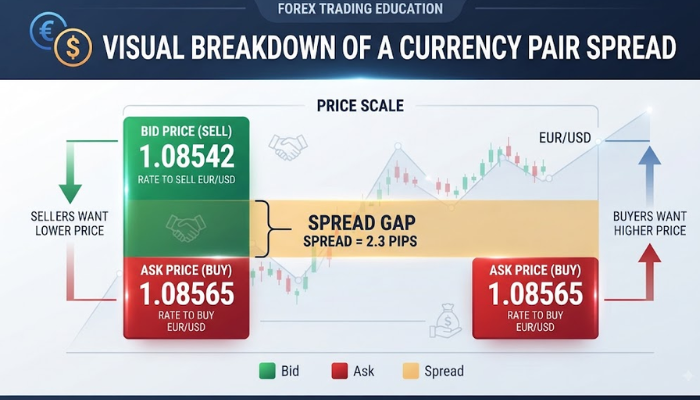
- The bid price is the highest price a buyer is willing to pay. The ask price is the lowest price a seller will accept . You buy at the ask price. You sell at the bid price.
- Example: If EUR/USD shows bid 1.1000 and ask 1.1002, you can sell at 1.1000 or buy at 1.1002.
Spread
- The spread is the difference between the bid and ask price . This is how brokers make money. A tight spread means a liquid market .
- Example: If bid is 1.1000 and ask is 1.1002, the spread is 2 pips.
Pip
A pip measures price movement. For most currency pairs, 1 pip is 0.0001 . If EUR/USD moves from 1.2000 to 1.2005, it moved 5 pips . For JPY pairs, 1 pip is 0.01 .
Lot Size
Forex trades use standard sizes. One standard lot is 100,000 units of currency . There are also mini lots (10,000) and micro lots (1,000) .
Example: If you buy 1 standard lot of EUR/USD at 1.1000, you control 100,000 Euros.
Order Types: Trading Words Meaning
Market Order
A market order is executed immediately at the current market price . You get the best available price at that moment.
Limit Order
A limit order is placed to buy below the current price or sell above the current price . You control the execution price. But the order may not be filled if the price does not reach your level .
- Buy limit: Buy at a price lower than current market price.
- Sell limit: Sell at a price higher than current market price .
Stop Order
A stop order is placed to buy above or sell below the current price . It is often used to limit losses or protect profits .
- Buy stop: Buy above the current price.
- Sell stop: Sell below the current price .
Stop-Loss Order
A stop-loss order automatically closes your position when the price reaches a level you set . This is vital for risk management . It limits how much you can lose on a trade.
Take-Profit Order
- A take-profit order closes your position when the price reaches your profit target . It locks in your gains automatically.
-
Trading Positions: Long and Short
Long Position
- Going long means buying an asset. You expect the price to rise. You profit if the price goes up .
- Example: You buy EUR/USD at 1.1000. If it rises to 1.1050, you make a profit.
Short Position
- Going short means selling an asset you do not own. You expect the price to fall. You profit if the price goes down .
- Example: You sell EUR/USD at 1.1000. If it falls to 1.0950, you make a profit.
Open Position
An open position is a trade that is still active. It has not been closed. Your profit or loss is floating .
Closed Position
A closed position is a trade that has been completed. You have realized your profit or loss .
Market Sentiment Terms
Bull Market
A bull market has rising prices. Bulls are optimistic. They expect prices to go higher . When the market is bullish, traders are buying.
Bear Market
A bear market has falling prices. Bears are pessimistic. They expect prices to go lower . When the market is bearish, traders are selling.
Support and Resistance
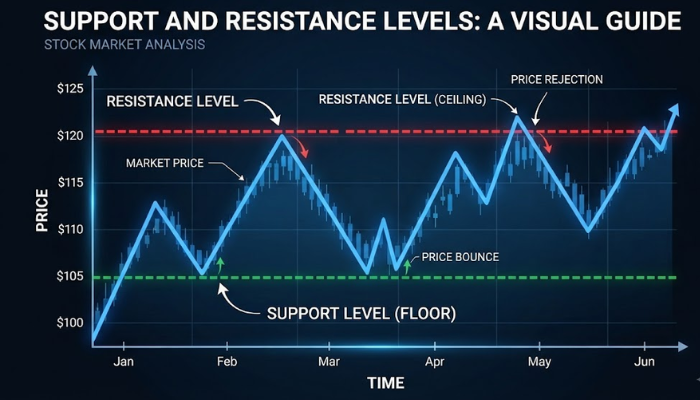
- Support is a price level where buying pressure is strong enough to prevent the price from falling further . Resistance is where selling pressure prevents the price from rising further .
- Traders use these levels to enter and exit trades. Breakouts happen when price moves through these levels .
Trend
A trend shows the overall direction of price movement . An uptrend has higher highs and higher lows. A downtrend has lower highs and lower lows. A sideways trend moves within a range .
You May Also Read: Latest Trading Strategies 2026: Best Profitable Trading Guide
Leverage and Margin Terms
Leverage
- Leverage lets you control a large position with a small amount of money . It amplifies both gains and losses .
- Example: With 1:100 leverage, 1000 rupees controls 100,000 rupees worth of currency . A 1% price move gives a 100% gain or loss on your invested money.
Margin
Margin is the money you need to open a leveraged position . It is a deposit, not a fee . If your margin drops below the required level, you get a margin call .
Margin Call
A margin call happens when your account equity falls below the required margin . The broker asks you to deposit more money. If you do not, they may close your positions automatically .
Free Margin
Free margin is the amount available to open new positions . It is the difference between your equity and used margin.
Margin Level
- Margin level is equity divided by margin, expressed as a percentage .
- Example: If equity is 10,000 and margin used is 1,000, margin level is 1000%.
Risk Management Terms
Drawdown
Drawdown is the decline in account value from its peak . It measures how much you have lost from your highest point. Large drawdowns are a sign of high risk.
Slippage
Slippage happens when your trade fills at a worse price than expected . This often occurs during high volatility or major news events. The price moves too fast and "slips" through your desired level .
Volatility
Volatility measures how fast and how much price moves . High volatility means big swings. This offers more profit potential but also more risk .
Liquidity
Liquidity is how easily you can buy or sell an asset . High liquidity means fast execution and tight spreads. Low liquidity means slower execution and wider spreads .
Hedging
Hedging means opening a position that reduces your risk on another position . It is like insurance against adverse price moves.
Position Sizing
Position sizing means deciding how much to trade. It is a key part of risk management . You never risk more than you can afford to lose.
Technical Analysis Terms
Candlestick
A candlestick shows price movement over a specific time period. It displays the open, high, low, and close prices . Different patterns give clues about future price direction.
Timeframe
Timeframe is the period each candlestick represents . A 1-hour chart shows one hour of price data per candlestick. A daily chart shows one day .
Moving Average (MA)
A moving average calculates the average price over a specific number of periods . It smooths out price action to show the trend. A 50-day MA calculates the average closing price over the last 50 days .
MACD (Moving Average Convergence Divergence)
MACD is a popular indicator that tracks the relationship between two moving averages . It helps identify trends and momentum.
RSI (Relative Strength Index)
RSI measures the speed and change of price movements . It ranges from 0 to 100. Above 70 means overbought. Below 30 means oversold.
Market Participants Terms
Broker
A broker is the intermediary between you and the market. You place your trades through them . They provide the trading platform and execute your orders.
CFD (Contract for Difference)
A CFD lets you speculate on price movements without owning the underlying asset . You can trade forex, stocks, and commodities through CFDs. CFDs use leverage and carry high risk . Approximately 80% of retail accounts lose money trading CFDs .
OTC (Over the Counter)
OTC trades happen directly between two parties . They do not go through a central exchange. Most forex trading is OTC .
Forex Trading Terminology PDF Resources
If you want a forex trading terminology PDF for offline study, here are good options:
- OANDA Glossary - Comprehensive A-Z trading glossary with clear explanations
- CMC Markets Trading Glossary - Plain English explanations of key terms
- Global Prime Trading Glossary - Extensive glossary covering forex and CFDs
- BlackBull Markets Trading Glossary - Detailed glossary with examples
These resources are free and can be saved as PDFs for reference.
Quick Summary: Key Forex Trader Talk Terms
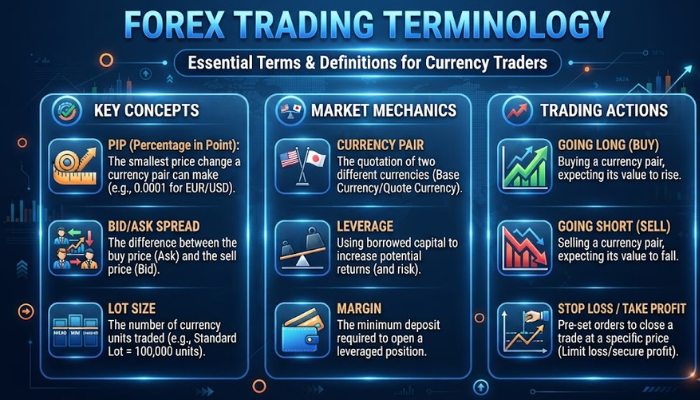
| Term | Simple Meaning |
|---|---|
| Pip | Smallest price movement, usually 0.0001 |
| Spread | Difference between buy and sell price |
| Leverage | Control large positions with small money |
| Margin | Money needed to open a leveraged position |
| Stop-Loss | Closes trade at a set loss level |
| Take-Profit | Closes trade at a set profit level |
| Long | Buy expecting price to rise |
| Short | Sell expecting price to fall |
| Bull | Expecting prices to rise |
| Bear | Expecting prices to fall |
| Support | Price level where buying pressure stops falls |
| Resistance | Price level where selling pressure stops rises |
FAQs
1. What does pip mean in forex trading?
A pip is the smallest price movement in forex. For most pairs, 1 pip is 0.0001. If EUR/USD moves from 1.2000 to 1.2005, that is 5 pips .
2. What is the difference between bid and ask price?
The bid is the price you can sell at. The ask is the price you can buy at. You buy at the ask and sell at the bid. The difference is the spread .
3. What does leverage mean in forex trading?
Leverage lets you control a large position with a small deposit. A 1:100 leverage means you control 100,000 rupees with only 1,000 rupees. It multiplies both profits and losses .
4. What is a stop-loss order?
A stop-loss order automatically closes your trade at a price you set. It prevents you from losing more than you want. It is a vital risk management tool .
5. What does going long and going short mean?
Going long means buying. You profit if the price rises. Going short means selling. You profit if the price falls .
6. What is a margin call?
A margin call is when your broker asks for more money because your account equity has dropped too low. If you do not add funds, the broker can close your positions .