

Best ETFs for Bear Market Investing: A Simple 2026 Guide
When stock markets fall, most investors lose money. But some people actually make money during crashes. They use special tools called bear market ETFs. These are designed to go up when the market goes down. If you are worried about a market crash or want to protect your portfolio, you need to know about these options.
The best ETFs for bear market investing include defensive funds that lose less money and inverse funds that profit from declines. This guide explains both types in simple words. It covers SQQQ for tech bets, SPXS for broad market exposure, and VOO for long-term safety. No complicated terms. Just clear advice to help you survive and profit in any market condition.
Understanding Bear Market ETFs
There are two main types of bear market ETFs. Each works differently.
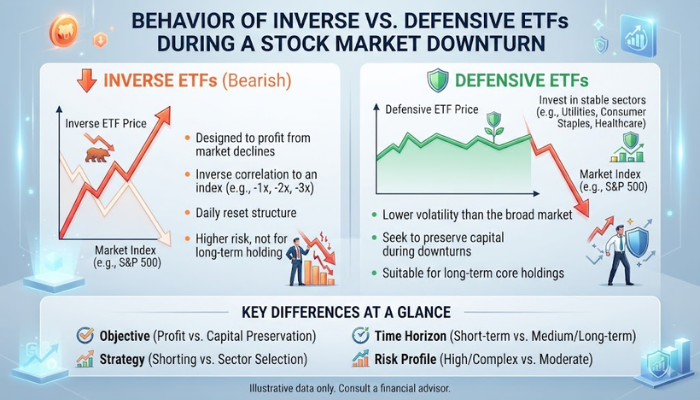
Defensive ETFs
These are regular ETFs that go down less than the market during crashes. They do not go up when the market falls. But they lose less money. They are called defensive because they protect your portfolio from big losses.
Inverse ETFs
These are designed to go up when the market goes down. They move in the opposite direction of the index they track . If the S&P 500 falls 1 percent, a 1x inverse ETF rises about 1 percent. Some inverse ETFs use leverage. A 3x inverse ETF rises 3 percent for every 1 percent the index falls .
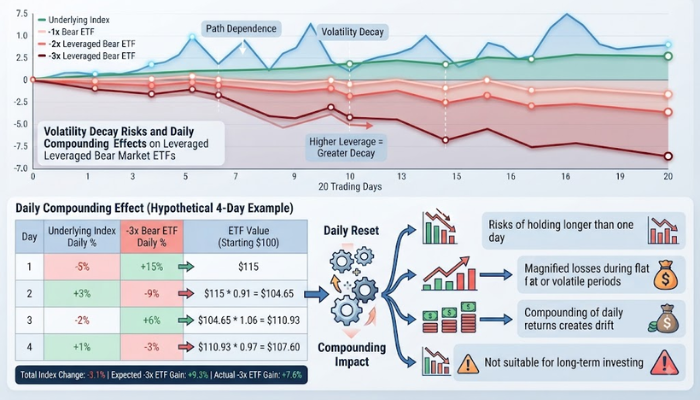
Important warning: Inverse ETFs are designed for daily trading. They reset every day . If you hold them for more than one day, the math of compounding can make your returns different from what you expect . In choppy markets, these ETFs can lose value even if the market does not move much overall .
Read More: Can I Invest in ETFs Every Month? Complete Guide
Best Defensive ETFs for Bear Markets
These are safer options that help you survive a market crash without taking on too much risk.
1. Vanguard Total Bond Market ETF (BND)
This ETF gives you exposure to the entire investment-grade bond market. It includes corporate bonds, Treasuries, and mortgage-backed securities .
- Why it works in a bear market: Bonds often move in the opposite direction of stocks. When stocks fall, bond prices often rise. This ETF provides protection against equity volatility .
- Expense ratio: Low
- Risk level: Moderate - has some interest rate sensitivity
2. Vanguard Consumer Staples ETF (VDC)
This ETF invests in defensive stocks. These are companies that sell everyday products like food, beverages, and household items.
- Why it works in a bear market: People still buy these products even during recessions. This makes consumer staples stocks more stable than other sectors. In 2022, the S&P 500 fell 18 percent, but this ETF fell less than 2 percent .
- Risk level: Still has stock market risk. But it falls less than the broader market during crashes.
3. Vanguard Extended Duration Treasury ETF (EDV)
This ETF invests in long-term government bonds.
- Why it works in a bear market: When the stock market crashes, investors rush to the safety of government bonds. This pushes bond prices up. If the Federal Reserve cuts interest rates during a recession, long-term bond prices can rise significantly .
- Risk level: These bonds are sensitive to interest rate changes. They can be volatile.
Best Inverse ETFs for Bear Markets
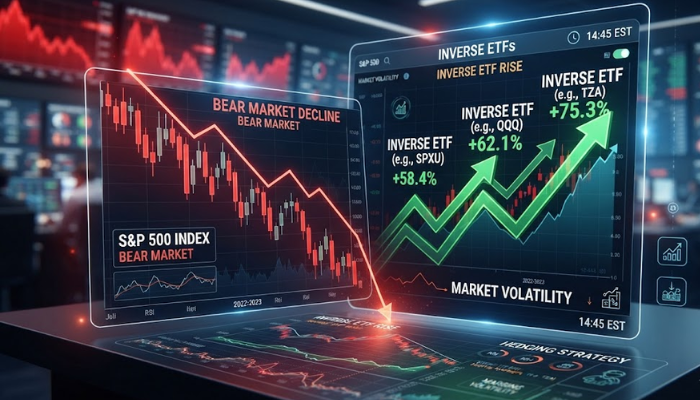
These are for investors who want to profit directly from market declines. They carry much higher risk.
1. ProShares UltraPro Short QQQ (SQQQ)
This is a 3x leveraged inverse ETF. It aims to deliver three times the opposite daily return of the tech-heavy Nasdaq 100 index .
- Best for: Traders with a bearish short-term view on large-cap technology stocks. SQQQ is one of the most widely traded inverse ETFs with about 93 million shares traded daily .
- Expense ratio: 0.95 percent
- Assets under management: ~$2.9 billion
2. Direxion Daily S&P 500 Bear 3X Shares (SPXS)
This ETF aims for 3x inverse daily performance of the S&P 500 Index .
- Best for: Traders who want leveraged downside exposure to the overall U.S. stock market. This is a broad-market bearish bet.
- Expense ratio: 1.04 percent
- Total assets: ~$315 million
- 52-week range: $25.53 to $47.20
- Important: The 3-year return shows the danger of holding. Over the past 3 years, it has lost about 40 percent . This is because markets generally go up over time.
3. Direxion Daily Semiconductor Bear 3X Shares (SOXS)
This ETF provides 3x leveraged daily downside exposure to the semiconductor industry index .
- Best for: Traders who believe AI-related chip stocks are overvalued and due for a correction. Semiconductor stocks have been volatile due to AI spending concerns.
- Average daily volume: ~172 million shares
- Assets under management: ~$1.5 billion
4. Direxion Daily Small Cap Bear 3X Shares (TZA)
This ETF provides 3x leveraged daily downside exposure to the small-cap Russell 2000 index .
- Best for: Traders with a bearish outlook on the U.S. economy. Small-cap stocks are more sensitive to economic conditions.
- Expense ratio: 0.99 percent
- Assets under management: ~$307 million
Specialized Inverse ETFs for Targeted Bets
If you have a strong conviction about specific sectors, these ETFs offer more focused exposure.
1. Direxion Daily Dow Jones Internet Bear 3X Shares (WEBS)
This aims for -3x daily performance of the Dow Jones Internet Composite Index. It includes about 40 internet-focused companies like Amazon and Netflix .
- Expense ratio: 1.07 percent
- Yield: 2.6 percent dividend
2. MicroSectors FANG+ Index -3X Inverse Leveraged ETN (FNGD)
This targets 10 of the biggest tech names, including the FANG stocks plus Nvidia and Alibaba .
- Expense ratio: 0.95 percent
- Risk: Very high - concentrated on just 10 stocks. But these stocks have a major impact on the S&P 500's performance .
Bear Market ETF 3X Options
All 3x leveraged inverse ETFs carry extreme risk. They are only for active traders who understand daily resets.
What 3x means: If the index falls 1% in one day, the 3x ETF rises 3%. But if the index rises 1%, the ETF falls 3%. Losses compound quickly .
Key 3x bear market ETFs:
| ETF | Ticker | Target | Expense Ratio |
|---|---|---|---|
| ProShares UltraPro Short QQQ | SQQQ | -3x Nasdaq 100 | 0.95% |
| Direxion Daily S&P 500 Bear 3X | SPXS | -3x S&P 500 | 1.04% |
| Direxion Daily Semiconductor Bear 3X | SOXS | -3x Semiconductors | 0.97% |
| Direxion Daily Small Cap Bear 3X | TZA | -3x Russell 2000 | 0.99% |
| Direxion Daily Financial Bear 3X | FAZ | -3x Financials | 1.08% |
Bear Market ETFs for Buy and Hold Investors
Most buy-and-hold investors should avoid inverse ETFs entirely . But there are better ways to prepare for a bear market.
Vanguard S&P 500 ETF (VOO)
This tracks the 500 largest U.S. companies. It has delivered average annual returns of 15 percent over the past 16 years .
- Why it works during bear markets: The S&P 500 is more diversified than the Nasdaq. In 2022, the Nasdaq fell 32.4 percent while the S&P 500 fell only 18.2 percent . VOO is a good way to own the market without taking on excessive tech concentration risk.
- Expense ratio: 0.03 percent
Vanguard Total Stock Market ETF (VTI)
This includes the entire U.S. stock market - over 3,000 additional mid and small-cap stocks beyond the S&P 500 .
Expense ratio: 0.03 percent
Vanguard Total International Stock ETF (VXUS)
This gives exposure to over 8,700 non-U.S. stocks. International stocks can provide diversification when U.S. markets fall .
Expense ratio: 0.05 percent
Schwab U.S. Dividend Equity ETF (SCHD)
This focuses on financially healthy companies with strong dividend histories. Dividends provide income that can offset share price losses in down markets .
- Dividend yield: 3.3 percent
- Expense ratio: 0.06 percent
You May Also Read: Best ETF for Retirement: Top Funds to Buy and Hold
Important Risks of Inverse ETFs
1. Daily Reset Problem
Inverse ETFs are designed for daily performance. If you hold for longer periods, results can differ from expectations . Volatility decay can erode value in sideways markets.
2. Compounding Losses
In a volatile market, even if the index ends flat, an inverse ETF can lose value due to daily reset .
3. High Expense Ratios
Most inverse ETFs charge 0.95 to 1.07 percent expense ratios . This is much higher than normal ETFs.
4. Derivatives Risk
These funds use futures and swaps. Counterparty risk exists . Fund managers handle the complicated trading .
5. Not for Everyone
Financial advisors strongly warn that inverse ETFs are for experienced traders only. They are not suitable for long-term wealth building .
Are Inverse ETFs Available in India?
- No. As of 2026, inverse ETFs are not permitted in India. SEBI has not approved these products for trading on NSE or BSE .
- SEBI is concerned about market stability and the risk of increased volatility . Indian investors do not have access to these products.
- But defensive ETFs and broad-market index funds are available in India. These can help you manage bear market risk.
Quick Summary Table
| ETF Type | Examples | Best For | Risk Level |
|---|---|---|---|
| Defensive Bond | BND, EDV | Protecting against market drops | Low-Moderate |
| Defensive Stock | VDC | Less severe losses in crashes | Moderate |
| Broad Market | VOO, VTI, VXUS | Long-term buy and hold | Moderate |
| Dividend Focus | SCHD | Income to offset losses | Moderate |
| 1x Inverse | Various | Short-term bearish bets | High |
| 2x/3x Inverse | SQQQ, SPXS, SOXS | Active short-term trading | Extreme |
FAQs
1. What is a bear market ETF?
A bear market ETF is designed to help you during market declines. Defensive ETFs lose less than the market. Inverse ETFs actually go up when the market goes down .
2. Are inverse ETFs good for beginners?
No. Financial advisors strongly recommend against inverse ETFs for casual investors. They are for experienced traders who understand daily resets and volatility .
3. What is the best inverse ETF for a bear market?
Popular options include SQQQ for tech exposure, SPXS for broad market exposure, and SOXS for semiconductor exposure. But all carry high risk .
4. Can I hold inverse ETFs for the long term?
No. Inverse ETFs reset daily. Long-term holding can lead to unpredictable returns due to volatility decay .
5. What should a beginner buy during a bear market?
Beginners should stick to broad index ETFs like VOO or VTI. These are low-cost and diversified. During the 2022 bear market, VOO fell only 18 percent while the Nasdaq fell 32 percent .