

Stock Investing Strategies for Small Investors: How to Start with Little Money
Small investors face a simple problem. You want to grow your money. But you do not have a big lump sum. You worry about losing what little you have. This guide gives you real stock investing strategies for small investors.
You will learn how to start with little money. You will see the four main investment strategies. You will also learn the truth about earning daily income from the stock market without risk. No complicated jargon just clear steps that work for your budget. Read this guide start small, stay consistent build wealth over time.
Start With What You Have
You do not need lakhs to begin. You can start with one share. Or even a fractional share on some platforms . The minimum amount depends on the stock price you want to buy. But brokers and experts suggest investing at least 5,000 to 10,000 to keep transaction costs from eating your returns .
If you have less, start with mutual funds or ETFs. SIPs in mutual funds can start at 500 per month . This gives you instant diversification without needing to pick individual stocks.
Read More: What Is Market Capitalization in Stocks? Formula, Examples and Types
What Are the 4 Investment Strategies?
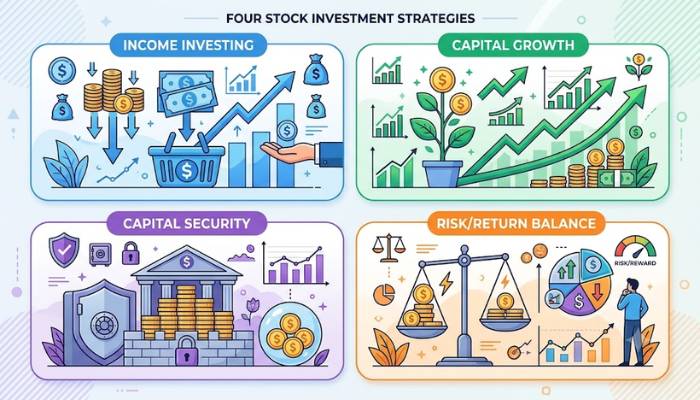
Most investing approaches fall into four broad styles. Understanding them helps you pick what fits your personality and goals.
- Income Investing: You focus on assets that pay you regularly. Dividend stocks. Bonds. REITs. The goal is steady cash flow, not big price jumps. This suits people who need regular income .
- Capital Growth: You buy assets that can increase in value over time. Growth stocks. Emerging market funds. You accept more risk for higher potential returns. This works if you have a long time horizon and can handle ups and downs .
- Capital Security: You prioritize protecting your money. Government bonds. High-quality corporate bonds. Stable securities. You accept lower returns to avoid losses. This suits conservative investors or those nearing retirement.
- Risk/Return Balance: You mix assets to balance risk and reward. Some growth. Some safety. This is the most common approach for everyday investors. You tailor the mix to your comfort level .
How to Start Investing in Stocks with Little Money?
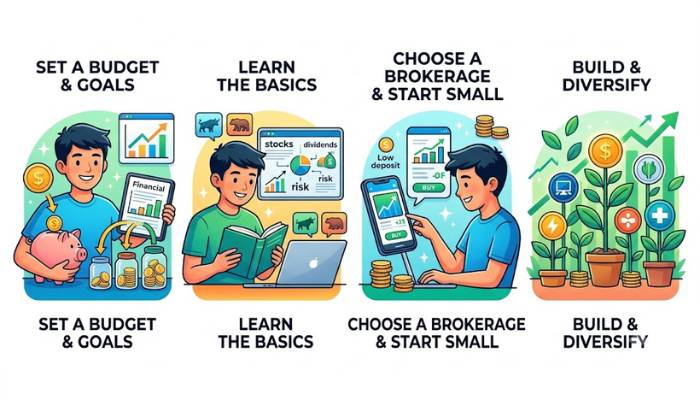
Here is a simple plan for small investors.
Use a Stock SIP
- A stock SIP means investing a fixed amount into selected shares at regular intervals. Monthly. Automatically. This removes the emotional decision of when to buy .
- Why it works: You buy when prices are high. You also buy when prices are low. Over time, your average cost evens out. You do not need to time the market .
How to do it: Pick three to five large, stable companies. Think banks, IT firms, or consumer companies. Set a fixed date each month. Automate the purchase. Do not check prices daily .
Keep Your Portfolio Small and Boring
A common beginner mistake is buying 15 or 20 stocks based on tips. This leads to confusion and poor monitoring. Start with just three to five high-quality companies. These are not exciting stories. But they are more forgiving if you make a timing mistake .
Use the 100 Minus Age Rule
This simple rule helps you decide how much to put in stocks. Subtract your age from 100. That is the percentage you can put in equities. If you are 30, put 70% in stocks and 30% in safer options like bonds .
Consider the X/3 Strategy
Split your investment into three parts. Invest one part now. Add another when the market drops. Make the last investment after a closer look. This step-by-step method reduces the risk of putting all your money in at the wrong time.
How to Become an Investor in Startups?
- Angel investing is very different from stock market investing. It is high risk. Most startups fail. But it can offer high returns if you pick a winner .
- The rules are strict. SEBI requires angel investors to have net tangible assets of at least 2 crore (excluding your home). You also need early-stage investment experience, or serial entrepreneur experience, or ten years as a senior management professional. You must invest a minimum of 25 lakh over five years through an Angel Fund .
This is not for small investors. It is for wealthy individuals who can afford to lose their entire investment. If you are curious, start by building your network and learning about sectors you understand. But do not put in money you cannot afford to lose .
The Truth About Earning Money Daily Without Risk
You have seen ads promising daily income from the stock market with no risk. This is a lie.
- No strategy eliminates risk. Markets go down. Stocks fall. Even the safest bonds carry some risk. Anyone promising "daily income without risk" is trying to sell you something. Probably a course. Or a trading bot. Or a scam.
- The closest thing to low-risk income is dividends from stable companies. Or interest from government bonds. But these pay monthly or quarterly, not daily. And they still carry some risk.
If someone guarantees daily profits, walk away. That is not investing. That is a trap.
Quick Summary Table
| Strategy | What It Means | Best For |
|---|---|---|
| Income Investing | Dividend stocks, bonds for regular cash | Retirees, income seekers |
| Capital Growth | Growth stocks for long-term appreciation | Young investors, long horizon |
| Capital Security | Government bonds, stable assets | Conservative investors |
| Risk/Return Balance | Mix of growth and safety | Most everyday investors |
| Stock SIP | Fixed amount monthly into few stocks | Beginners with small budgets |
FAQs
1. What are the 4 investment strategies?
Income investing (regular cash), capital growth (long-term appreciation), capital security (protecting money), and risk/return balance (mixing risk and safety). Most small investors should start with a balanced approach .
2. How to start investing in stocks with little money?
Start with a stock SIP. Pick three to five stable companies. Invest a fixed amount monthly. Automate it. Or start with a mutual fund SIP from 500 per month. Do not try to time the market .
3. How to become an investor in startups?
Angel investing requires SEBI compliance. You need 2 crore in net tangible assets. You need relevant experience. You must invest at least 25 lakh through an Angel Fund. This is not for small investors .
4. Can I earn money daily from the stock market without risk?
No. Anyone promising this is lying. All investing carries risk. The closest to low-risk income is dividends or bond interest. But these are not daily and not risk-free.
5. How much money do I need to start?
You can start with one share. But experts suggest 5,000 to 10,000 to keep costs low. Mutual fund SIPs start at 500 per month .
6. What is a stock SIP?
A stock SIP means investing a fixed amount into selected shares at regular intervals. It automates buying and removes emotional decisions. It averages your purchase cost over time .
7. Should I pick many stocks or few?
Few. Start with three to five high-quality companies. Too many stocks lead to confusion and poor monitoring. Keep it simple and boring .
8. What is the 100 minus age rule?
Subtract your age from 100. That is the percentage you can put in stocks. If you are 30, put 70% in equities and 30% in safer options. It balances risk as you age .