
What Documents Required for Buying a House? Complete Checklist 2026
Buying a house is one of the biggest financial decisions you will ever make. One missing paper can turn your dream home into a legal nightmare. That is why knowing what documents required for buying a house is the most important step before you pay any money.
In India, property transactions involve many legal papers. Builders, sellers, and banks all ask for different documents. If you do not check them carefully, you could face disputes, fines, or even lose your money.
This guide covers all the property documents list you need. Whether you are buying a flat from a builder or a resale property, we explain each document in simple language. Use this as your ownership proof documents list and property ownership proof documents list.
Why Checking Documents Matters?
Every year, many buyers face legal trouble because they did not verify the papers. A property might have a bank loan against it. The builder might not have the proper approvals. The seller might not have clear ownership. All these problems come to light only when you check the paperwork.
The new property registration rules in India now make five documents mandatory for any legal sale: Aadhaar card, PAN card, property documents, utility bills, and property valuation certificate . These reforms aim to make property transactions safer for buyers.
But these are just the basics. You need to check many more documents to be fully protected.
Read More: Real Estate Terminology A to Z: Complete Buyer Guide
The Essential Documents Checklist
Here is the complete property documents list you must verify.
1. Sale Deed
The sale deed is the most important document. It is the legal proof that ownership has been transferred from the seller to you . Without this, you do not legally own the property.
What to check:
- The seller's name matches the property records
- The property description is correct
- It is registered at the sub-registrar office
- There are no missing pages or corrections
The sale deed must be registered with the local sub-registrar office to be legally valid .
2. Title Deed
The title deed establishes who owns the property . It is not the same as the sale deed. The sale deed is the transfer paper, while the title deed is the ownership proof.
Why it matters: The seller must have a clear and marketable title. This means there are no competing claims, disputes, or liens on the property . If the title is not clear, you could lose the property later.
3. Mother Deed
The mother deed traces the property's ownership history. It shows the chain of ownership from the original owner to the current seller .
What to check:
- There is no break in the ownership chain
- All previous transfers were legal
- There is no dispute mentioned in past records
Banks require the mother deed before giving a home loan. It protects you from future ownership disputes .
4. Encumbrance Certificate (EC)
The encumbrance certificate shows if the property has any loans, mortgages, or legal cases against it . It is proof that the property is clean and free from financial liabilities.
Where to get it: The sub-registrar office issues this certificate . You should check the EC for at least the last 30 years.
If there is a loan on the property and the seller has not repaid it, the bank can take the property away from you. The EC protects you from this risk.
5. Builder-Buyer Agreement
When buying a flat from a builder, the builder-buyer agreement is a critical document . It contains all the terms of the purchase.
What to check:
- Possession date
- Payment schedule
- Penalty for delay
- Carpet area mentioned clearly
- Any extra charges
Read this agreement carefully before signing. Many buyers face problems because they did not understand the hidden clauses.
6. Building Plan Approval
Every construction must have approval from the local municipal authority . The approved building plan confirms that the construction follows building rules and zoning laws.
What to check:
- The actual construction matches the approved plan
- The plan is signed by the municipal authorities
- There is no deviation from the sanctioned plan
If the building plan is not approved, the construction is illegal. The authorities can order demolition.
7. Commencement Certificate (CC)
The commencement certificate is the document that allows the builder to start construction . It is issued by the local authority after the building plan is approved.
Without this certificate, the builder cannot legally start construction. This is an important document to check before booking a flat in an under-construction project.
8. Completion Certificate
The completion certificate is issued after the construction is finished . It confirms that the building is built according to the approved plan and follows all safety rules.
Why it matters: Without a completion certificate, the building is considered unauthorised. You may face legal issues, fines, or even eviction .
9. Occupancy Certificate (OC)
The occupancy certificate is the final document that allows you to move into the flat . It is issued by the local municipal authority after the building is complete and safe for living.
What to check:
- The certificate is recent
- It covers your specific flat
- It is issued by the correct authority
Without an occupancy certificate, the property is not legally habitable. You will not get water, electricity, or gas connections.
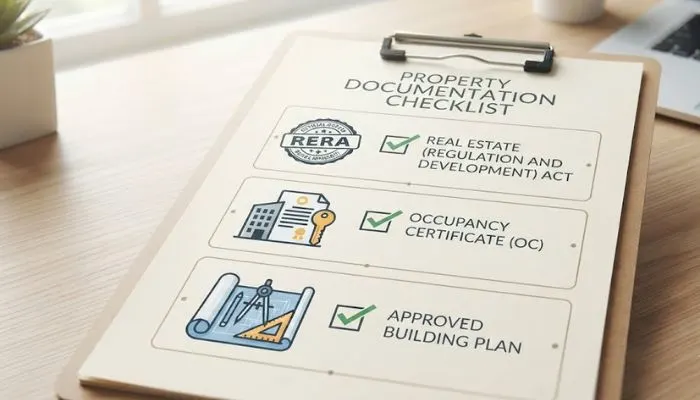
10. RERA Registration
RERA is the Real Estate Regulatory Authority. Every project must be registered with RERA . If a project is RERA registered, the builder has to follow strict rules.
What to check:
- The RERA registration number is valid
- The project details match the RERA portal
- There are no complaints against the project
You can check the RERA number on your state's RERA website. Do not buy in a project that is not RERA registered.
11. Khata Certificate
The khata certificate is a government-recognised property document . It is used for tax purposes and registering the property with local authorities.
What to check:
- The property details match
- The khata is in the seller's name
- The khata is active and valid
A valid khata certificate proves the property's legal status. You need it for electricity, water, and other connections .
12. Allotment Letter
The allotment letter is given by the developer when you book a flat in an under-construction project . It confirms that you have been allotted a specific unit.
What to check:
- Unit number and size
- Payment schedule
- Extra charges mentioned
Banks ask for the allotment letter when giving a home loan .
13. No Objection Certificates (NOCs)
NOCs are certificates from various government departments . They confirm that the property follows all rules.
NOCs needed:
- Fire safety department
- Water supply board
- Electricity board
- Environment department
- Development authority
Missing NOCs can cause legal and safety problems later .
14. Property Tax Receipts
The latest property tax receipts show that the seller has paid all dues . If there are pending taxes, you will have to pay them.
What to check:
- All taxes are paid up to date
- The receipts are in the seller's name
- There are no disputes on tax payments
Unpaid taxes can delay the property registration and lead to penalties.
15. Mutation Records
Mutation means updating the property ownership records in the government database . The mutation records show that the property is registered in municipal or land records.
The terminology varies by state. In some states, it is called 7/12 extract or property card.
16. Conversion Certificate
If agricultural land has been converted for residential or commercial use, you need a conversion certificate . Without this, the construction is unauthorised and can be demolished.
17. General Power of Attorney (GPA)
When the property is sold by an attorney or representative, check the power of attorney . This document proves that the person selling has the legal authority to do so.
What to check:
- The GPA is registered
- It is valid and current
- The seller's name matches
You May Also Read: Best Real Estate Apps for Buyers in India 2026
Documents for Home Loan
Banks ask for many documents before approving a home loan. Here is the list :
Identity proof:
- Aadhaar card
- PAN card
- Passport or driving licence
Income proof:
- Last 6 months salary slips
- Last 2 years income tax returns
- Bank statements for 6 months
Property documents:
- Sale agreement
- Builder-buyer agreement
- Allotment letter
- RERA registration
- Title documents
Other documents:
- Loan application form
- Passport size photos
- Proof of down payment
Key Documents to Check Before Buying Flat from Builder
When buying from a builder, focus on these documents:
| Document | Why It Matters |
|---|---|
| RERA Registration | Project is legal and regulated |
| Building Plan Approval | Construction follows rules |
| Commencement Certificate | Builder can start construction |
| Builder-Buyer Agreement | Terms of purchase are clear |
| Completion Certificate | Building is complete and safe |
| Occupancy Certificate | You can legally move in |
| Encumbrance Certificate | No loans or claims on property |
| Title Deed | Clear ownership |
| Mother Deed | Ownership history |
| NOCs | All approvals are in place |
For Resale Properties
If you are buying a resale property, check these additional documents:
- Previous sale deed from the seller's purchase
- Property tax receipts for all years
- Encumbrance certificate for 30 years
- Mutation records showing ownership
- No dues certificate from the housing society
- Electricity and water bills showing no pending dues
FAQs
1. What documents do I need to check before buying a flat?
You must check the sale deed, title deed, mother deed, encumbrance certificate, building plan approval, completion certificate, occupancy certificate, RERA registration, and NOCs .
2. What is the most important document when buying a property?
The sale deed is the most important. It proves the transfer of ownership from the seller to you .
3. Do I need to check documents if buying from a reputed builder?
Yes. Even reputed builders can have issues. Always verify all documents yourself .
4. What is a mother deed?
It is the document that traces the ownership history of the property from the original owner to the current seller .
5. What is an encumbrance certificate?
It is a document that shows if there are any loans, mortgages, or legal cases on the property .
6. Why is the occupancy certificate important?
The OC proves that the building is safe for living. Without it, you cannot get electricity, water, or gas connections .
7. What happens if a property does not have RERA registration?
The project is illegal. You have no legal protection. Do not buy .
8. Can I buy a property without a completion certificate?
No. Without a completion certificate, the building is unauthorised. You may face legal issues .
9. How do I get an encumbrance certificate?
You can get it from the sub-registrar office where the property is registered .
10. Is a khata certificate mandatory?
Yes. It proves the property's legal status. It is needed for tax purposes and to get utility connections .