

Rental Property Depreciation Tax Benefits: A Simple Guide
Owning a rental property comes with a big tax advantage that many landlords miss. It is called depreciation. You can deduct a portion of the property's cost every year from your rental income. This lowers your taxable income and puts more money in your pocket. The best part? You do not need to spend any cash to claim it. It is a paper deduction.
This guide explains rental property depreciation tax benefits in plain words. We cover what is depreciation of rental property and how to calculate depreciation on rental property IRS rules. We also explain the rental property depreciation income limit and how a rental property depreciation tax benefits calculator works.
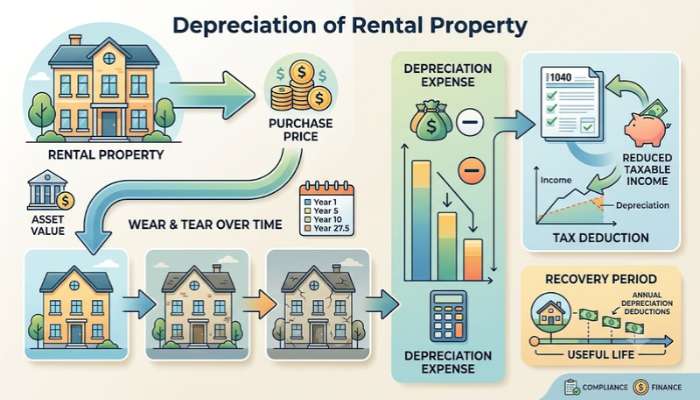
What is Depreciation of Rental Property?
Depreciation is the wear and tear on a property over time. Buildings age. Roofs weaken. Appliances break down. The tax law lets you deduct this loss in value as a business expense.
You cannot depreciate land. Land does not wear out. You can only depreciate the building and the assets inside it.
To claim depreciation, the property must meet four tests. You must own it. You must use it for income. It must have a useful life of more than one year. And you must be the one who placed it in service .
Read More: How to Calculate Total Homeownership Costs: A Complete Guide
How to Calculate Depreciation on Rental Property (IRS Rules)
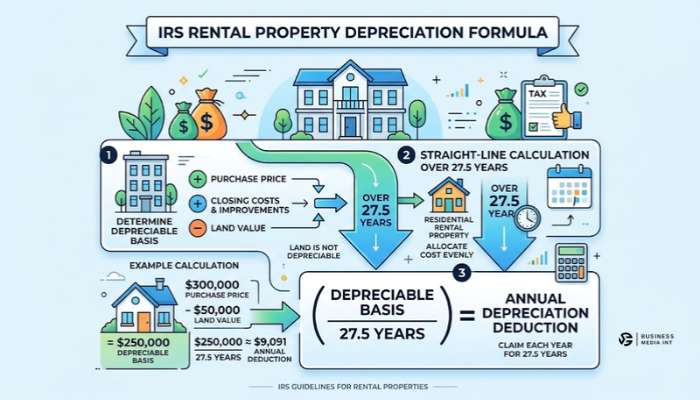
The IRS uses a system called MACRS. For residential rental property, the rules are simple.
The formula:
Depreciable Basis ÷ 27.5 years = Annual Depreciation
The depreciable basis is not the full purchase price. You must subtract the land value. You also add certain closing costs and improvements.
- Example:
You buy a rental property for $500,000. The land is valued at $150,000. You pay $12,000 in closing costs. You spend $28,000 on improvements. - Your depreciable basis is:
$500,000 + $12,000 + $28,000 – $150,000 = $390,000 - Your annual depreciation is:
$390,000 ÷ 27.5 = **$14,181 per year** - The 27.5-year period applies to residential rental buildings. Appliances, carpets, and furniture are depreciated over 5 years. Roads and fences take 15 years .
Important: You start depreciating when the property is "placed in service." That means the date it is ready and available for rent. Not the date you bought it .
Rental Property Depreciation Income Limit
Here is the catch. Depreciation often creates a tax loss. Your expenses (including depreciation) may be more than your rental income. This is called a passive loss.
The IRS limits how much of this loss you can use to offset other income, like your salary.
The $25,000 Allowance:
If you actively participate in managing the property, you can deduct up to **$25,000 of rental losses against your non-passive income .
The Phaseout:
This $25,000 benefit shrinks as your income rises.
-
At modified adjusted gross income (MAGI) of **$100,000 or below**, you get the full $25,000.
-
At **$135,000**, the allowance drops to about $7,500.
-
At $150,000 or above, the allowance is gone entirely .
If you are married filing separately, the maximum is $12,500, and the phaseout range is $50,000 to $75,000 .
What happens to the disallowed loss?
It is not lost forever. It is suspended and carried forward. You can use it in future years when you have passive income, or when you sell the property.
Rental Property Depreciation Tax Benefits Calculator
You do not need expensive software. You can build a simple calculator yourself.
- Step 1: Find your depreciable basis.
Purchase price + closing costs + improvements – land value. - Step 2: Divide by 27.5.
This gives your annual depreciation. - Step 3: Check your income.
If your MAGI is under $100,000, you can likely use the full $25,000 loss allowance. If it is higher, apply the phaseout. - Step 4: Calculate your tax savings.
Multiply the allowed depreciation by your tax rate.
Example:
- Depreciation = $14,181. Tax rate = 24%. Tax savings = $3,403 per year.
- Over 10 years, that is over $34,000 in tax savings. And you did not spend a single rupee to get it.
- Many online calculators do this math for you. But always check the inputs. The land value and basis are the most common errors.
You May Also Read: Real Estate Investment Strategies for Beginners: Complete Guide
Other Things to Know
Different assets, different lives.
The building is 27.5 years. But appliances, carpeting, and furniture are 5-year property. Land improvements like fences and parking lots are 15-year property. A cost segregation study can reclassify some building components into shorter-lived assets. This gives you bigger deductions in the early years.
Repairs vs improvements.
A repair keeps the property in normal working condition. You deduct it in the year you pay. An improvement adds value or extends the life. You must depreciate it over time.
Depreciation recapture.
When you sell, the IRS takes back some of the benefit. The depreciation you claimed is taxed at a maximum rate of 25%. This is called unrecaptured Section 1250 gain. Plan for this when you sell.
Common Mistakes to Avoid
1. Depreciating Land
Land never depreciates. If you include land value in your basis, you will overstate your deductions. The IRS can penalize you later .
2. Using the Purchase Date
Depreciation starts when the property is ready for rent. If you buy in March but rent it out in June, you start in June .
3. Confusing Repairs with Improvements
A repair keeps the property in working order. It is deductible now. An improvement adds value or extends life. It must be capitalized and depreciated over time .
4. Forgetting Depreciation Recapture
When you sell, the IRS taxes the depreciation you claimed. This is called unrecaptured Section 1250 gain. It is taxed at up to 25%. You cannot escape it. But you can plan for it .
FAQs
1. What is depreciation of rental property?
It is a tax deduction for the wear and tear on your rental building. You deduct a portion of the property's cost each year. It lowers your taxable rental income without costing you cash.
2. How long do I depreciate a residential rental property?
Under IRS rules, residential rental property is depreciated over 27.5 years using the straight-line method .
3. Can I depreciate the land?
No. Land is not depreciable. You must subtract the land value from your basis before calculating depreciation .
4. What is the rental property depreciation income limit?
If you actively participate, you can deduct up to **$25,000** in rental losses against other income. This benefit phases out between $100,000 and $150,000 of modified adjusted gross income .
5. How do I calculate depreciation on rental property IRS?
Use this formula: (Purchase price + closing costs + improvements – land value) ÷ 27.5 = annual depreciation .
6. What happens to my depreciation deduction when I sell?
You must pay tax on the depreciation you claimed. This is called depreciation recapture. It is taxed at a maximum rate of 25% .
7. Do appliances have a different depreciation period?
Yes. Appliances, carpets, and furniture used in a rental are depreciated over 5 years under MACRS .
8. Can I use a calculator to estimate my depreciation tax savings?
Yes. Multiply your annual depreciation by your marginal tax rate. For example, $14,181 × 24% = $3,403 in annual tax savings. Many online tools do this for you.