

Real Estate Terminology A to Z: Complete Buyer Guide
Buying a property can feel like learning a new language. Builders, brokers, and bankers throw around words that sound complex and confusing. If you do not understand this real estate terminology, you might sign papers you regret later. This is why every buyer must learn the basics before visiting any site. Our simple guide covers real estate terminology for beginners in plain, everyday language.
We have created a complete real estate terminology list from A to Z, so you never feel lost in a meeting. Consider this your personal real estate terminology sheet. We explain every real estate terms a-z without any fancy jargon. Once you know these words, you will negotiate better and avoid costly mistakes.
Why Real Estate Terminology Matters?
Real estate jargon is not for showing off. These words have legal and financial meaning. When you sign an agreement, you are bound by these terms. Not knowing them can cost you money. You might pay more than the market rate. You might sign a contract with hidden clauses. You might even lose your deposit.
Learning the real estate terminology helps you ask the right questions. You can negotiate better. You can spot red flags early. It also helps you trust the process. When you know what the agent is saying, you feel in control.
Read More: Best Real Estate Apps for Buyers in India 2026
Important Real Estate Terms You Must Know
Here is a simple real estate terminology list with explanations.
A
- Agreement to Sell
This is a contract between the buyer and the seller. It states the price, payment schedule, and possession date. It is not the final sale deed. It is a promise to sell . - Amenities
These are features that make a property attractive. Examples include swimming pool, gym, garden, and clubhouse. Builders use amenities to charge higher prices . - Amortisation
This is the process of repaying a loan through regular payments. Each payment covers both the principal amount and the interest . - Appreciation
This means an increase in the property value over time. It happens due to market demand, infrastructure development, or location advantages . - Asking Price
This is the price listed by the seller. It is not always the final price. You can negotiate . - Auction
A public sale where the property goes to the highest bidder. The buyer must pay immediately .
B
- Basic Selling Price (BSP)
This is the base rate per square foot listed by the builder. It excludes extra charges like taxes, parking, and clubhouse fees . - Broker
A licensed person who helps buyers and sellers transact. He takes a commission for his service . - Builder-Buyer Agreement
This is the main agreement between you and the developer. It has all terms of the purchase. Read it carefully before signing . - Built-Up Area
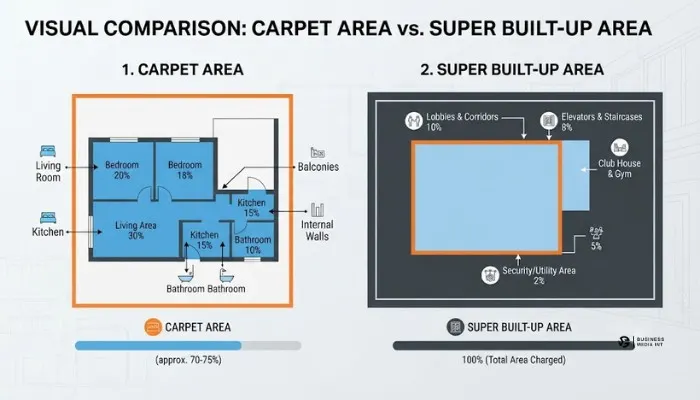
This is the total floor area including the wall thickness. It is more than the carpet area. Builders often quote this to show a bigger size .
C
- Capital Gains Tax
This is the tax you pay when you sell a property at a profit. If you sell within 2 years, it is short-term capital gains. If you sell after 2 years, it is long-term capital gains . - Carpet Area
This is the actual area inside the flat where you can lay a carpet. It excludes walls, balcony, and common areas. RERA mandates that builders must quote the carpet area . - Caveat Emptor
This is a Latin phrase meaning "let the buyer beware." The buyer must verify everything about the property. The seller is not responsible for hidden defects . - Certificate of Title
This is a legal document showing the ownership of a property. It proves that the seller has the right to sell . - Commencement Certificate
This is a document issued by the local authority giving permission to start construction. The builder must have this before beginning work . - Completion Certificate
This is issued after the building is constructed. It confirms that the building follows all safety and construction rules. Without this, the building is not legal . - Conveyance Deed
This is the legal document that transfers the property title from the seller to the buyer. It is the final document of ownership . - CREDAI
Confederation of Real Estate Developers' Associations of India. This is an apex body of real estate developers. It works to create a transparent and organised industry . - Curb Appeal
This is how attractive a property looks from the street. A well-maintained garden and fresh paint increase the curb appeal. It helps in selling the property faster .
D
- Down Payment
This is the initial payment you make when buying a property. It is usually 10-20% of the total cost. The remaining amount is taken as a loan . - Due Diligence
This is the process of checking all aspects of a property before buying. It includes legal checks, physical inspection, and financial verification .
E
- Easement
This is a right to use someone else's land for a specific purpose. For example, a utility company may have an easement to lay pipelines through your property . - EMI (Equated Monthly Instalment)
This is the fixed amount you pay every month to repay your home loan. It includes both principal and interest . - Encumbrance
This is a claim or liability on the property. It could be a mortgage, unpaid taxes, or a legal dispute. An encumbrance certificate proves the property is free from such claims . - Equity
This is the difference between the property value and the outstanding loan amount. If your property is worth 50 lakhs and your loan is 30 lakhs, your equity is 20 lakhs .
F
Freehold Property
This means you own both the property and the land it stands on. You have full ownership. There is no time limit .
H
- HOA (Homeowners' Association)
This is a group of residents in a community. They set rules for the community. They also collect maintenance fees for common areas . - Home Inspection
This is a professional check of the property before buying. The inspector looks for structural issues, plumbing problems, and electrical defects. It helps you avoid costly repairs later .
L
- Leasehold Property
In this type, you own the property for a fixed period, usually 90-99 years. You do not own the land. You must pay ground rent to the landowner . - Loan-to-Value Ratio (LTV)
This is the percentage of the property value that the bank gives as a loan. For example, if the property is worth 50 lakhs and the bank gives 40 lakhs, the LTV is 80% .
M
Mutation
This is the process of updating the property ownership records in the government database. It is mandatory after buying a property .
N
No Objection Certificate (NOC)
This is a document stating that the issuer has no objection to the transaction. For example, if you sell a property, you may need NOC from the housing society .
O
Occupation Certificate
This is a document issued by the local authority allowing you to move into the building. It confirms that the building is safe for living. Without this, the possession is illegal .
P
Possession
This is the date when you get the keys and can move into your property. The builder gives you possession after all payments and legal formalities .
PLC (Preferential Location Charges)
This is an extra charge for flats in a preferred location. For example, a flat facing the garden or park may have PLC. A flat on the corner may also cost more .
R
- Real Property
This is the legal term for land and anything permanently attached to it. This includes buildings, trees, and mineral rights. It does not include movable items . - RERA (Real Estate Regulatory Authority)
This is the government body that regulates the real estate sector. Every project must be registered with RERA. This provides transparency and protects buyers . - Registration Charges
This is the fee you pay to register the property in your name. In India, it ranges from 3-8% of the property value. The rate varies from state to state .
S
- Sale Deed
This is the final document that transfers ownership from the seller to the buyer. It is signed after all payments are made. The sale is not valid until the sale deed is registered . - Stamp Duty
This is a tax paid to the state government for registering the property. It is a percentage of the property value. The rate varies by state . - Super Built-Up Area
This is the built-up area plus the proportionate share of common areas. Common areas include the lobby, stairs, and liftshaft. Builders often quote this to inflate the size. Always ask for the carpet area .
T
- Title Deed
This is the main document proving ownership of a property. It shows the chain of ownership from the original owner to the current owner . - Tripartite Agreement
This is a three-party agreement between the buyer, builder, and bank. It is used when you take a home loan. The agreement defines the rights and obligations of all parties .
U
Undivided Share (UDS)
When you buy a flat, you also own a share of the land on which the building stands. This is called the undivided share of land. You do not have a specific plot; you have a proportionate share of the total land .
V
Valuation
This is the process of estimating the market value of a property. A professional valuer does this. Valuation is needed for loans, insurance, and taxation .
A Quick Comparison Table of Key Terms
| Term | What it Means | Why it Matters |
|---|---|---|
| Carpet Area | Actual area inside the flat (excluding walls) | Tells you the real living space. RERA requires this. |
| Super Built-Up Area | Carpet area + wall thickness + common area share | Builders use this to show bigger size. Compare carpet area. |
| Freehold | Full ownership of land and property | You can sell or transfer without restrictions. |
| Leasehold | Ownership for a fixed time period (90-99 years) | Land belongs to someone else. You pay ground rent. |
| RERA Registered | Project approved by the regulatory body | Ensures builder follows rules. Safe to buy. |
| Encumbrance Certificate | Proof that property has no legal claims | Essential for clear title. Bank requires it. |
Tips for First-Time Buyers
1. Always Ask for Carpet Area
Do not be impressed by big numbers. Builders often quote the super built-up area. Always ask for the carpet area. This is the real size of your home.
2. Verify RERA Registration
Before you book any flat, check if the project is registered with RERA. You can find this on the state RERA website. If the project is not registered, stay away.
3. Read the Agreement Carefully
Do not sign anything in a hurry. Read the builder-buyer agreement slowly. Check the possession date, payment schedule, and cancellation policy. If there are hidden charges, ask for clarity.
4. Do Your Due Diligence
Do not trust the builder blindly. Check the land title. Verify the approvals. Visit the site. Talk to other buyers. This is your hard-earned money. Do not take shortcuts.
5. Get Professional Help
If you do not understand the documents, hire a property lawyer. His fee is small compared to the risk. He will help you avoid legal disputes later.
FAQs
1. What is carpet area?
Carpet area is the space inside your flat where you can keep your things. It does not count the walls. Builders talk about super built-up area because it sounds bigger. But you must ask for carpet area. That is the real size you get. RERA makes builders mention this clearly now.
2. Why check RERA?
RERA is the government body that regulates real estate. Every project needs a RERA number. If a project has RERA, the builder has to give possession on time. If he delays, he pays you a penalty. You can check the RERA number on your state's website. Do not buy without it.
3. Freehold or leasehold?
Freehold means you own the land and building forever. You can sell or gift it anytime. Leasehold means you own the building for a fixed time, usually 99 years. The land belongs to someone else. You pay ground rent every year. Freehold is better but leasehold is common in big cities.
4. What is encumbrance certificate?
This paper shows if there are any loans or cases on the property. It proves the property is clean. Banks need this before giving you a home loan. If there is a loan and the seller has not paid, the bank can take the property. Get this certificate from the sub-registrar office.
5. How much is stamp duty?
Stamp duty is a tax you pay to your state government. You pay it when you register the property. The rate is 3% to 8% of the property value. For a 50 lakh flat at 5%, you pay 2.5 lakhs extra. This is a one-time payment. Save for this from day one.