

Top ETFs to Invest in This Year for Long-Term Growth and Wealth
If you are looking for the top ETFs to invest in this year, you have come to the right place. ETFs are simple baskets of stocks that let you own many companies with one single purchase. They cost very little in fees and give you instant diversification.
This makes them perfect for new investors who do not want to pick individual stocks. The best part is you can start with just 500 rupees. No need to study complex charts or follow market news daily. Just pick a broad market ETF, put money in regularly, and let time do its work. This guide will show you exactly which ETFs to buy and hold for the long run.
What Is An ETF In Simple Words?
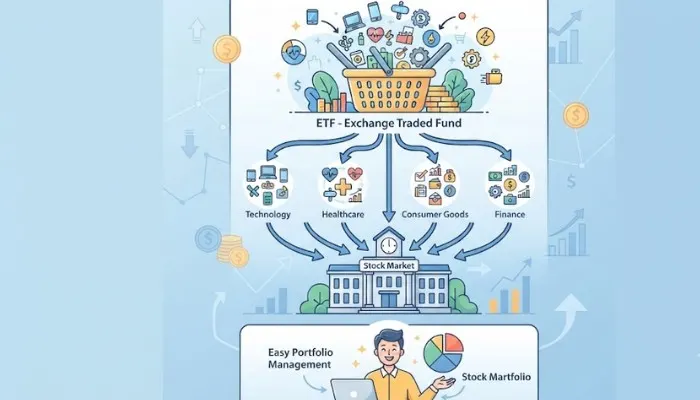
ETF stands for Exchange Traded Fund. Think of it as a basket of stocks. When you buy one ETF, you own a small piece of many companies at once. Instead of buying 50 different company shares, you buy one ETF that holds all 50.
This gives you diversification. If one company does badly, others might do well. Your money does not get wiped out because of one bad decision.
Read More: Best Performing ETFs in India for 10 Years: Top Picks
Why ETFs Are Perfect For Beginners?
The best ETFs to invest in for beginners have three things in common. Low cost. Broad diversification. Simple structure.
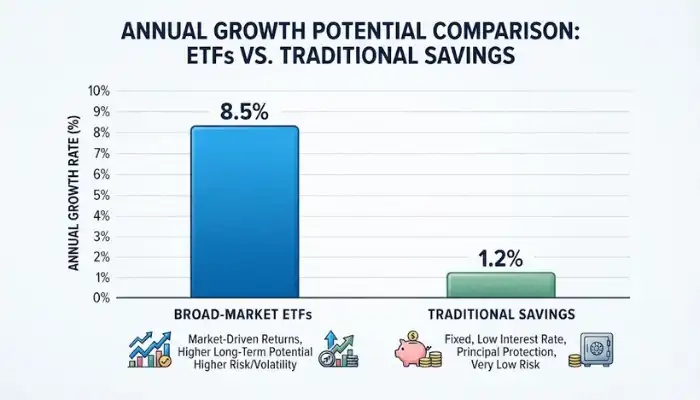
Most ETFs charge very low fees. Some charge just 0.03 percent per year . That means on 10,000 rupees, you pay only 3 rupees in fees each year. Compare this to mutual funds that charge 1 to 2 percent. Over time, those lower fees make a huge difference.
ETFs also give you instant diversification. One fund can hold thousands of companies. The Vanguard Total Stock Market ETF holds about 3700 US companies . You get all of them in one single purchase.
The Best ETFs To Invest In 2026
Here are the top ETFs to invest in this year. I have split them into categories so you can pick what matches your needs.
For US Market Exposure
Vanguard S&P 500 ETF (VOO)
- This is the most famous ETF in the world. It tracks the 500 biggest US companies. Think Apple, Microsoft, Nvidia, Amazon. It recently became the first ETF to reach 1 trillion dollars in assets . That shows how much trust investors have in it.
- The fee is just 0.03 percent. It holds 503 stocks . Over the past 10 years, it gave average annual returns of 15.24 percent . If you want simplicity, this is the one.
Vanguard Total Stock Market ETF (VTI)
- This is like VOO but bigger. It holds the entire US stock market. That means large companies, mid-sized companies, and small companies. It holds about 3700 stocks .
- The fee is also 0.03 percent. If you want maximum diversification in one fund, VTI is better than VOO. It gives you exposure to small companies that VOO does not include.
Invesco NASDAQ 100 ETF (QQQM)
- This tracks the NASDAQ 100 index. That means it holds 100 of the biggest technology companies. It is a cheaper version of the famous QQQ fund .
- In 2026, growth stocks have significantly outperformed value stocks . If you believe technology will keep growing, this fund is worth considering. The fee is 0.15 percent .
For International Diversification
Vanguard Total International Stock ETF (VXUS)
- The US is about 60 percent of the global stock market . If you only invest in US stocks, you are missing 40 percent of the world. VXUS solves this problem.
- It holds about 8600 companies outside the US. These include companies from Europe, Japan, India, China, and Brazil . The fee is 0.05 percent.
- In early 2026, international developed markets actually outperformed the US . This shows why diversification matters. You never know which market will do well.
For Dividend Income
Schwab US Dividend Equity ETF (SCHD)
- This fund holds 100 US companies that pay good dividends. It screens companies for things like dividend history and financial health . Holdings include Coca-Cola, Verizon, and Pfizer.
- In 2026, SCHD is up 18.3 percent so far . The fee is 0.06 percent. The yield is about 3.4 percent. Regular income helps you stay invested during market volatility.
Vanguard High Dividend Yield ETF (VYM)
- This is another excellent dividend option. It holds 608 stocks that pay above-average dividends . The fee is just 0.04 percent.
- What is interesting is that VYM has quietly outperformed the S&P 500 in 2026 so far . This shows that income-focused stocks are doing well this year.
For Technology And Growth
VanEck Semiconductor ETF (SMH)
- Semiconductors are the backbone of AI. And AI is the biggest trend in 2026. Companies are spending billions on AI infrastructure .
- SMH holds the biggest semiconductor companies. These include Micron, Taiwan Semiconductor, and AMD . The fund has grown massively in 2026. It has $73.89 billion in assets .
- Analysts have a Strong Buy rating on this ETF. The average price target implies 16.82 percent upside .
For Stability And Safety
Vanguard Total Bond Market ETF (BND)
- Stocks go up and down. Bonds are usually more stable. When the stock market crashes, bonds often hold their value or even go up .
- BND holds the entire US bond market. This includes government bonds and corporate bonds. The fee is 0.03 percent. The current yield is about 3.9 percent .
- With interest rates at 19-year highs in 2026, bonds are more attractive than they have been in years . A starting point for young investors is 10 to 20 percent in bonds. For older investors, 30 to 50 percent.
You May Also Read: Best Dividend ETFs for Passive Income in India: Complete Guide 2026
Best ETFs To Invest In For Beginners - Indian Market Options
If you are in India, you also have excellent ETF options. Here are some of the best ETFs to invest in for beginners in India.
Nifty 50 ETFs
These track India's top 50 companies. The Nippon India ETF Nifty 50 BeES is a popular choice . It has a low expense ratio of 0.04 percent . This is your core holding for Indian market exposure.
Nifty Next 50 ETFs
These track companies just below the top 50. These companies have growth potential. Some might eventually become Nifty 50 companies. They have higher risk but higher potential returns .
Gold ETFs
Gold ETFs are a good diversifier. Gold performs well during inflation and uncertainty . It does not correlate with stocks. This helps reduce overall portfolio risk.
Best ETFs To Buy And Hold For Long Term
If you want the best ETFs to buy and hold for years, here is my recommendation.
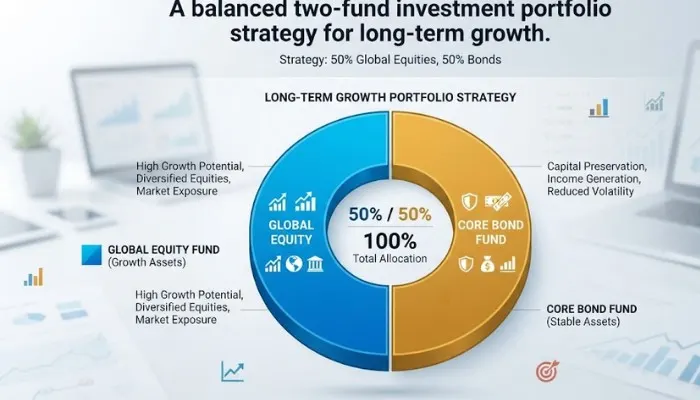
The Two-Fund Portfolio:
- 80 percent VTI (US total stock market)
- 20 percent BND (US total bond market)
This is simple. It is cheap. And it works .
The Three-Fund Portfolio:
- 60 percent VTI (US stocks)
- 30 percent VXUS (International stocks)
- 10 percent BND (Bonds)
This gives you global diversification. You own the entire world's stock market plus some bonds for safety .
The One-Fund Portfolio:
-
100 percent iShares Core 60/40 Balanced Allocation ETF (AOR)
This is the ultimate simple option. It automatically holds 60 percent global stocks and 40 percent global bonds. It rebalances itself. You do nothing .
The only catch is the fee. At 0.15 percent, it costs more than building your own portfolio. But for someone who does not want to manage asset allocation, this is excellent .
Best ETFs To Invest In 2026 For Indian Investors
Indian investors can also use these global ETFs through international brokerages. But there are also excellent Indian options.
- Core Holding: A Nifty 50 ETF like Nippon India ETF Nifty 50 BeES. This gives you exposure to India's biggest companies.
- Growth Option: A Midcap ETF like Nifty Midcap 150 ETFs. These have higher growth potential but higher risk .
- Diversifier: A Gold ETF. This reduces overall portfolio risk.
- Specialty Option: Tech ETFs like ITBEES . These focus on the IT sector. They have higher risk but can give higher returns in a tech boom.
How Much Money Do You Need To Start?
In India, you can start with as little as 500 rupees. In the US, most brokerages allow fractional shares now. You can start with small amounts.
The important thing is not how much you start with. The important thing is that you start and stay consistent.
Common Mistakes Beginners Make
- Mistake 1: Buying Fancy Thematic ETFsThere are ETFs for everything now. AI ETFs. Metaverse ETFs. Crypto ETFs. Most of these have high fees. Most of them underperform the market. Stick with simple broad-market ETFs.
- Mistake 2: Checking Prices Every DayThis makes you emotional. It makes you sell when you should hold. Check your portfolio once a month. That is enough.
- Mistake 3: Trying To Time The MarketNobody knows when prices will go up or down. Even professionals get this wrong. Just invest regularly and hold for the long term.
- Mistake 4: Paying Too Much In FeesSome ETFs charge 0.5 percent or more. Over 20 years, those fees eat up a huge portion of your returns. Always choose low-cost ETFs.
How To Choose The Best ETF For You?
Ask yourself these questions:
- How long can I keep my money invested?
- How much risk can I handle?
- Do I want US stocks, Indian stocks, or both?
- Do I want income from dividends or growth from stock prices?
- Am I comfortable with a simple strategy or do I want to try more advanced things?
Your answers will guide your choice.
Final Summary
The top ETFs to invest in this year are simple, low-cost, and broadly diversified. VOO or VTI for US stocks. VXUS for international. BND for bonds. If you are in India, add a Nifty 50 ETF and maybe a Gold ETF.
The best ETFs to invest in for beginners are boring. They do not make exciting headlines. But they build wealth over time. That is what matters.
The best ETFs to buy and hold are the ones you never sell. Buy them. Hold them. Add more money regularly. That is the entire strategy. It is simple. But simple works.
The best ETFs to invest in 2026 are the same ones that were good in 2020 and will be good in 2030. Low-cost broad-market index funds. Nothing more complicated than that.
Start today. Start small. Stay consistent. Let compounding do its work. That is how you build real wealth with ETFs.
FAQs
1. Are ETFs safe for new investors?
Yes. Your money is spread across many companies. If one company fails, you still have others. In India, SEBI keeps a watch on all ETFs. Your money is kept with a separate bank. Even if the ETF company shuts down, your investments are safe. The only real danger is market going up and down. But over many years, markets always go up.
2. How much money is needed to start?
You can start with just 500 rupees in India. One unit of an ETF costs between 50 and 500 rupees. There is no minimum amount needed. Buy however many units you can pay for. Do not wait to save a big amount. Start with what you have today. Add some money every single month. Even 500 rupees monthly becomes big after 20 years.
3. How are ETFs different from mutual funds?
ETFs are bought and sold during market hours. Price keeps changing all day. Mutual funds are priced only once after market closes. ETFs need no minimum investment. Mutual funds ask for 5000 rupees or more. ETFs have much lower charges. Most ETFs take 0.03 to 0.10 percent. Mutual funds take 0.5 to 2 percent every year. Over time, higher charges reduce your final returns.
4. How to buy ETFs in India?
Open a Demat account and trading account with any broker. Zerodha, Groww, Angel One are good options. Put money from your bank to trading account. Search for the ETF name or symbol. Type how many units you want. Click on buy button. Your order goes through immediately when market is open. Opening an account takes only 15 minutes online.
5. Which ETF is good for long term?
For Indian market, Nippon India ETF Nifty 50 BeES is a top choice. For US market, VOO and VTI are excellent. These track the biggest companies in the country. Charges are very low at 0.03 percent. Keep your money for 10 years or more. Do not sell when prices fall. Add money regularly every month. This simple method has worked for decades.