
Best Intraday Trading Strategies for Beginners: Proven Day Trading Methods
Intraday trading means buying and selling shares on the same day. You do not hold any share overnight. The aim is to make money from the price changes that happen during market hours. Many people think intraday trading is a quick way to earn money. But it is not that simple. It comes with high risk. You need a plan. You need discipline. This guide is for you if you are new and want to know the basics, the rules, the tips, and the best intraday trading strategies.
What is Intraday Trading?
Intraday trading is a way to trade where you buy and sell stocks within the same trading session. All your positions must be closed before the market shuts for the day. You cannot keep them for the next day. The aim is to gain from small price movements in a stock over a few hours or minutes.
When you buy a stock and hold it for years, you are an investor. When you buy and sell on the same day, you are a trader. Intraday trading is short-term. It does not involve the real transfer of shares to your Demat account. You only trade on the price difference.
Read More: What Is the Best Trading Strategy for Beginners? A Complete Guide
How Does Intraday Trading Work?
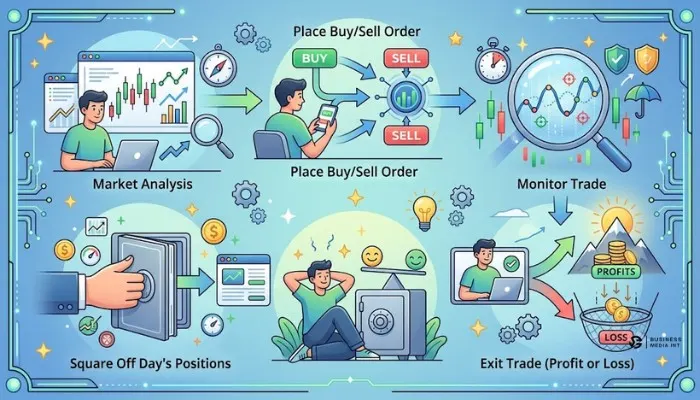
Here is a simple example. You buy shares of Company A at 100 in the morning. By afternoon, the price goes up to 105. You sell your shares. Your profit is 5 per share. If the price falls to 95, you still have to sell to close your trade. You make a loss of 5 per share. The rule is simple: you must close your trade before the market closes.
Brokers give you a margin for intraday trades. Margin is money borrowed from the broker. It lets you trade more than your actual capital. For example, with 10,000, you might be able to buy shares worth 50,000. This is called leverage. Leverage can increase your profit. But it can also increase your loss. That is why trading is risky.
Why Do People Trade Intraday?
People like intraday trading for a few reasons. One reason is the chance to make good money quickly. The stock market moves up and down a lot during the day. Traders try to use these movements to make a profit.
Another reason is no overnight risk. When you hold a share for days or months, news or events after market hours can affect the price the next day. In intraday trading, you close all positions. So, you are safe from the risk of big gaps in price when the market opens the next day.
Brokers also charge lower fees for intraday trades. Since you trade more often, they charge less per trade. Some people also get a feeling of control. They like the fast pace and making decisions quickly.
The Risks of Intraday Trading
It is also important to know the risks. Many new traders lose money in intraday trading. The market is very unpredictable. Prices move fast. You can lose a big portion of your capital if a trade goes against you.
Leverage can be very dangerous. It can multiply your losses just as easily as it multiplies your profits. Some traders also get emotional. They become greedy when they are making money and scared when they are losing. These emotions lead to bad decisions.
A study found that up to 70% of intraday traders face losses. This shows how hard it is. You must be ready for this. Do not trade with money you cannot afford to lose. Start with a small amount. Learn first. Then, if you get better, you can think about trading more.
Simple Rules for Intraday Trading
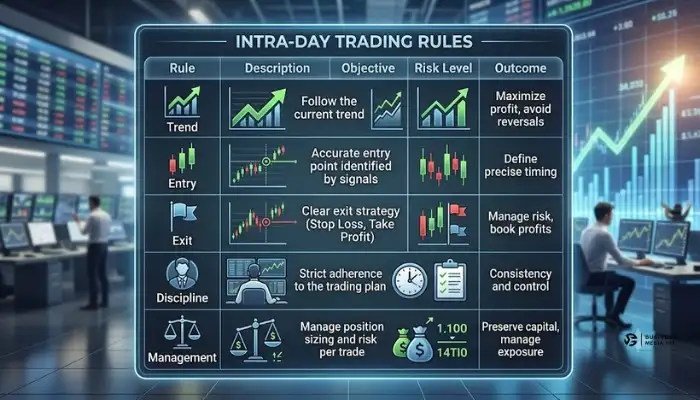
If you are a beginner, you must follow some basic rules. These will protect your money and help you trade in a disciplined way.
Rule 1: Always Use a Stop-Loss
A stop-loss is the most important tool for intraday trading. It is an order you place with your broker to sell a stock if its price falls to a certain level. This limits your loss on that trade.
For example, you buy a stock at 100. You set a stop-loss at 98. If the price falls to 98, the stock is sold automatically. Your loss is only 2 per share. Without a stop-loss, the price could fall much more. You could lose a lot of money.
Rule 2: Trade Only Liquid Stocks
Liquid stocks are shares that are bought and sold in large numbers every day. Large companies usually have liquid stocks. They are easy to buy and sell. You can enter and exit a trade quickly without a big change in price.
Illiquid stocks are hard to trade. There are not many buyers and sellers. If you try to sell, you may not find a buyer. You could get stuck with the stock. This is very risky for intraday trading. Always choose stocks with high trading volume.
Rule 3: Follow the Trend
Do not go against the market trend. If the market is going up, look for buying opportunities. If it is going down, look for selling opportunities. Trading against the trend is like swimming against the current. It is very hard. You will face more losses. Look at the price movement and trade in the same direction.
Rule 4: Have a Target Price
Before you enter a trade, know your exit price. This is called your target price. It is the price at which you will sell to take profit. Do not enter a trade without a clear target. This helps you avoid greed. When the price hits your target, book your profit. Do not hold on for more profit. The market can reverse quickly.
Rule 5: Do Not Overtrade
You do not need to trade every day. You do not need to trade many stocks. Quality is more important than quantity. Focus on one or two stocks. Wait for good opportunities. Many beginners overtrade. They make many trades without a clear plan. This increases their brokerage costs and losses. Be patient. Trade only when you see a good chance.
Rule 6: Close All Positions
This is the basic rule of intraday trading. You must close all your positions before the market closes. If you do not close your trades, the broker will do it for you. They will charge a fee. More importantly, you might face overnight risk. Global events can affect the market after it closes. Always be a trader, not an investor by default.
Best Intraday Trading Strategies for Beginners
A strategy is a plan. It tells you when to enter a trade, when to exit, and how much to risk. Here are a few simple strategies you can start with.
Momentum Trading
Momentum trading means trading in the direction of the strong trend. You look for stocks that are moving up strongly. You buy them and ride the trend. As the trend continues, you make a profit. You exit when the momentum starts to slow down. You can also use this for stocks that are moving down strongly. This strategy works well for beginners because the trend is easy to see.
Breakout Trading
This strategy uses support and resistance levels. A support level is a price where a stock does not fall below. A resistance level is a price where a stock does not go above. When the price breaks above the resistance level, it is a bullish signal. You buy the stock. If the price breaks below the support level, it is a bearish signal. You sell the stock. Mak sure there is high volume when the price breaks out.
Scalping
Scalping is a very short-term strategy. You make many trades in a day. You aim to make a small profit on each trade. You hold a stock for only a few minutes. This strategy needs fast execution and constant attention. It can be tough for beginners because of high stress and transaction costs. It is better to try other strategies first.
You May Also Read: How to Avoid Emotional Trading: Simple Guide for Traders
Simple Tools and Indicators
You do not need to know everything to start. But knowing a few basic tools will help you.
Moving Average
The Moving Average (MA) shows the average price of a stock over a certain time. It smooths out price changes. The 20-day moving average is common. If the price is above the moving average, it is a bullish sign. If the price is below, it is a bearish sign.
RSI (Relative Strength Index)
RSI measures how fast prices are changing. It is a momentum indicator. The RSI goes from 0 to 100. If RSI is above 70, the stock is overbought. This means the price might come down. If RSI is below 30, the stock is oversold. This means the price might go up.
VWAP (Volume Weighted Average Price)
VWAP is important for intraday trading. It gives you the average price of a stock based on volume and price. Big traders use this a lot. If the price is above VWAP, the stock is doing well. It is a good time to buy. If the price is below VWAP, the sentiment is negative. It is a good time to sell or stay away.
Choosing Stocks for Intraday Trading
Picking the right stock is very important. Not every stock is good for intraday trading.
Look for stocks with high liquidity. You can check the volume. High volume means easy entry and exit. Choose large-cap stocks. They are usually liquid.
Check the news. Stocks that react to news can give quick profit chances. But be careful. News can also cause sudden losses. Pick stocks with decent volatility. They should move enough in price to give you a profit. But they should not move so much that you cannot manage the risk.
Final Tips for New Traders
Start small. Do not use all your money on day one. Use a small part of your capital. This limits your losses while you learn. Practice with a demo account first. Many brokers give you a virtual account with fake money. You can try your strategies without any real risk.
Do not get emotional. The market can make you feel greedy or scared. Stick to your plan. Do not make sudden decisions based on feelings. Keep a trading journal. Write down your trades. Note what worked and what did not. This helps you improve.
Learn from your mistakes. You will make mistakes. Every trader does. The key is to learn from them. Do not repeat the same error. Trading is a journey. It takes time and practice to become good.
Intraday trading can give you good returns. But it is not a shortcut to getting rich. It is a serious activity. You need to be disciplined, calm, and patient. Follow the rules. Learn the strategies. Manage your risk. With time and effort, you can become a successful trader.