

Best Performing ETFs in India for 10 Years: Top Picks
ETFs are passive investment funds that track stock market indexes. They are different from mutual funds because they trade on stock exchanges just like shares. You need a demat account and a trading account to buy and sell ETFs.
If you are looking for the best performing ETFs last 10 years in India, Nifty 50 index ETFs have consistently delivered strong returns with expense ratios as low as 0.04%. These funds simply track the Nifty 50 index which contains India's 50 largest companies.
Best Performing ETFs in India for 10 Years
The best performing ETFs in India over the last decade are Nifty 50 index ETFs. These funds track the Nifty 50 index which contains the 50 largest companies in India. The most popular and highest-performing options are:
Nippon India ETF Nifty 50 BeES: This fund has a 5-year return of 88.62% and a 3-year return of 44.26%. It has the highest trading volume which means you can buy and sell without any difficulty. The expense ratio is just 0.04%.
SBI Nifty 50 ETF: This fund manages over 2 lakh crore in assets. Government bodies like EPFO invest here which makes it very safe and stable. It has delivered 82.81% over 5 years.
ICICI Prudential Nifty 50 ETF: This fund has 87.86% returns over 5 years and 48.29% over 3 years. It is known for keeping tracking error very low at 0.02%.
UTI Nifty 50 ETF: This fund has given 83.54% returns over 5 years and 49.04% over 3 years. It has a large asset base which gives it great stability.
Kotak Nifty 50 ETF: This fund has a tracking difference of -0.17% over 10 years. The fund manages 2,558 crore in assets.
SBI BSE Sensex ETF: This fund tracks the BSE Sensex index. It has the lowest tracking difference of -0.08% over 10 years. The fund manages 1,23,085 crore in assets. Since launch, it has given 15.19% CAGR.
Read More: Best Dividend ETFs for Passive Income in India: Complete Guide 2026
What is Tracking Difference and Why It Matters?
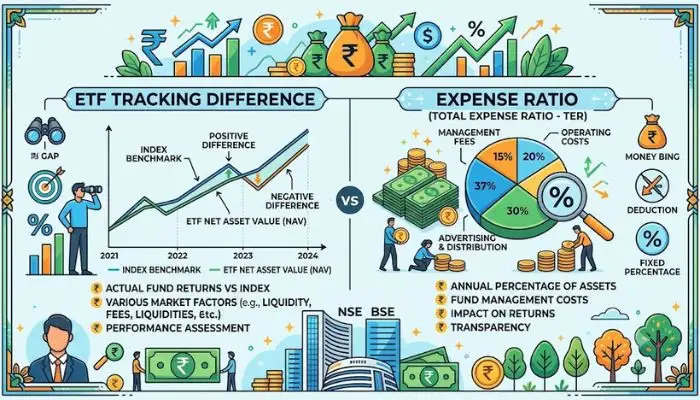
Tracking difference shows the gap between the fund's returns and the benchmark index returns. A negative tracking difference means the fund underperformed its benchmark. For long-term investors, tracking difference matters more than expense ratio.
Lowest Tracking Difference ETFs (10 Years)
| Scheme Name | 10-Year Tracking Difference | AUM (Cr) | Expense Ratio |
|---|---|---|---|
| SBI BSE Sensex ETF | -0.08% | 1,23,085 | 0.04% |
| Aditya Birla Sun Life Nifty ETF | -0.16% | 2,667 | 0.06% |
| ICICI Prudential Nifty 50 ETF | -0.16% | 18,557 | 0.03% |
| Kotak Nifty 50 ETF | -0.17% | 2,559 | 0.04% |
| Nippon India ETF Nifty BeES | -0.17% | 31,055 | 0.04% |
Data as of August 31, 2024
SBI BSE Sensex ETF has the best 10-year tracking difference at -0.08%. This means it closely follows its benchmark. The tracking error is also very low at 0.03.
Top ETFs for SIP in India
SIP allows you to invest a fixed amount every month. Here are the top performing ETFs for SIP based on returns:
Equity Index ETFs
Nippon India ETF Nifty 50: The most liquid ETF with massive trading volume. You can enter and exit easily without price impact. Expense ratio is low at 0.04%. The fund has been around since 2001.
SBI Nifty 50 ETF: Lowest expense ratio among Nifty ETFs at 0.04%. Manages the largest AUM giving it stability. Tracking error is just 0.02%.
ICICI Prudential Nifty 50 ETF: Very efficient tracking with 0.02% tracking error. Competitive expense ratio of 0.03%. The fund launched in March 2013.
UTI Nifty 50 ETF: Largest in size. Handles massive government pension investments. Highly reliable for long-term SIP.
Motilal Oswal NASDAQ 100 ETF: This international ETF tracks the NASDAQ 100. It has given strong SIP returns of 22.47% annualized over 10 years. A 13,333 monthly SIP investment of 15,99,960 grew to 52,46,909.
Mid Cap ETFs
Nippon India ETF Nifty Midcap 150: Has given 164.24% over 5 years. Manages over 2,800 crore in assets. Expense ratio is 0.21%. This fund invests in the next 150 companies after the top 100.
Mirae Asset Nifty Midcap 150 ETF: Has delivered strong growth with low expense ratio of 0.05%. Tracking error is very low at 0.04%. This fund is a cost-effective choice for midcap exposure.
Small Cap ETFs
HDFC Nifty Smallcap 250 ETF: Invests in companies ranked 251-500. Has given 75.98% since inception. Manages over 1,500 crore in assets. This is high risk but high return potential.
Gold ETFs
Gold ETFs have also performed well over 10 years. Most gold ETFs have delivered 14-15% SIP returns. Here are the top gold ETFs:
- LIC MF Gold ETF: 10-year SIP returns of around 15.35%. Expense ratio is 0.32%.
- Aditya Birla Sun Life Gold Fund: 10-year SIP returns of approximately 15.08%.
- Axis Gold Fund: 10-year SIP returns of about 14.84% with 0.17% expense ratio.
- SBI Gold Fund: 10-year SIP returns of around 14.83%. Has one of the lowest expense ratios at 0.10%.
How to Choose the Best ETF?
You should check the tracking difference. A lower negative tracking difference is better. Look for expense ratio below 0.10% for index ETFs. Higher AUM means better liquidity and lower impact cost. Check the trading volume to ensure easy buying and selling. Consider whether you want to invest in India or international markets.
You May Also Read: Best ETF Categories for Investors Top 10 ETF Funds in India for Long-Term
Benefits of ETF Investing
ETFs have very low expense ratios compared to mutual funds. They provide instant diversification across many companies. You can buy and sell ETFs anytime during market hours. Tracking is transparent since you can see the index performance. There is no exit load. You can start with small amounts. SIP makes it easy to invest regularly.
Risks to Consider
ETFs carry market risk like any equity investment. There is no active management to protect against falls. Tracking error can reduce returns slightly. Currency risk exists in international ETFs. Some ETFs have low liquidity.
Final Recommenations for Long-term Investors
For 10-year investment, choose Nifty 50 ETFs as the core of your portfolio. They have given consistent returns and have the lowest costs. The best options are SBI Nifty 50 ETF, Nippon India ETF Nifty BeES, and ICICI Prudential Nifty 50 ETF. All have expense ratios below 0.05% and track their benchmarks very closely.
For diversification, add Midcap 150 ETFs like Nippon India ETF Nifty Midcap 150. These have given higher returns over 5 years at 164%. For international exposure, consider Motilal Oswal NASDAQ 100 ETF which has delivered exceptional SIP returns.
Gold ETFs can be added for stability. They give 14-15% returns over 10 years and act as a hedge against inflation.
Start your SIP today with as little as 500. Stay invested for the full 10 years. Increase your investment amount annually. Monitor tracking error and expense ratio regularly. Rebalance your portfolio every year. Remember, patience is the key to wealth creation with ETFs.
FAQs
1. Can I do SIP in ETFs?
Yes. You buy units yourself every month through your trading account. Brokers like Zerodha and Groww allow auto-purchase. No minimum limit.
2. ETF or mutual fund - which is better?
ETF is cheaper. Expense ratio is 0.05% vs 1-2% in mutual funds. You can trade anytime. Mutual funds offer auto-SIP convenience. For long term, ETFs save more money.
3. How much money do I need to start?
Just one unit. Nifty 50 ETFs cost around 250-500. You also need a demat and trading account.
4. Are ETFs safe for retirement?
Yes, if you choose Nifty 50 or Sensex ETFs. SBI Nifty 50 ETF has EPFO backing. But markets can go down. Stay invested for 10+ years for safety.