

How Margin Trading Works in Stock Market – Complete Guide for Indian Investors
Margin trading is when you borrow money from your broker to buy more shares than your own money allows. You put down some money as security, and the broker gives you the rest. This lets you control a bigger position with smaller capital.
Simple example – you have Rs 1 lakh. Your broker gives you Rs 4 lakh more. Now you can buy shares worth Rs 5 lakh. This is exactly how margin trading works in stock market.
What Is Margin in Trading – The Basic Concept
Margin in trading is the minimum amount you must keep with your broker to take a position. Think of it as a security deposit. You are not buying the shares fully with your money. You are putting a part of the money, and the broker funds the rest.
How much margin do you need?
SEBI sets margin rules for all Indian brokers. For most cash market trades, you need minimum 20% margin. For futures and options, the margin percentage changes based on the stock's volatility.
Real numbers for understanding:
- You want to buy shares worth Rs 10 lakh
- Your broker asks for 20% margin
- You pay Rs 2 lakh from your pocket
- Broker gives Rs 8 lakh as loan
- This is how margin trading works in stock market
Read More: Difference Between Stock Market and Share Market Explained Simply

What Is Margin in Stock Market – The Complete Picture
Margin in stock market is not free money. It is a loan from your broker. You pay interest on this loan. The interest rate is usually between 10% to 18% per year. Some brokers charge daily interest, some charge monthly.
Important things to know about margin:
- Margin is calculated daily – Your broker checks your position value every day at closing time
- Margin changes with price – If share price drops, your margin requirement goes up automatically
- Broker can sell your shares – If you cannot pay extra margin, broker sells your holdings without asking
- Interest adds up fast – The longer you hold margin position, the more you pay in interest
Margin Trading Example – Step By Step
Let me give you a clear margin trading example so you understand exactly how this works.
Example Scenario:
Mr Sharma sees that Reliance Industries share price is Rs 2500. He believes the price will go up to Rs 2800 in one month.
- Mr Sharma has Rs 5 lakh in his trading account
- He wants to buy 200 shares of Reliance at Rs 2500
- Total cost = 200 x 2500 = Rs 5 lakh
- His own money is exactly Rs 5 lakh, so he can buy only 200 shares
With Margin Trading:
- Broker gives 4x margin (this means you can buy 4 times your money)
- Mr Sharma puts Rs 5 lakh as margin
- Broker gives Rs 15 lakh extra
- Total buying power = Rs 20 lakh
- He buys 800 shares at Rs 2500 (800 x 2500 = Rs 20 lakh)
What happens next:
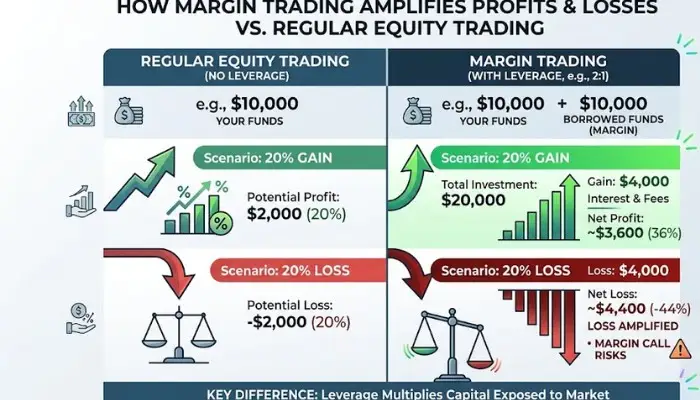
Case 1 – Price goes up
- Price becomes Rs 2800 after one month
- Value of 800 shares = 800 x 2800 = Rs 22.4 lakh
- Profit = Rs 22.4 lakh – Rs 20 lakh = Rs 2.4 lakh
- After paying interest (say Rs 15,000), net profit = Rs 2.25 lakh
- Without margin, profit would have been only Rs 60,000
Case 2 – Price goes down
- Price becomes Rs 2300 after one month
- Value of 800 shares = 800 x 2300 = Rs 18.4 lakh
- Loss = Rs 20 lakh – Rs 18.4 lakh = Rs 1.6 lakh
- Plus interest of Rs 15,000 = total loss Rs 1.75 lakh
- Without margin, loss would have been only Rs 40,000
This margin trading example shows both sides clearly. Margin amplifies your profits and your losses both.
Types Of Margin In Stock Market
1. Initial Margin
This is the minimum amount you must pay to start a trade. SEBI fixes this percentage. For example, if initial margin is 20%, you pay 20% of the total trade value.
2. Maintenance Margin
This is the minimum balance you must maintain in your account after taking a position. Usually this is lower than initial margin. For example, if maintenance margin is 15%, you must keep at least 15% of the total position value in your account.
3. Variation Margin
This is the extra money your broker asks for when the share price moves against you. If your shares lose value, your margin percentage automatically drops. The broker asks you to add more money to bring it back to required levels.
Real Rules For Margin Trading In India
SEBI rules all traders must follow:
- Peak Margin Rules – SEBI introduced peak margin rules in 2020. You cannot take unlimited positions anymore. You must have enough margin for your peak position during the day.
- 80-20 Rule – Currently, brokers can give up to 4x margin for cash delivery. This means you pay 20%, broker gives 80%.
- Intraday Margin – For intraday trading, some brokers give up to 5x to 20x margin depending on the stock.
- No Margin For Illiquid Stocks – You cannot get margin on penny stocks or stocks with low liquidity.
- Margin Collection Before Trade – As per SEBI, margin must be collected before the trade is executed. No more post-trade margin collection.
Benefits Of Margin Trading
- Higher buying power – You can buy more shares with less money
- Diversification – You can invest in multiple stocks with same capital
- Leverage opportunity – Small price movements give big returns
- Intraday advantage – You can trade multiple times in a day with same money
Risks Of Margin Trading – What No One Tells You
- Magnified losses – Losses also get multiplied just like profits
- Interest costs – You pay interest even when you are losing money
- Margin calls – Broker can forcefully sell your shares at the worst time
- Emotional pressure – When markets fall, margin traders panic and sell at bottom
-
Over trading – Easy margin makes you overtrade and lose money faster
Margin Call – The Most Dangerous Thing
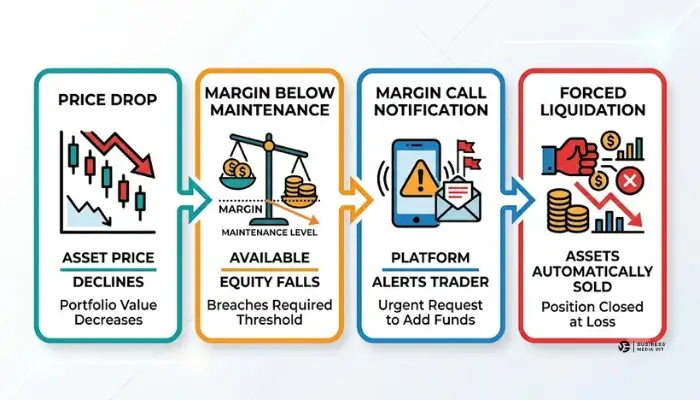
A margin call happens when your account value falls below the maintenance margin. Your broker sends you a notice to add more money or sell some shares.
What happens during margin call:
- You get a call, email or SMS from broker
- You have a few hours to add money
- If you do not add money, broker sells your shares
- Broker sells at whatever price is available
- You have no control over the selling price
Real margin call example:
You bought shares worth Rs 10 lakh with Rs 2 lakh margin. The share price drops 20%. Your shares are now worth Rs 8 lakh. Your margin is now only Rs 2 lakh on Rs 8 lakh position, which is 25%. If maintenance margin is 30%, you get a margin call. You need to add Rs 40,000 to make margin 30% again.
You May Also Read: Stock Market Investing After Age 50: A Smart Retirement Strategy for Indians
Who Should Use Margin Trading?
Margin trading is suitable for:
- Experienced traders who understand market movements
- People who can take risk and handle losses
- Short term traders and scalpers
- People who track markets daily
Margin trading is NOT suitable for:
- First time investors
- People who cannot handle losses
- Retired persons depending on savings
- People who cannot track markets daily
- Anyone who wants long term investment
How To Start Margin Trading In India?
Step 1 – Choose your broker
Check which brokers offer margin trading. Most top brokers like Zerodha, Groww, Angel One, Upstox all offer margin. Compare their interest rates and margin limits.
Step 2 – Open trading account
You need a trading and demat account. Complete KYC with PAN card, Aadhaar, bank details.
Step 3 – Check margin limits
Each stock has different margin percentages. Check your broker's margin calculator before trading.
Step 4 – Start small
Do not use full margin on first day. Start with small positions. Understand how margin works practically.
Step 5 – Keep extra funds
Always keep some extra money in your account. This protects you from sudden margin calls.
Common Mistakes In Margin Trading
Mistake 1 – Using maximum margin all the time
This is the biggest mistake. If market moves against you, you lose everything quickly.
Mistake 2 – Not understanding interest charges
Many traders do not calculate interest costs. These costs eat into your profits.
Mistake 3 – Holding margin positions overnight
Overnight positions carry higher risk. Intraday margin is usually cheaper and safer.
Mistake 4 – Not setting stop losses
Without stop loss, one bad trade can wipe out your entire account.
Mistake 5 – Averaging down on margin
Buying more shares when price falls is dangerous with margin. It increases your leverage and risk.
Tips For Safe Margin Trading
- Use only 50% of available margin – Keep buffer for emergencies
- Set strict stop loss – Decide loss limit before entering trade
- Calculate interest cost – Include interest in your profit calculation
- Track daily positions – Check your margin status every day
- Keep extra funds ready – For sudden margin calls
- Avoid illiquid stocks – Margin on liquid stocks is safer
- Do not trade on tips – Margin amplifies loss on wrong tips
- Exit on target – Do not get greedy with margin positions
Margin Trading vs Regular Trading – Quick Comparison
| Feature | Regular Trading | Margin Trading |
|---|---|---|
| Own money needed | 100% | Only 20% to 50% |
| Buying power | Limited to your capital | 3x to 20x of capital |
| Profit potential | Limited | High |
| Loss potential | Limited to your capital | Can lose more than capital |
| Interest cost | None | 10% to 18% yearly |
| Risk level | Low to medium | Very high |
| Best for | Long term investors | Short term traders |
Final Word
Margin trading can make you rich quickly. It can also make you lose everything faster. This is not a tool for everyone.
If you are new to stock market, avoid margin for at least 6 months. Learn how markets move. Understand technical and fundamental analysis. Then slowly start using small margin amounts.
If you are an experienced trader, margin can be your best friend. Use it wisely. Keep strict risk management. Always know your exit before you enter.
One golden rule – never use margin on money you cannot afford to lose completely. Stock markets are unpredictable. Even the best traders get it wrong sometimes. Margin just makes those wrong decisions more expensive.
FAQs
Q1. What is margin in trading and how much do I need?
Margin in trading is the minimum amount you pay from your pocket. As per SEBI, for most stocks you need minimum 20% margin. Some volatile stocks need 30% to 40% margin.
Q2. How margin trading works in stock market for beginners?
For beginners, margin trading works like a loan from broker. You pay some money, broker gives you more. But remember, losses are also multiplied. Start with small amounts and understand the process first.
Q3. What is margin in stock market and how is it calculated?
Margin in stock market is calculated as a percentage of total trade value. SEBI fixes this percentage. For example, if margin is 20%, you pay Rs 20 for buying shares worth Rs 100.
Q4. Give me a simple margin trading example?
You have Rs 1 lakh. Broker gives 4x margin. You can buy shares worth Rs 4 lakh. If share price goes up 10%, you earn Rs 40,000 on Rs 1 lakh investment. If price goes down 10%, you lose Rs 40,000.
Q5. What happens if I cannot pay margin call?
If you cannot pay margin call, your broker sells your shares at market price. You have no choice. This can cause big losses, especially in falling markets.
Q6. Is margin trading allowed in India?
Yes, margin trading is completely legal in India. SEBI regulates all margin trading rules. All registered brokers offer margin trading services.
Q7. Can I lose more than my investment in margin trading?
Yes, in margin trading you can lose more than your investment. If price falls sharply, you lose your entire margin and still owe money to broker. This is why margin trading is considered high risk.
Q8. What is the interest rate on margin trading?
Interest rates vary from broker to broker. Generally, rates are between 10% to 18% per year. Some brokers charge daily interest, so your interest cost depends on how long you hold the position.