

Stock Market Investing After Age 50: A Smart Retirement Strategy for Indians
Many people in India believe that once you cross 50, you should avoid the stock market. They feel it is too risky and that fixed deposits are the only safe option.
This is a common but costly belief. With rising prices and longer lifespans, avoiding stocks can put your retirement plan in danger. This article explains why stock market investing after age 50 is not only safe but necessary for a comfortable future in India.
Why You Cannot Ignore Stocks After 50?
Let us first address the most common question. Why should a 50-year-old person even look at stocks? Isn't it safer to just stick with fixed deposits and post office schemes?
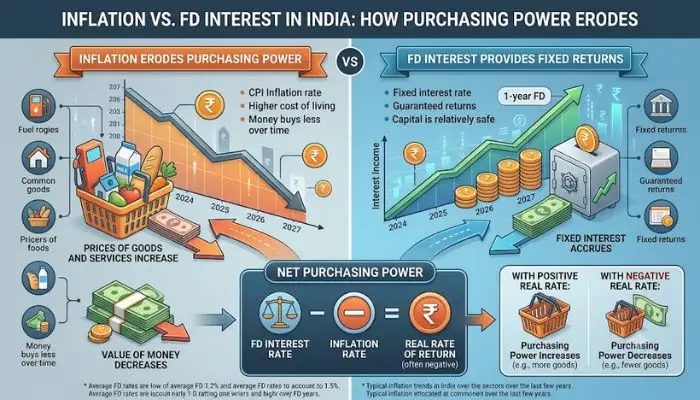
The simple truth is that inflation eats away your money every year. In India, inflation stays around 6% on average. If you put your money in a fixed deposit that gives 7% interest, your real return after inflation is only 1%. This is not enough to build a good retirement corpus. You need your investments to grow faster than inflation so that your money keeps its value. This is where stocks can help.
Retirement for many Indians is not 10-15 years anymore. People are living longer. A person who reaches 60 can expect to live another 18 years on average. For those with good income, this can be even longer. When you have 20 to 25 years of retired life, your money needs to last that long. Fixed deposits alone may not be enough to fund such a long retirement. You need growth in your portfolio to keep up with rising costs of food, medical care, and other expenses. An allocation to stocks becomes essential to boost your corpus during your non-working years.
Consider this example. If you retire at 60 with annual expenses of 12 lakh and earn only 6% return, you would need about 3.6 crore to fund your life until age 90. But if you can earn 10% return with some help from stocks, the amount you need falls to around 2.15 crore. This is a big difference. Stocks can help you reduce the size of the retirement corpus you need to build.
Read More: Best Stocks Under 100 for Long-Term Investment in India
Understanding Your Risk Capacity at 50
Before we get into specific investment plans, we must understand one important point. How much risk can you take after 50?
When you were in your 30s or 40s, you could afford to make mistakes in your investments. If you lost some money in stocks, you had time to recover. But after 50, you do not have the same luxury. If you lose a big part of your savings just before retirement, it is very hard to recover. This is why your approach to stock market investing after age 50 needs to be different.
The most important change you need to make after 50 is to focus on protecting your money from big losses, rather than chasing the highest possible returns. This means you should avoid very risky investments like small-cap stocks or thematic funds that can fall sharply in a market crash. Your goal is to grow your money steadily, not to get rich overnight.
There is a story of Mr Raghavan, a 70-year-old retired person. He started investing in stocks after the Covid crash and put most of his money into small-cap and mid-cap funds. In a rising market, this gave him good returns. But this type of portfolio is very risky for someone his age. If the market falls, his small-cap heavy portfolio can lose 60-70% of its value. Such a loss would be very painful at his age. His approach to fund selection was rather blunt, with little respect for any asset-allocation rationale. The highest returns decided his choices.
The SIP and SWP Strategy for Retirement Income
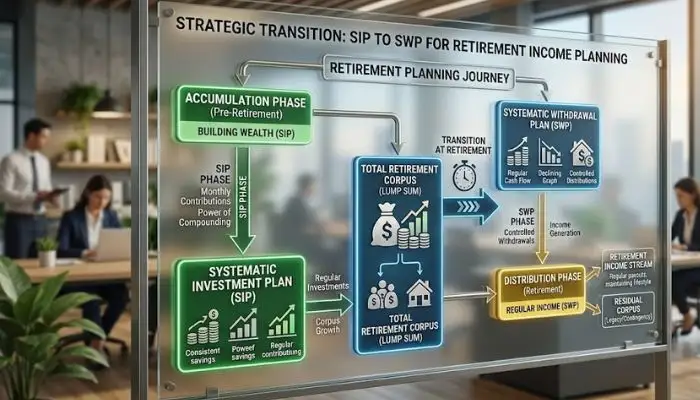
One of the best ways to invest after 50 is to use a combination of SIP and SWP.
A SIP or Systematic Investment Plan is something you use to build your savings. You invest a fixed amount every month into a mutual fund. An SWP or Systematic Withdrawal Plan is used after you have built your savings. It allows you to take out a fixed amount of money every month from your mutual fund, similar to getting a pension.
Let us look at how this works with a simple example. Suppose you start a SIP of 10,000 per month at age 30 and continue for 20 years. Assuming 12% annual return, your investment can grow to about 1 crore by the time you turn 50. Now at 50, you can move this 1 crore into a hybrid or balanced fund and start an SWP. With 8% annual return, you can withdraw 65,000 every month for 20 years. You will still have over 1 crore remaining even after 20 years of withdrawals. This means you get a steady monthly income while your money continues to grow.
This SIP-to-SWP method is a good plan because it solves two problems. First, it helps you build a retirement fund through disciplined investing. Second, it gives you a predictable income stream after retirement. You can also increase your SWP amount every year by 5% to keep up with inflation and maintain your standard of living.
Choosing the Right Investment Instruments at 50
The best investment plan at age 50 depends on your goals, but a balanced mix of the following can work well.
National Pension System (NPS)
The National Pension System is a government-backed retirement savings scheme. It is designed specifically to help people build a retirement corpus with tax benefits and disciplined long-term investing.
Why NPS is good after 50: NPS offers tax benefits under Section 124 of the new Income Tax Act. You can claim up to 1.5 lakh deduction for your own contribution and an additional 50,000 deduction exclusive to NPS. If your employer contributes, that also gives you tax benefit. At 50, you can choose a more conservative asset allocation by reducing equity exposure and increasing debt. NPS allows you to do this through Active Choice. When you reach 60, you can withdraw 60% of the corpus tax-free and use 40% to buy an annuity for regular pension income. This provides both a lump sum and a steady income stream for retirement.
Mutual Funds
Mutual funds offer flexibility and growth potential. They can play a key role in your retirement portfolio.
Why mutual funds are good after 50: You can invest in large-cap funds or hybrid funds which carry lower risk than small-caps. Hybrid mutual funds solve both stock and bond selection problems. They automatically track and rebalance your portfolio at the right times. This saves you capital gains tax that you would pay every time you rebalance your portfolio yourself. For investors who find fund selection troublesome, passive funds like index funds tracking the Nifty 100 or Nifty Midcap 150 can serve very well. They have low costs and you do not need to frequently change your funds based on performance.
EPF and PPF
These are the bedrock of safety in your portfolio. The Employees' Providnt Fund and Public Provident Fund offer stable and tax-free returns. They give your portfolio stability and balance out the volatility of stocks. For a 50-year-old, keeping a portion of savings in these schemes ensures safety of capital.
How Much to Allocate to Stocks at 50?
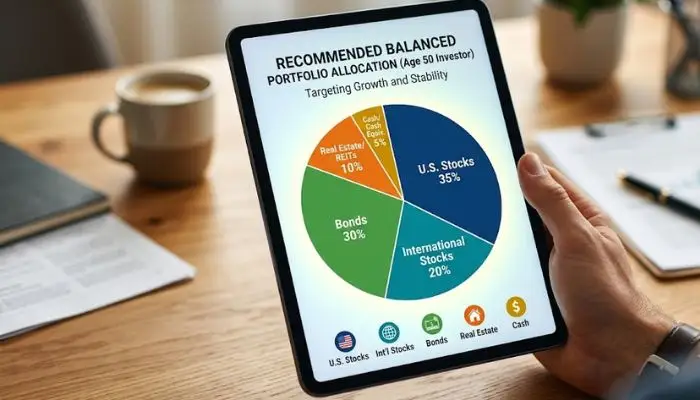
The right mix of stocks and debt is the most important decision you will make. Many financial experts suggest that at age 50, you should have about 40-50% of your portfolio in stocks and the rest in debt and safer instruments. A portfolio with only 30% in equity and 70% in debt would have contained losses to just 12-15% even in the worst market crash. This shows the value of keeping equity allocation moderate.
You can also look at the SIP investment chart to understand the power of starting early. If you start at 30 with a 30-year horizon, a 14,165 monthly SIP can help you retire with 5 crore. But if you delay that decision by a decade and start at 40, you will need to invest over 50,000 per month to achieve the same goal. This is why starting even at 50 is better than waiting longer.
You May Also Read: Top Cybersecurity Stocks in India for Big Growth 2026
Common Mistakes to Avoid After 50
Many investors make mistakes after 50 that can hurt their retirement plans. Here are some common ones to avoid.
Investing in small-cap heavy portfolios: As we saw with Mr Raghavan, small-cap and mid-cap funds can fall sharply in a market crash. A small-cap heavy portfolio is not suitable for someone at or near retirement.
Trying to trade or pick individual stocks: Unless you were already a seasoned stock-picker before retirement, the mutual fund route serves you better. The main goal of your post-retirement equity exposure is to fetch a good return, not to pass time or treat it as a hobby.
Chasing high returns over safety: When you are employed and salary comes regularly, you can afford some investing mistakes. But after retirement, capital loss is very tough to recover. Focus on downside protection over return maximization.
Ignoring inflation: Many people put all money in fixed deposits and forget that inflation will reduce their purchasing power over time. Remember that long-term inflation in India averages 6%, and debt returns struggle to match this on a post-tax basis. An allocation to equities helps you beat inflation.
Conclusion
Stock market investing after age 50 is not only possible but necessary for many Indians. You cannot rely only on fixed deposits and post office schemes to fund a retirement that may last 20 to 30 years. Inflation will erode your savings if you do not get some growth from equities. At the same time, you need to be careful with the amount of risk you take. Focus on large-cap and hybrid funds, avoid small-caps and thematic funds, and keep a good portion of your savings in safe debt instruments.
The best investment plan at age 50 for an Indian investor is a balanced mix of NPS for tax benefits and annuity income, mutual funds for growth and liquidity, and EPF for safety. Use the SIP and SWP strategy to build your corpus and then get regular income. Most importantly, do not delay. Every year you wait means you need to invest more to achieve the same goal. Start today, stay disciplined, and retire with the confidence that your money will last.