

How to Identify Long Term Growth Stocks in India
Many people want to grow their money but do not know how. If you are one of them, this guide helps you. How to identify long term growth stocks is not as tough as you think. You do not need to be a finance expert. You do not need to watch the market all day.
You just need to follow some simple rules. Look for companies that grow their sales and profits every year. Check if they have low debt and good returns. See if their growth is steady, not just for one year. Also check if the price is fair. This guide gives you a clear path to find such stocks. Start today. Your future self will thank you.
What Is a Growth Stock?
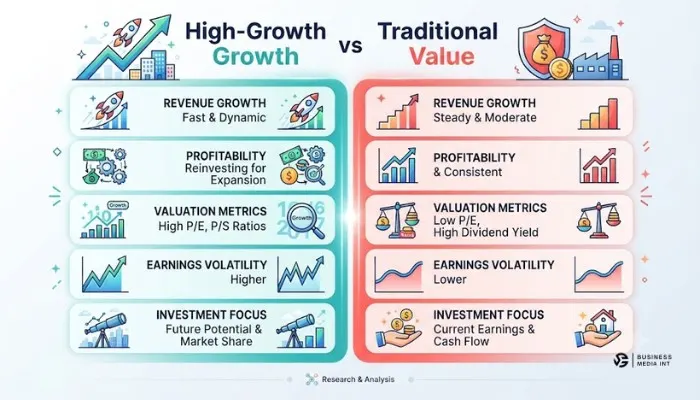
Growth stocks are shares of companies that grow their sales and profits faster than the market. People pay more for these stocks because they expect higher profits in the future . These companies often trade at higher prices compared to their earnings.
Read More: Difference Between NSE and BSE: Complete Guide for Beginners
Simple Rules to Find Growth Stocks
Rule 1: Check Profit Growth Against the Economy
A good test is to check if a company's profit grows faster than India's economy. India's real GDP is expected to grow at 6.4% in 2025 and 2026 . Look for companies whose profit grows faster than this.
Companies whose profit after tax (PAT) grows faster than the economy often show good management, strong market position, and steady demand for their products . These are the traits that make them attractive for long-term investing.
Rule 2: Follow the QGLP Formula
Motilal Oswal created a simple framework called QGLP. It stands for Quality, Growth, Longevity, and Price . Let me break it down.
- Quality - Does the company have a strong position in its market? Does it have pricing power? Does the management use money wisely? Good companies earn returns above their cost of equity.
- Growth - Has the company shown strong and steady earnings growth? Do not look for one-time spikes. Look for consistent growth over many years.
- Longevity - Can the company keep growing for many years? This is very important. A company that grows for 10 years is better than one that grows for 2 years.
- Price - Even a good company can be a bad investment if you pay too much. Check if the current price is reasonable compared to the company's growth.
Only about 4% of listed companies become long-term compounders . QGLP helps you find these rare stocks.
Rule 3: Look for Low Debt and Good Returns
A company should not have too much debt. Debt to equity ratio below 0.5 is good . The company should also have a high return on equity (ROE). A 10-year average ROE above 15% shows the company has a long track record of profitability .
Rule 4: Check If Growth Comes from Real Operations
Sometimes profit growth comes from one-time gains, lower taxes, or interest savings. This is not sustainable. Check if revenue and operating profit also support the profit growth . Also check if the company is generating cash. Companies that generate cash can grow without depending on outside money.
Examples of Growth Stocks in India
Let me give you some examples from experts.
- Dixon Technologies - This company makes LED TVs, mobiles, and washing machines. It has strong clients and a growing mobile segment. It is also entering new areas like refrigerators .
- Larsen & Toubro - This company builds infrastructure. It benefits from government spending on roads, metros, and other projects. It has a large order backlog that gives revenue visibility for many years .
- Eicher Motors - This company makes Royal Enfield bikes. It benefits from rising premium consumption in India. It is also expanding to other countries .
- HDFC Bank - This is India's largest private sector bank. Experts expect the bank to grow faster than the banking sector in the coming years. It has strong asset quality and a large deposit base .
- Trent - This retail company has grown its profit at 63.5% CAGR over 3 years . It benefits from rising consumption in India.
- BSE - This stock exchange has transformed from a cash equity platform to a dominant derivatives exchange. It benefits from growing retail participation in the stock market .
- Zomato - This food delivery company has shown strong sales growth. It is also expanding into quick commerce. Some experts see it as a recovery play .
- Solar Industries - This company has grown profit at 41.4% CAGR over 3 years. It benefits from India's defence and energy needs .
- Polycab - This company makes cables and wires. It has grown profit at 28.3% CAGR over 3 years. It benefits from India's infrastructure buildout and electrification push .
- Hero MotoCorp - The world's largest two-wheeler manufacturer. It is a cash-rich defensive compounder. It is also pivoting toward electric vehicles under the Vida brand .
- Hindustan Construction Company (HCC) - This is a turnaround story. The company has reduced its debt significantly. It has specialised expertise in tunnels, metro works, and hydro power projects that is not easy to replicate .
How to Check a Stock's Growth?
Look at Sales and Profit Growth
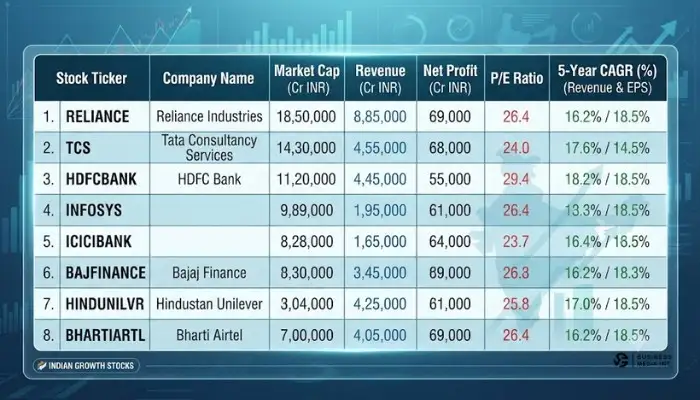
Check the company's sales growth over 3 years and 5 years. Then check profit growth over 3 years and 5 years. Good companies show consistent growth in both.
Companies like Jio Financial Services (sales CAGR 139.6%, profit CAGR 112.5%), Zomato (sales CAGR 69%), and BSE (sales CAGR 56.3%, profit CAGR 75.2%) show high growth rates .
Check the PEG Ratio
The PEG ratio compares price-to-earnings (P/E) with earnings growth rate. A PEG ratio below 1 suggests the stock may be undervalued relative to its growth .
Check Promoter Holding
Promoters are the company founders or owners. If they hold more than 40% of the company, they have significant stake in the business. This is good .
Short Term Stocks vs Long Term Growth Stocks
Many people ask me how to pick good stocks for short term as well. Let me clear this.
- Short-term stocks are for quick gains, typically 1 to 3 months . They depend on price momentum, trading volume, and news triggers like earnings or government policy changes . Traders look for highly liquid stocks, breakout patterns, and technical indicators like RSI and moving averages .
- Long-term growth stocks are different. They depend on business fundamentals, consistent earnings growth, and sustainable competitive advantages. You hold them for years, not weeks.
If you are a beginner, focus on long-term growth stocks. Short-term trading needs more skill and carries more risk.

Common Mistakes to Avoid
Mistake 1: Buying Because the Price is Low - Some people buy stocks under 5 rupees thinking they are cheap. This is a mistake. These stocks often have weak financials, low liquidity, and high risk .
Mistake 2: Ignoring Valuation - Even a good company can be a bad buy if you overpay. Check the P/E ratio and PEG ratio. Compare them to the company's historical averages.
Mistake 3: Chasing One-Time Growth - Some companies show very high growth in one year. This could be from a one-off event. Check if the growth is sustainable.
Mistake 4: Not Checking Debt - High debt can kill a company. Check the debt-to-equity ratio. Companies with low debt are safer.
Mistake 5: Following "Hot Tips" - Do not buy stocks just because someone on social media recommends them. Do your own research.
You May Also Read: How Margin Trading Works in Stock Market Complete Guide for Indian Investors
Simple Checklist for Finding Growth Stocks
- Is the company's profit growth higher than India's GDP growth (6.4%)?
- Has the company shown consistent growth over 3 to 5 years?
- Is the debt-to-equity ratio below 0.5?
- Is the 10-year average ROE above 15%?
- Is the promoter holding above 40%?
- Is the PEG ratio below 1?
- Is the current P/E reasonable compared to historical average?
- Does the company have a competitive advantage?
- Can the company keep growing for many years?
- Does the company generate cash from operations?
Final Words
How to identify long term growth stocks does not need to be complicated. You just need a systematic approach. Check the company's growth against the economy. Use the QGLP framework. Check debt and returns. Do not ignore valuation. Avoid common mistakes. Follow a checklist.
India's economy is growing. Many companies will benefit. Your job is to find the ones that will grow consistently for many years. Use the simple rules in this guide. Be patient. Do your research. Over time, your portfolio will grow.
FAQs
1. How much money do I need to start buying growth stocks?
You can start with just 500 rupees. Many apps in India let you buy small amounts. You do not need lakhs to begin. Start with what you have. Learn as you invest.
2. Is it possible to lose everything in growth stocks?
Yes. Growth stocks are risky. Some companies fail. Some do not grow. That is why you should never put all your money in one stock. Buy different stocks from different sectors. This keeps your money safer.
3. How can I tell if a stock costs too much?
Check the P/E number. Compare it with the company's past P/E. Compare it with other companies in the same business. If the P/E is much higher than its growth rate, it is overpriced. Also look at the PEG ratio. If PEG is above 2, the stock is costly.
4. Should I pick big companies or small companies?
Big companies are safer. They grow slowly but steadily. Small companies can grow fast but can also fail. For new investors, start with big companies. Once you learn more, you can try smaller ones. Keep a mix of both.