

Top Treasury Bonds for 2026 Investors: Best Bond Picks
The year 2026 presents a strong case for fixed-income investing, and the search for the top treasury bonds for 2026 investors has become a major focus in India. With the Reserve Bank of India maintaining stable rates, these government-backed instruments offer a safe haven for capital. Currently, yields are hovering around an attractive 7%, providing a reliable source of accrual income.
For those looking to balance their portfolio, treasury bonds provide a shield against stock market fluctuations. This guide cuts through the complexity, explaining how regular investors can access these sovereign securities through platforms like the RBI Retail Direct account without the need for a broker.
Why Bonds Are Getting Attention in 2026?
The Reserve Bank of India has kept the repo rate at 5.25 percent . This has made bond yields attractive. Currently, bond yields are around 7 percent, which is the highest in almost two years . When you invest in bonds, you get regular interest payments. This is called accrual income. Many experts suggest that now is a good time to focus on steady income from bonds rather than waiting for rates to change .
Read More: Best Bonds for Conservative Investors in India (2026 Guide)
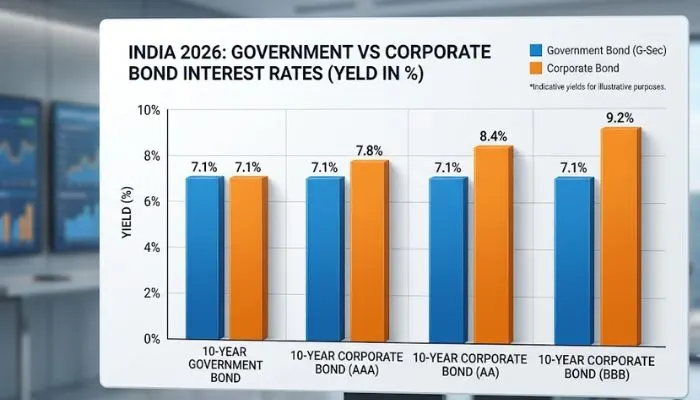
Best Government Bonds in India for 2026
Government bonds are considered very safe because the Government of India backs them. Here are the top options in 2026.
RBI Floating Rate Savings Bond
This is one of the most popular bonds among Indian investors. It gives you 8.05 percent interest every year . What makes this special is that the interest rate changes every six months. It is linked to the National Savings Certificate rate plus 0.35 percent . You get interest payments twice a year on January 1 and July 1 . The bond matures after seven years . Senior citizens can withdraw their money early under certain conditions . This bond has sovereign backing, which means the government guarantees your money .
10-Year Government Securities
This is the standard bond in India's debt market. It currently gives you about 7.05 percent yield . The tenure is around ten years . The government pays interest twice a year on these bonds. This bond is good for people who want to invest for the long term and want safety. In May 2026, the yield stayed near 7.05 percent . Changes in crude oil prices, rupee value, and global uncertainty affect this rate .
State Development Loans
State governments issue these bonds to build roads, bridges, and other infrastructure. They give you higher returns than central government bonds. The interest rate is between 7.40 percent and 7.60 percent . The tenure ranges from five to fifteen years . Different states offer different rates based on their financial health . These bonds carry state government guarantee, so they are very safe. They are a good choice if you want slightly more return than central government bonds.
Sovereign Gold Bonds
These bonds let you invest in gold without buying physical gold. You get a fixed interest of 2.50 percent on the issue price . Plus, you get the benefit of gold price increase . The tenure is eight years . If you hold them until maturity, capital gains are tax-free . This is a big advantage for long-term investors. The budget of 2026 has confirmed that tax exemptions apply only to original subscribers who hold the bond until maturity .
Treasury Bills
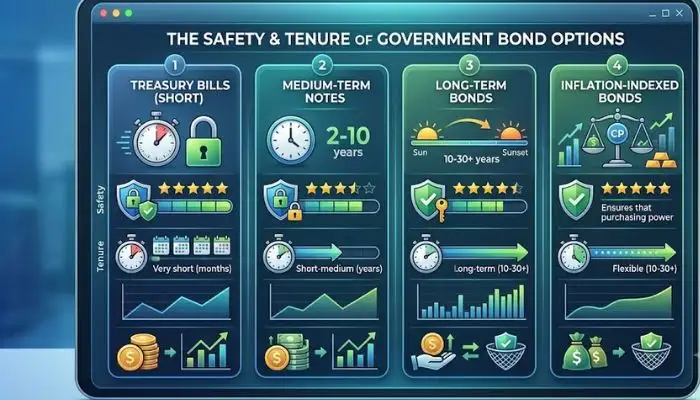
These are short-term government securities. They are issued at a discount and redeemed at full face value. You do not get regular interest payments. The profit comes from the difference between buying price and selling price. The 91-day treasury bill gives you about 6.50 percent yield . The 364-day treasury bill gives you about 6.60 percent yield . These are ideal for parking your money for a few months with zero risk . They have high liquidity, meaning you can sell them easily.
Best Corporate Bonds for 2026
Here are some high-quality corporate bonds that you can consider.
AAA-Rated PSU Bonds
These are issued by public sector companies and have the highest safety rating. Power Finance Corporation has a bond giving 7.24 percent interest maturing in 2031 . REC Limited offers 7.44 percent interest maturing in 2028 . NHPC gives 6.86 percent interest maturing in 2034 . NTPC offers 7.32 percent interest maturing in 2029 . These companies have government ownership, which reduces risk. The yields on AAA-rated corporate bonds range from 7.0 percent to 8.0 percent in 2026 .
AAA-Rated Financial Institution Bonds
NABARD offers 7.27 percent interest maturing in 2030 . HDB Financial Services gives 7.35 percent interest maturing in 2030 . Tata Capital Housing Finance offers 7.50 percent interest maturing in 2031 . These are top-rated bonds from strong financial institutions. The risk is low because these companies have strong financial health.
List of Government Bonds Listed on NSE
The National Stock Exchange lists many government and government-backed bonds. Here is the list of available instruments :
Central Government Bonds:
- Compensation Bond
- Converted Stock
- Floating Rate Bond
- Government Loan
- Treasury Bill
- Zero Coupon Bond
- Index Bond
State Government Bonds:
-
Development Loan
Public Sector Bonds:
- Promissory Note
- Taxable Bond
- Tax-Free Bond
- Infrastructure bonds
- Green Bond
Institution Bonds:
- Floating Rate Bond
- Non-SLR Bond
- SLR Bond
- Zero Coupon Bond
- Tax free bond
You can buy and sell these bonds through your trading account.
Government Bonds vs Corporate Bonds: What to Choose?
Risk Level: Government bonds have sovereign backing. The government guarantees your money. Corporate bonds depend on the issuing company's financial health. AAA-rated corporate bonds have very low risk but not zero risk .
Returns: Government bonds give you 6 to 8 percent returns. Corporate bonds can give you 7 to 10 percent returns . Higher returns come with higher risk.
Liquidity: Government bonds have excellent liquidity. You can buy and sell them easily.
Taxation: Both types of bonds are taxable according to your income tax slab. For listed corporate bonds, if you sell before 12 months, it is short-term capital gain taxed at slab rate. If you sell after 12 months, you pay 12.5 percent long-term capital gains tax without indexation .
You May Also Read: Treasury Bonds for Retirement Income: Safe Guide India
How to Invest in Government Bonds?
RBI Retail Direct Account
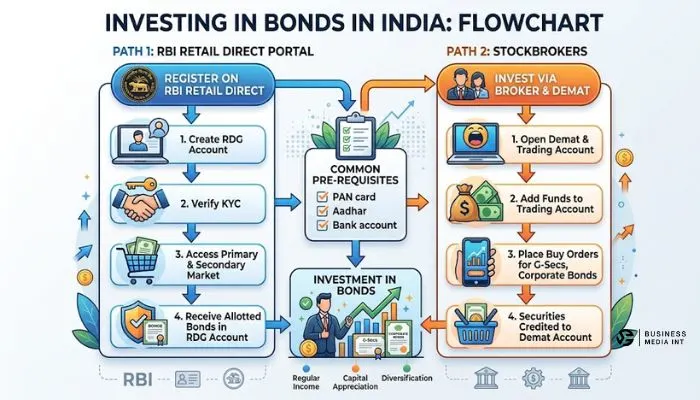
The RBI has made it very easy for retail investors. You can open a Retail Direct Gilt Account directly with the central bank . Opening and maintaining this account is free . You can place a non-competitive bid and get the best price . There is no brokerage fee. You can choose between central government bonds, state development loans, and treasury bills .
Through Brokers
You can also buy government bonds through your stockbroker. They will charge a small fee. The process is simple. You place an order through your trading account. The bonds are credited to your Demat account.
Through Mutual Funds
If you do not want to buy bonds directly, you can invest in corporate bond funds. In 2026, many good funds are available . HDFC Corporate Bond Fund gives 7.39 percent three-year return . ICICI Prudential Corporate Bond Fund gives 7.67 percent three-year return . SBI Corporate Bond Fund gives 7.17 percent three-year return . These funds invest in high-quality bonds and are managed by professionals. The minimum investment is as low as Rs 100 in some funds .
How to Invest in Corporate Bonds?
Primary Market: Companies issue new bonds through public issues. You can apply during the issue period through your broker or bank. Allotment is on a first-come-first-served basis .
Secondary Market: You can buy listed bonds on NSE or BSE through your trading account . The minimum investment is usually Rs 10,000 . Many listed bonds are available at Rs 1,000 per unit .
Through SEBI-Registered Platforms: SEBI's OBPP framework has improved retail access. These platforms display standard information like credit rating, yield to maturity, coupon, and maturity . This helps you compare bonds easily.
What to Check Before Buying a Bond?
Credit Rating: This tells you about the issuer's ability to pay. AAA is the highest rating. AA is one notch below. Lower ratings mean higher risk . Ratings are opinions from agencies like CRISIL, ICRA, and CARE .
Yield to Maturity: This is the annual return if you hold the bond until maturity. It is more accurate than the coupon rate. You can compare different bonds using this number .
Secured vs Unsecured: Secured bonds have asset backing. If the company defaults, you have a claim on those assets. Unsecured bonds rely only on the company's promise to pay .
Tenure: Match the bond tenure with your investment goal. Longer tenures carry more interest rate risk .
Tax Treatment: Understand how your interest income and capital gains will be taxed. There is no TDS on interest from listed bonds held in Demat form .
Tax Implications for Bond Investors
Interest Income: The interest you earn is taxed as "Income from Other Sources" at your income tax slab rate . There is no TDS for listed bonds held in Demat form .
Capital Gains: If you sell the bond on the exchange, capital gains tax applies. Short-term gains (sold within 12 months) are taxed at slab rate. Long-term gains (sold after 12 months) are taxed at 12.5 percent without indexation .
If you hold the bond to maturity, only the interest income is taxable. There is no capital gains tax on maturity for standard coupon-bearing bonds .
Important Risks to Understand
Credit Risk: This is the risk that the issuer may not pay interest or principal. Lower-rated bonds have higher credit risk. Ratings are not guarantees of repayment .
Interest Rate Risk: When market interest rates rise, existing bond prices fall. If you sell before maturity, you may make a loss. Holding to maturity protects you from price movement .
Liquidity Risk: Some bonds do not trade actively on exchanges. You may not find a buyer when you want to sell .
Reinvestment Risk: When you get interest payments, you may not get the same rate when reinvesting the money.
Expert Advice for 2026
Experts suggest focusing on quality over high returns. The RBI has kept rates unchanged, so now is the time for steady income . High-quality corporate bonds and PSU bonds can give attractive returns . It is good to diversify across issuers, maturities, and ratings rather than putting all money in one bond .
Nishchay Nath, founder of BondScanner, says investors should expect mid-to-high single digit returns from good bonds . If you see bonds offering 9 to 12 percent returns, they come with higher credit risk .
Conclusion
2026 is a good year for bond investors in India. You can choose between government bonds with sovereign safety and corporate bonds with higher returns. The RBI Retail Direct account makes government bonds very accessible. Corporate bonds are available through exchanges and mutual funds.
The RBI Floating Rate Savings Bond at 8.05 percent is excellent for safety. State Development Loans give you 7.40 to 7.60 percent with state government backing. AAA-rated corporate bonds like PFC and REC offer 7.24 to 7.44 percent with high safety.
Before investing, check the credit rating, yield to maturity, and tenure. Match the bond with your financial goal. Diversify your investments across different types. Remember that higher returns always come with higher risk. Keep realistic expectations. Good quality bonds will give you steady returns if you hold them to maturity.
Start small, learn as you go, and build your bond portfolio step by step.
FAQs
1. Which gives better returns, government or corporate bonds?
Corporate bonds give more, around 7.40 to 8.30 percent. Government bonds give around 6 to 7 percent. Government bonds are safer, corporate bonds give higher returns.
2. Can I buy bonds through my Demat account?
Yes. Many bonds are listed on the National Stock Exchange. You can buy and sell them just like shares through your trading account.
3. How is bond interest taxed?
You pay tax on interest according to your income tax slab. If you sell after 12 months, you pay 12.5 percent long-term capital gains tax. If you hold till maturity, no capital gains tax.
4. What is the minimum money needed to start?
You can start with Rs 100 through mutual funds. For direct bonds on the exchange, you need around Rs 10,000.