

How to Invest in S&P 500 from India: Complete Guide 2026
Investing in global markets is no longer a dream for Indian residents. The S&P 500 is the most talked about index in the world. It holds five hundred of the biggest American companies. If you want to know how to invest in S&P 500 from India, you have come to the right place.
Many Indian investors now look at this index to grow their money. The process is simple and fully legal. You do not need to live in America or have a foreign bank account. Indian mutual funds and international brokers offer easy ways to start.
Why Should Indian Investors Look at the S&P 500?
Putting all your money in one country is risky, no matter how strong that country is. India has a great market, but it is still a single market. By adding money in the S&P 500, you spread your risk across the biggest economy in the world. The American stock market has a history of giving good returns over the long term. The S&P 500 is the best way to track that market.
There is another benefit. When you invest in the S&P 500, you are buying assets in US dollars. The value of the Indian rupee keeps going down against the dollar. Over time, this works in your favor. Even if the S&P 500 stays flat, a weaker rupee will increase your returns when you convert back to Indian money.
Let us be clear about one thing. You cannot directly buy the S&P 500 index. It is a list, not a share. You cannot go to a broker and ask for "one S&P 500." You need to buy products that track this list. These are called index funds or exchange traded funds. These funds hold the same stocks as the list and their value goes up and down with the list.
Read More: How to Build an Investment Portfolio for Beginners in India

The Main Routes to Invest in the S&P 500 from India
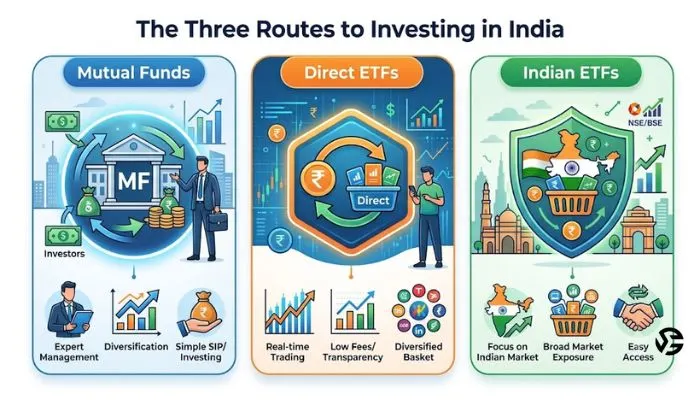
There are three main ways for an Indian resident to put money in the S&P 500. Each way has its own pros and cons. You must pick the one that fits your needs and your understanding.
Route One: Indian Mutual Funds that Track the S&P 500
This is the most common and easiest route for retail investors. These are mutual funds in India that take your rupees and invest in S&P 500 funds listed in the US. You simply buy these Indian mutual funds through any app or website you already use. This method is simple and supports systematic investment plans. You can start a SIP with as little as five hundred rupees.
There are a few things to know about this route. These funds often have higher costs. This is because they invest in other funds. You are paying for the Indian fund and the US fund inside it. Also, these funds sometimes pause fresh investments. The Reserve Bank of India puts a limit on how much money Indian funds can send abroad. When that limit is reached, the fund stops taking new money.
The Motilal Oswal S&P 500 Index Fund is the most popular in this category. It has an asset under management of over four thousand crore rupees. Its return since launch is over eighteen percent. The fund is managed by Mr. Sunil Sawant. The expense ratio for the regular plan is around one percent. You need a minimum of five hundred rupees to start.
Route Two: Direct Investment in US ETFs through an International Broker
This is the second route. You open an account with an international broker. Then you send money from India to that account. You can send up to two hundred fifty thousand US dollars every year under the RBI's scheme. Once the money reaches your US account, you buy the S&P 500 ETF directly on the American exchange.
This route has lower costs than Indian mutual funds. The expense ratio of US ETFs is much lower. You also hold the US security directly in your name. This gives you more control. The main problem is that it is more complex. You need to fill out forms for sending money abroad. You also need to pay for currency conversion. You have to report these investments in your Indian tax return in a special schedule.
Route Three: Indian Exchange Traded Funds that Track US Indices
Some ETFs are listed on Indian exchanges. These ETFs track the S&P 500 or other US indices. You can buy and sell them just like you buy Indian stocks. They are settled in rupees. You do not need to open any foreign account. The Mirae Asset S&P 500 Top 50 ETF is one example. It invests in the top fifty companies of the S&P 500.
There is a downside to this route. The liquidity for such ETFs is sometimes low. This means there may not be enough buyers and sellers. You may not get a fair price when you buy or sell. The tracking error can also be high. This means the ETF may not perfectly copy the movement of the S&P 500.
How to Invest Using an SBI Platform?
Many Indian investors ask about SBI. There is no separate fund called "SBI S&P 500 Fund." But you can use the SBI Securities platform or the SBI Mutual Fund app to buy the Motilal Oswal S&P 500 Index Fund. The process is the same as buying any other mutual fund. You log in to your account, search for the fund, and place your order. You can choose to do a one-time lump sum or start a SIP.
If you are using SBI Bank to send money abroad for direct investment, you will need to fill a form called Form A2. This form tells the bank that you are sending money for investment purposes. The bank will then convert your rupees to dollars and send the money to your US brokerage account.
Understanding the Costs
Every investment comes with costs. You need to know what you are paying. The expense ratio is the yearly fee the fund charges. This is taken from the fund's assets. For Indian mutual funds, this is around one percent. For US ETFs, it is very low, around zero point zero three percent. The difference matters a lot over twenty years. A higher expense ratio will eat into your returns.
If you are investing directly, you also pay for currency conversion. Every time you convert rupees to dollars, the bank charges a spread. This is the difference between the buying and selling price of the dollar. This is not a fee you can avoid. Some brokers also charge a platform fee or a brokerage fee. Always check the full list of charges before opening an account.
Tax Implications for Indian Investors
Tax on US investments is different from tax on Indian stocks. You have to know the rules to avoid trouble. For Indian residents, the US does not charge any capital gains tax. This means when you sell your US stocks or ETFs, you do not pay any tax to the US government. You only pay tax in India.
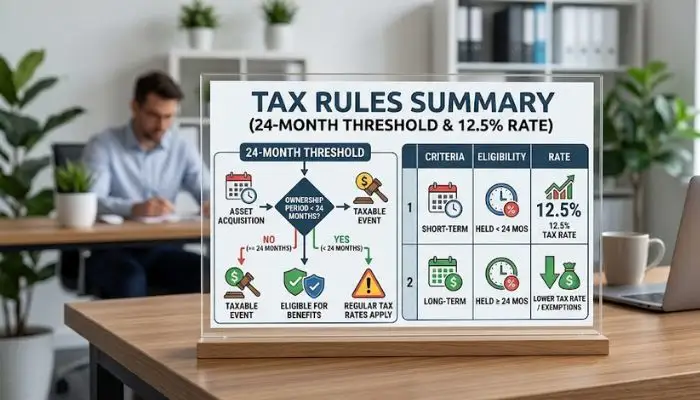
In India, the tax depends on how long you hold the investment. If you hold the US stock or ETF for more than twenty four months, it is long term. The profit is taxed at twelve point five percent. There is no indexation benefit. If you hold it for less than twenty four months, it is short term. The profit is added to your total income and taxed at your income tax slab rate.
Dividends from US stocks are treated differently. The US government takes a withholding tax of twenty five percent from your dividend. You can claim a credit for this tax in your Indian return. This means you will not be taxed twice on the same income.
There is a very important point about reporting. You must report your foreign assets in the FA schedule of your income tax return. This is not optional. If you forget to do this, you can face a heavy penalty under the Black Money Act. You must report the details even if you do not have any income from these assets. The report is made as of 31st December of the year. It is best to use a good tax professional who knows these rules.
You May Also Read: Is Investing Better Than Saving Money in India? Complete Guide
Key Risks You Need to Know
Investing in the S&P 500 is not risk free. You need to be aware of the problems before you start. The biggest risk is currency risk. You are investing in dollars. If the rupee gets stronger against the dollar, your returns go down. Your total return in rupees is the return of the S&P 500 plus the change in exchange rate. If the S&P 500 gives a ten percent return but the rupee gets stronger by five percent, your final return is only five percent.
There is also market risk. The S&P 500 can go down sharply in a market crash. It happened in 2008, in 2020, and in 2022. The index can have a bad year or even a bad decade. You need a long term view to ride out these cycles. You should not invest money that you need in the next five years.
Regulatory risk is another issue. The rules on foreign investment can change. The government can change the tax laws. The RBI can change the limit on how much money you can send abroad. The Indian mutual funds can stop taking fresh money. These are things you cannot control.
A Closer Look at the Motilal Oswal S&P 500 Index Fund
This fund deserves special attention because it is the most popular choice for Indian investors. It is an open ended fund. This means you can buy and sell units at any time. The fund tries to copy the performance of the S&P 500. The fund manager buys the same stocks in the same proportion as the index.
The fund had a net asset value of around twenty eight rupees in April 2026. The total fund size was nearly four thousand crore rupees. This shows that many investors trust this fund. The fund has given a return of over thirty three percent in one year as of April 2026. Since its launch in April 2020, it has given nearly nineteen percent annualized returns. The expense ratio is just over one percent. The minimum investment is only five hundred rupees. There is an exit load of one percent if you redeem your units within seven days of purchase.
The top holdings of this fund are the big US companies. Nvidia forms over seven and a half percent of the fund. Apple is around six and a half percent. Microsoft is around five percent. These are the giants of the American economy. By investing in this fund, you get a share of these companies with just five hundred rupees.
Step by Step Process to Start Investing
Here is a simple guide to get you started. First, decide which route you want to take. If you want the easiest way, choose the Indian mutual fund route. Go to your mutual fund app or website. Look for the Motilal Oswal S&P 500 Index Fund. Complete your KYC if you have not done it yet. Then start a SIP or make a lump sum investment.
If you want the direct route, you need to do more work. First, find a good international broker. The broker should be regulated in the US. Open an account with them. You will need to submit your PAN card, address proof, and bank details. Then you need to send money from your Indian bank account to your US brokerage account. This is done under the LRS. You will need to fill a form and provide the purpose of remittance.
The bank will charge you for the currency conversion. Once the money reaches your US account, you can buy the S&P 500 ETF of your choice. VOO is a popular choice from Vanguard. SPY is another good choice from State Street.
Final Thoughts
Investing in the S&P 500 from India is a good way to diversify your portfolio. It gives you access to the best companies in the world. It also gives you a hedge against the falling rupee. You can choose the simple Indian mutual fund route or the more complex direct investment route.
Each has its own costs and benefits. The Motilal Oswal S&P 500 Index Fund is a good starting point for most investors. It is easy, affordable, and regulated. Just remember to think long term and do your homework. This is not a short term trade. This is a long term investment in the growth of the American economy. Start small, stay consistent, and watch your money grow.
FAQs
1. Can I start with just 500 rupees?
Yes. You can start a SIP in the Motilal Oswal S&P 500 Index Fund with just five hundred rupees. This is the easiest way for small investors to begin.
2. Which is better - Indian mutual fund or direct US ETF?
Indian mutual funds are simpler. You pay higher fees but the fund handles everything. Direct ETFs have lower fees but you need to open a US brokerage account and send money abroad. Pick what fits your comfort level.
3. What about taxes?
If you hold for over 24 months, you pay 12.5% on profits. If you hold for less, you pay tax as per your income slab. You must also report your foreign holdings in your tax return every year.
4. Is my money safe?
Yes, when you invest through SEBI-regulated mutual funds or registered US brokers. But remember, the S&P 500 can go up and down. This is a long term investment, not a quick profit plan.
5. Can I take my money out anytime?
Yes. You can stop your SIP or sell your units whenever you want. But short term selling has higher taxes. Some funds also charge a small fee if you withdraw within a few days.