

Best ETF Categories for Investors – Top 10 ETF Funds in India for Long-Term
Many people in India want to grow their money for the long term. They look for safe and simple ways to invest. One good way is to buy ETF. ETF full form is Exchange Traded Fund. It is like a basket of stocks. You buy it on the stock exchange just like a share. It is cheap and easy.
In this article, we will tell you best ETF categories for investors. We will also give you a list of top 10 ETF funds in India for long-term. You will see best performing ETFs last 10 years in India. And finally we will tell you best ETF for long-term for different needs.
What is an ETF in Simple Words?
Imagine you want to buy shares of 50 good companies. But buying each share is costly. So you buy one ETF that holds those 50 companies. That one ETF moves like the 50 shares together. You pay less money. You pay less fee to the fund house. That is ETF.
ETF is different from mutual fund. Mutual fund you buy and sell at one price at end of day. ETF you buy and sell anytime during market hours. Also ETF cost is very low. That is why many investors like ETF for long term.
In India, ETF market is growing fast. People now understand that low cost is good for long term returns. Even one percent less fee every year makes big difference after 20 years.
Read More: Best ETF Strategies for Long Term Investors to Build Wealth

Best ETF Categories for Investors
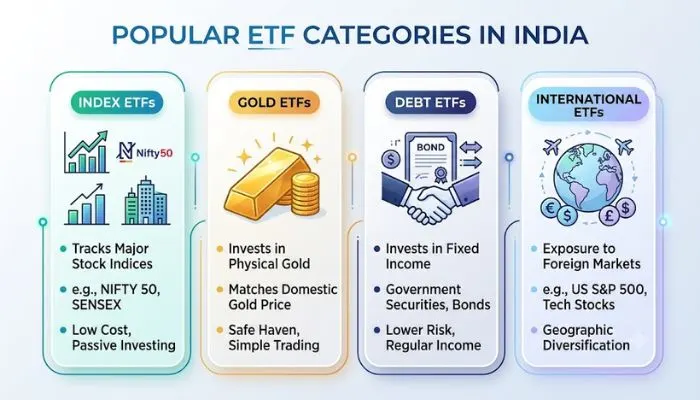
Not all ETF are same. Some hold shares of big companies. Some hold gold. Some hold government bonds. You must know which category fits your need. Below are best ETF categories for investors in India.
1. Large Cap Equity ETF
This category holds shares of top 100 companies in India by market size. Examples are Reliance, TCS, HDFC Bank, Infosys. These companies are stable. They grow slowly but steadily. This category is good for new investors. It is also good for people who do not want sudden ups and downs.
Large cap ETF in India gives 12 to 14 percent return on average over long term. Last 10 years have been good for large cap. The risk is low compared to small cap.
2. Index ETF
Index ETF copies a stock market index like Nifty 50 or Sensex. When Nifty goes up, your ETF goes up. When Nifty falls, your ETF falls. Index ETF is very simple. You do not need to research companies. You just believe India will grow.
Nifty 50 index ETF is the most popular in India. It holds 50 top companies. This is best ETF for long-term for many people because it is diversifed and cheap.
3. Gold ETF
Gold ETF holds real gold in a vault. Each unit of gold ETF is equal to one gram of gold. You do not have to buy physical gold. You do not pay making charges. You do not worry about theft. You can sell gold ETF anytime on stock exchange.
Gold gives good return when stock market goes down. It is a safety net. Many Indian investors keep 5 to 10 percent of their money in gold ETF.
4. Debt ETF
Debt ETF holds government bonds or company bonds. It gives fixed return. The return is lower than equity but risk is very low. People near retirement like debt ETF. Also people who want to keep emergency fund like debt ETF.
In India, Bharat Bond ETF is a good example. It is backed by government. It gives safe return.
5. International ETF
Some Indian ETF hold shares of foreign companies. For example US companies like Apple, Google, Amazon. You buy Indian ETF but your money goes to US market. This is good because India market and US market do not go up and down at same time. So your total portfolio stays balanced.
Motilal Oswal S&P 500 Index ETF is one example. It copies American index S&P 500.
6. Sectoral ETF
Sectoral ETF holds only one sector like banking, IT, pharma, or energy. This is risky because if that sector does bad, your money goes down. But if you understand a sector well, you can get high return. For example IT sector did very well in last 5 years.
Only experienced investors should put big money in sectoral ETF. For long term, best ETF categories for investors are usually large cap and index ETF.
Top 10 ETF Funds in India for Long-Term
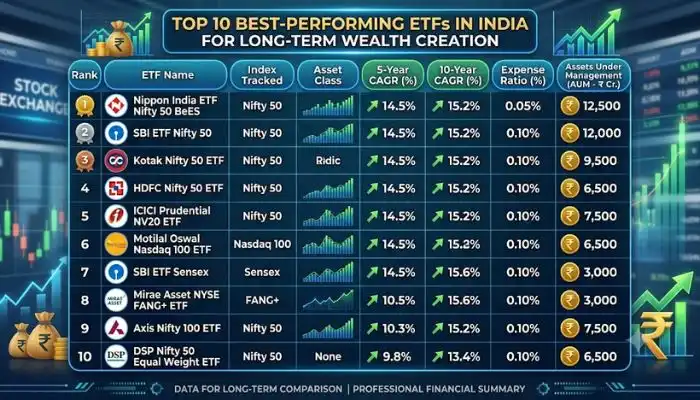
Now we give you top 10 ETF funds in India for long-term. These funds have good track record. Their cost is low. Their size is big so you can buy and sell easily. We have checked last 5 and 10 year performance.
| Number | ETF Name | Category | Expense Ratio | 10 Year Return (approx) |
|---|---|---|---|---|
| 1 | Nippon India ETF Nifty 50 | Index ETF | 0.05% | 13.8% |
| 2 | UTI Nifty Index ETF | Index ETF | 0.05% | 13.7% |
| 3 | HDFC Sensex ETF | Index ETF | 0.06% | 13.5% |
| 4 | Bharat 22 ETF | Government backed | 0.07% | 12.9% |
| 5 | CPSE ETF | PSU companies | 0.10% | 14.2% |
| 6 | Motilal Oswal S&P 500 Index ETF | International | 0.15% | 15.1% (in dollar terms) |
| 7 | Nippon India ETF Gold BeES | Gold | 0.80% | 9.5% |
| 8 | ICICI Prudential Nifty Next 50 ETF | Mid-large cap | 0.10% | 14.9% |
| 9 | SBI ETF Nifty 50 | Index ETF | 0.06% | 13.6% |
| 10 | Kotak Nifty ETF | Index ETF | 0.05% | 13.7% |
These top 10 ETF funds in India for long-term are safe choices. Most of them are index ETF because index ETF gives good return with very low cost. You do not need to buy all ten. Picking two or three is enough.
Best Performing ETFs Last 10 Years in India
Now let us talk about best performing ETFs last 10 years in India. Returns here are historical. Past does not guarantee future. But looking at last 10 years helps you see which categories did well.
Here are the top return makers in last 10 years:
- ICICI Prudential Nifty Next 50 ETF – This ETF holds companies that are just outside Nifty 50. These companies grow faster. Last 10 years return is near 15 percent.
- CPSE ETF – This holds shares of government companies like Coal India, NTPC, Power Grid. These gave very good dividend and price rise.
- Motilal Oswal S&P 500 Index ETF – This gave more than 15 percent in dollar terms. But rupee fall also helped Indian investors.
- Nippon India ETF Nifty 50 – Steady 13.8 percent return. No drama. Just solid growth.
- Bharat 22 ETF – This gave around 13 percent. It holds companies from different sectors.
Gold ETF did not come in top 5 because last 10 years gold gave only 9 to 10 percent. But gold is still good for safety.
So best performing ETFs last 10 years in India are mostly from growth index like Nifty Next 50 and PSU. But remember, higher return also means higher ups and downs.
Best ETF for Long-Term for Different Investors
One person asks what is best ETF for long-term. Another person asks same. But answer changes based on your age, goal, and risk taking ability.
For Young Person (Age 25 to 35)
Goal is wealth growth over 20 to 30 years. Best ETF for long-term for young person is Nifty 50 index ETF. Put 70 percent money in Nippon India Nifty 50 ETF. Put 20 percent in Motilal Oswal S&P 500 ETF for international exposure. Put 10 percent in gold ETF for safety.
For Person Near Retirement (Age 50 to 60)
Goal is safety with some growth. Best ETF for long-term for this person is debt ETF or balanced mix. Put 50 percent in Bharat Bond ETF. Put 30 percent in Nifty 50 ETF. Put 20 percent in gold ETF.
For Person Who Wants High Growth
If you can take big ups and downs, then put 50 percent in ICICI Nifty Next 50 ETF and 50 percent in CPSE ETF. This combination gave very high return last 10 years. But in some years it also fell sharply.
For Person Who Wants Simple One ETF Only
If you do not want to manage many things, buy only one ETF. That is Nippon India ETF Nifty 50 or UTI Nifty Index ETF. Put all your money there. Keep buying every month. Do not sell for 15 years. This is the simplest and most effective best ETF for long-term for most people.
How to Buy ETF in India?
Buying ETF is very easy. You need a demat account and trading account. You can open account with Zerodha, Groww, Angel One, Upstox, or any bank.
After opening account, you put money in it. Then go to buy section. Type the ETF name or code. For example Nippon India Nifty 50 ETF code is NIFTYBEES. Type how many units you want. Then buy at market price.
You can buy ETF just like you buy shares of Reliance or Tata. You can also sell anytime when market is open.
One more way is to do SIP in ETF. Some apps like Groww allow you to buy ETF automatically every month. But remember, ETF price changes every second. So your SIP will buy at different prices each time. That is fine for long term.

ETF vs Mutual Fund – Which is Better for Long Term
Many people ask this question. Here is simple answer.
| Point | ETF | Mutual Fund (Index or Active) |
|---|---|---|
| Cost | Very low (0.05 to 0.2 percent) | High for active (1 to 2 percent). Low for index fund (0.4 to 0.8 percent) |
| Buying time | Any time during market hours | Only end of day price |
| Demat needed | Yes | No for regular mutual fund |
| Lumpsum or SIP | Both | Both |
| Best for | People who have demat and want low cost | People who want automatic investment without stock market tension |
For long term, low cost wins. So ETF is better if you know how to use demat account. If you do not want demat, then buy index mutual fund from SBI, UTI or HDFC.
Mistakes to Avoid When Buying ETF in India
Many new investors make mistakes. Here are common ones.
Mistake 1 – Buying Very Small ETF
Some ETF have very low trading volume. That means few people buy and sell them. If you want to sell, you may not find buyer. Always check the AUM (asset under management). Buy ETF that has at least 500 crore rupees AUM.
Mistake 2 – Buying at Very High Premium
Sometimes people rush to buy an ETF and pay price higher than its real value. This is called premium. Check the iNAV (intraday net asset value) on stock exchange website. Do not pay more than 1 percent extra.
Mistake 3 – Buying Many ETF
You do not need ten ETF. Two or three ETF are enough. One Nifty ETF, one gold ETF, one international ETF. That is all.
Mistake 4 – Selling in Down Market
People see market falling and sell in fear. That is wrong for long term. Best performing ETFs last 10 years in India had many down years. But they recovered. Stay calm.
You May Also Read: Active vs Passive ETFs: Which Investment Wins in 2026?
How Much Money to Put in ETF?
There is no fixed number. Start with as little as 500 rupees per month. You can buy one unit of Nifty ETF for around 250 rupees. Slowly increase over time.
A good rule is to put at least 50 percent of your total investment money in ETF if you are young. If you are older, put 30 percent.
Do not put all money in one day. Divide your money into 12 parts. Buy one part each month for next one year. This is called rupee cost averaging. It reduces risk.
Tax on ETF in India
Tax is important for long term returns. For equity ETF (like Nifty ETF, gold ETF is different), rules are:
-
If you sell after 1 year, you pay 10 percent tax on profit above 1 lakh rupees. This is LTCG.
-
If you sell before 1 year, you pay 15 percent tax on profit. This is STCG.
For gold ETF, same tax rules as debt funds. That means you pay tax according to your income slab if sold before 3 years. After 3 years, you pay 20 percent with indexation benefit.
Always talk to a tax person for your exact case. But for most people, holding equity ETF for more than 1 year is very tax friendly.
Final Words
ETF is a very good tool for long term investing. Best ETF categories for investors are large cap, index, gold, and international. In this article we gave you top 10 ETF funds in India for long-term. We showed best performing ETFs last 10 years in India. And we told best ETF for long-term based on your age and goal.
Now the most important thing is not knowledge. It is action. Open a demat account. Put your first 1000 rupees. Buy one unit of Nippon India Nifty 50 ETF. Next month do it again. Keep doing for 10 years. You will see good result.
Do not chase high return. Do not sell when market falls. Do not buy many ETF. Keep it simple. Keep cost low. Stay patient. That is how you win with ETF in India.
FAQs
Is ETF safe in India?
Yes. ETF are registered with SEBI. They are managed by big mutual fund houses like Nippon, UTI, SBI, HDFC. Your money is safe.
Can I lose all money in ETF?
Very rare. If you buy Nifty 50 ETF, you will lose money only if all 50 top companies of India become zero. That will not happen. But your value can go down in short term.
Which is best ETF for long-term for 500 rupee per month?
Buy Nippon India Nifty 50 ETF. Start with one unit. Add more when you have more money.
Do ETF give dividend?
Some ETF give dividend. But for long term growth, better to choose growth option. In growth option, dividend is reinvested inside the fund.
Can I buy US ETF from India?
You cannot directly buy US ETF like VOO or SPY from India because of RBI rules. But you can buy Indian ETF that holds US shares. Example Motilal Oswal S&P 500 ETF.