

How to Invest in Inflation Indexed Bonds in India – A Complete Guide
You work hard for your money. Every month you save some part of your salary. You put that money in bank fixed deposits. But after one year you see that the things you wanted to buy have become more expensive. The money you saved now buys less things. This is inflation. It quietly eats your savings.
Many people in India are worried about inflation. They want a safe place to keep their money where inflation does not destroy its value. Bank fixed deposits give you fixed interest. But when inflation goes up, that fixed interest is not enough. You lose buying power.
This is where inflation indexed bonds come in. These bonds are made to protect your money from inflation. The government of India through the Reserve Bank of India gives these bonds. When inflation goes up, the value of your bond also goes up. Your money stays safe.
In this article we will learn how to invest in inflation indexed bonds. We will also look at what these bonds are. We will compare them with other bonds. We will see the interest rates. We will also understand why this topic is important for UPSC exam. And we will see what RBI has done with these bonds.
What Are Inflation Indexed Bonds?
A bond is like a loan. You give your money to the government. The government promises to return your money after some years. Until then the government pays you interest every year. This interest is called coupon.
In normal bonds the interest is fixed. Suppose you buy a bond that gives 7 percent interest. For the next ten years you get 7 percent only. If inflation becomes 8 percent then you lose 1 percent. Your money buys less things.
Inflation indexed bonds are different. These bonds change with inflation. How does this work.
The government takes a number called the inflation index. In India this index is called Consumer Price Index or CPI. This number tells how much prices have gone up. The bond value is linked to this number.
When inflation goes up the bond value also goes up. When you get interest it is calculated on this new higher value. So both your main money and your interest keep pace with inflation.
This is a very simple and powerful idea. Your money does not become weak. It stays strong even when prices rise.
The Reserve Bank of India started giving these bonds to common people in 2013. The name of this bond was Inflation Indexed National Savings Securities. People call it IINSS for short.
Read More: Short Term vs Long Term Bonds India Which One is Better for You?

Inflation Indexed Bonds Interest Rates – How They Work
Inflation indexed bonds do not have one fixed interest rate like a bank FD. They have two parts.
The first part is a fixed real rate. The government decides this rate when the bond is first sold. This rate stays the same for the whole life of the bond. For example when RBI first sold these bonds the fixed real rate was 1.5 percent.
The second part is the inflation part. This part changes every six months. RBI takes the inflation number from the government. They add this inflation number to the fixed real rate.
Let me give you a simple example. Suppose you buy a bond with fixed real rate of 1.5 percent. In the first six months inflation is 4 percent. Your total interest for that six months is 1.5 plus 4 which is 5.5 percent.
Now suppose in the next six months inflation goes up to 6 percent. Your total interest becomes 1.5 plus 6 which is 7.5 percent.
So when inflation goes up your interest also goes up. Your return is never less than the fixed real rate. It always stays above inflation by that fixed amount.
This is very different from a fixed deposit. In a fixed deposit if inflation goes up you lose. In these bonds if inflation goes up you gain.
The interest is paid every six months. The interest goes directly to your bank account. You can use that money for your daily needs. Or you can reinvest it somewhere else.
One thing to note is that the interest you get is fully taxable. The government does not give any tax benefit on these bonds. You have to pay tax according to your income slab. We will talk more about tax later.
Capital Indexed Bonds vs Inflation Indexed Bonds – What Is The Difference
Many people get confused between these two names. Capital indexed bonds and inflation indexed bonds sound similar. But they are not the same. India had both at different times. Let us understand the difference clearly.
Capital indexed bonds came first. The government of India launched these bonds in 1997. Then again in 2004. The idea was to protect people from inflation. But these bonds had a big problem.
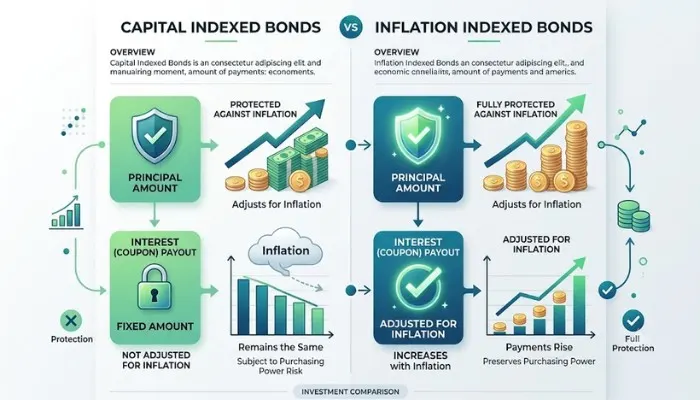
In capital indexed bonds only the main amount or capital is protected. The interest is not protected. This is the key difference.
Let me explain with an example. You buy a capital indexed bond for one lakh rupees. Inflation goes up by 5 percent. The government increases your main amount to one lakh five thousand rupees. So your capital is safe.
But the interest you get is still on the old one lakh rupees. And the interest rate is fixed. So if inflation is high the interest you get is not enough. You still lose buying power on the interest part.
This is why capital indexed bonds did not become popular. People saw that only half of their money was protected. The interest part was still eaten by inflation.
Then in 2013 the government launched inflation indexed bonds. These bonds protect both the main amount and the interest. This is the big difference.
In inflation indexed bonds the interest is calculated on the increased main amount. So you get more interest when inflation goes up. Your whole money is safe. Both what you invested and what you earn as interest keep pace with rising prices.
Here is a simple table to remember the difference.
| Feature | Capital Indexed Bonds | Inflation Indexed Bonds |
|---|---|---|
| Main amount protection | Yes | Yes |
| Interest protection | No | Yes |
| When was it launched | 1997 and 2004 | 2013 |
| Popular with people | No | More popular |
So when someone asks you the difference between capital indexed bonds and inflation indexed bonds you can say this. Capital indexed bonds only protect your main money. Inflation indexed bonds protect your main money and also your interest.
How To Invest In Inflation Indexed Bonds In India?
The Reserve Bank of India has made this process easy. You do not need to go to any office. You can do everything from your home on your computer or mobile phone.
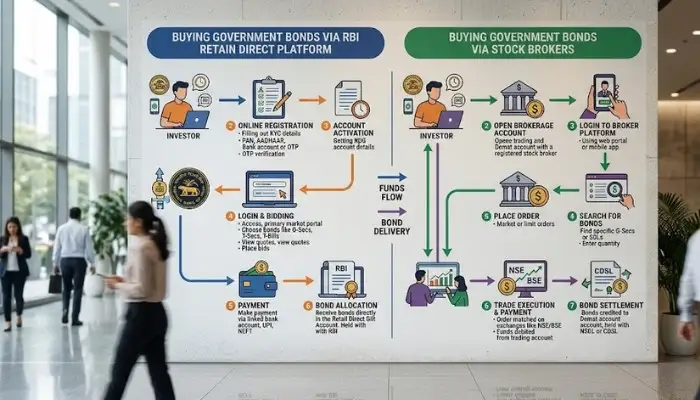
First you need to open an account on the RBI Retail Direct platform. This is a website made by RBI for common people to buy government bonds. Opening this account is free.
What do you need to open this account. You need your PAN card. You need your Aadhaar card. You need a bank account that is linked to your mobile number. You also need a Demat account.
A Demat account is like a digital locker for your shares and bonds. You can open a Demat account with any broker. Some popular brokers in India are Zerodha, Groww, Angel One, and Upstox. You can also open a Demat account with your bank. Many banks like SBI, HDFC, and ICICI offer Demat accounts.
Once you have your Demat account and your RBI Retail Direct account you can start buying.
Here are the steps in simple words.
- Step one – Log in to your RBI Retail Direct account.
- Step two – Go to the section where bonds are sold. Look for Inflation Indexed Bonds or IINSS.
- Step three – See how many bonds are available. The government does not sell these bonds every month. They come at certain times. You have to check the RBI website for the schedule.
- Step four – Decide how much you want to invest. The minimum amount for these bonds is five thousand rupees. You can buy in multiples of five thousand. The maximum amount for one person is ten lakh rupees.
- Step five – Place your order. The government will take your money from your bank account.
- Step six – The bonds will come to your Demat account. This takes a few days.
You can also buy these bonds from the stock market. After the government sells them first time they are listed on the Bombay Stock Exchange and National Stock Exchange. Just like you buy shares you can also buy these bonds from the exchange. But you need to know the ISIN number of the bond. You can find this on the exchange website.
Buying from the exchange is easier because you can buy any time the market is open. You do not have to wait for the government to sell new bonds. But the price on the exchange may be higher or lower than the original price. That depends on how many people want to buy and sell.
Who Should Buy These Bonds?
First type of person – You are retired or near retirement. You have saved money for your old age. You do not want to take any risk with that money. But you are worried that inflation will make your savings small. These bonds are perfect for you. The government gives the guarantee. So no risk of losing money. And inflation cannot hurt you.
Second type of person – You want to save for a childs education or marriage ten years from now. You know that prices will be much higher then. You want a safe place where your money grows at least as fast as inflation. These bonds work well for you.
Third type of person – You have money in bank fixed deposits. You see that after tax and after inflation you are actually losing money. You want to do better but without taking risk. These bonds are better than fixed deposits for beating inflation.
Now who should not buy these bonds.
If you are young and you want to grow your money fast then these bonds are not for you. The returns from these bonds are modest. They protect your money from inflation but they do not make you rich quickly. For fast growth you need shares or mutual funds. But those have risk. These bonds have no risk.
If you want to invest for less than five years then also these bonds are not good. The bond tenure is ten years. You can sell earlier on the exchange but the price may be less than what you paid. These bonds are meant for long term holding.
If you want regular fixed income every month then also these bonds are not the best. They pay interest every six months. Not every month. So for monthly expenses a fixed deposit or a monthly income scheme may be better.
Inflation Indexed Bonds UPSC – Why This Topic Is Important For Exam
If you are preparing for UPSC exam you cannot ignore this topic. The Union Public Service Commission has asked questions about inflation indexed bonds many times. In 2022 a question came in the prelims exam.
Let me tell you what UPSC wants you to know about these bonds.
First you must know the history. These bonds were announced in the 2013 budget. The finance minister at that time was P Chidambaram. The main reason for these bonds was to reduce the demand for gold. Indian people buy a lot of gold to protect against inflation. The government wanted to give a paper alternative. So they launched inflation indexed bonds.
Second you must know the difference between WPI and CPI. This is a favorite topic for UPSC. WPI is Wholesale Price Index. It measures prices at the factory gate. CPI is Consumer Price Index. It measures prices at the shop where you buy things.
The first inflation indexed bonds were linked to WPI. But soon people realized that WPI does not show the real inflation that common people face. When you buy vegetables milk and oil the price increase is shown in CPI not in WPI. So the government changed to CPI later. This is an important point for the exam.
Third you must know why these bonds did not become very popular. Despite being a good product not many people bought them. Why. There were two main reasons.
One reason was that the interest was taxable. If you are in the highest tax bracket you pay 30 percent tax on the interest. After tax your return is not much higher than a fixed deposit.
Second reason was that there was a deflation period in India. In 2015 and 2016 inflation came down. In some months prices actually fell. That meant the bond value also fell. People saw that their bond value was going down. They did not like this. They did not understand that deflation is temporary. So many people sold their bonds.
Fourth you must know that RBI bought back these bonds in 2016. Because not many people were buying them and the market was very small RBI decided to buy them back from people who wanted to sell. This is called a buyback.
For UPSC mains you may need to write about how inflation indexed bonds can help in financial inclusion. Or you may need to compare them with other inflation protection tools like gold. Keep these points in your notes.
You May Read Also: How to Buy Bonds on Paytm Money India Full Guide for Beginners
RBI Inflation Indexed Bonds – What The Central Bank Has Done
The Reserve Bank of India is the boss of all banks in India. RBI also manages government bonds. When the government decided to give inflation indexed bonds RBI became the seller.
RBI has done many things to make these bonds available to common people.
First RBI opened the Retail Direct platform. Before this you had to go through a bank or a broker to buy government bonds. The bank would take a fee. Now with Retail Direct you buy directly from RBI. No middleman. No fee.
Second RBI started giving these bonds in smaller amounts. Earlier government bonds were sold in minimum amounts of ten thousand or one lakh rupees. That was too high for common people. RBI brought the minimum down to five thousand rupees. This is a small amount that most people can manage.
Third RBI allowed these bonds to be held in Demat form. Earlier you had to take a physical paper certificate. That was difficult to keep safe. Now everything is digital. Your bonds are in your Demat account just like shares.
Fourth RBI started a scheme called IINSS-C. The C stands for cumulative. In this scheme you do not get interest every six months. The interest keeps adding to your main amount. At the end of ten years you get the whole amount with all the accumulated interest. This is good for people who do not need regular income and want the power of compounding.
Fifth RBI also started floating rate bonds. These are different from inflation indexed bonds but they also protect against rising interest rates. Many people confuse these two. Remember floating rate bonds change with bank interest rates. Inflation indexed bonds change with inflation. Both go up but for different reasons.
RBI has not sold new inflation indexed bonds for common people since 2015. The existing bonds are still there. People who bought them continue to hold them. But new issues have not come. If you want to buy now you have to buy from the stock exchange from someone who wants to sell.
Tax On Inflation Indexed Bonds
Tax is not a fun topic but it is important. Because the tax you pay affects how much money you finally get.
The interest you get from inflation indexed bonds is added to your other income. Then you pay tax according to your income tax slab.
Suppose you are in the 20 percent tax slab. You get ten thousand rupees as interest from these bonds. You have to pay two thousand rupees as tax. You keep eight thousand rupees.
If you are in the 30 percent tax slab you pay three thousand rupees tax. You keep seven thousand rupees.
There is no tax deducted at source on these bonds. That means when RBI pays you interest they do not cut any tax. The full amount comes to your bank. You have to calculate the tax yourself and pay it when you file your return.
If you sell these bonds on the stock exchange before ten years then you may have to pay capital gains tax. Capital gains tax is different from interest tax.
If you hold the bond for more than three years then it is long term capital gain. You pay tax at 20 percent with indexation benefit. Indexation means you adjust the purchase price for inflation so that you pay less tax.
If you hold the bond for three years or less then it is short term capital gain. You pay tax according to your income slab.
There is no special tax saving benefit in these bonds. Section 80C of the income tax act does not apply here. So if you want to save tax you need other instruments like PPF or ELSS mutual funds.
Risks You Should Know Before Buying
No investment is completely without risk. Inflation indexed bonds are very safe but they still have some risks. You should know them before you put your money.
First risk is liquidity risk. This is a big word but the meaning is simple. Liquidity means how easily you can sell something and get your money. If many people are buying and selling then liquidity is high. If very few people are buying and selling then liquidity is low.
The market for inflation indexed bonds in India is small. Not many people trade them on the stock exchange. If you want to sell you may not find a buyer immediately. Or you may have to sell at a lower price. This is a real risk.
Second risk is deflation risk. Deflation is when prices fall. It does not happen often in India but it can happen. In 2015 and 2016 India saw some deflation. When prices fall the value of your bond also falls. Your main amount becomes smaller. You get less interest.
But here is the good news. At maturity the government promises to give you at least the original amount you invested. Even if there was deflation your money does not go below what you put in. This guarantee is called principal protection.
Third risk is interest rate risk on the exchange. If you buy these bonds from the stock exchange instead of directly from RBI you pay a market price. That price can be higher or lower than the original value. If you need to sell when prices are low you may lose some of your money.
Fourth risk is that the government may not sell new bonds. As of now RBI has not sold new inflation indexed bonds for common people for many years. If you want to buy you have to use the exchange. And the bonds available on the exchange have different remaining tenures. You may not get a bond that matches your time frame.
Where Do These Bonds Stand Compared To Other Options?
First compare with bank fixed deposits. Fixed deposits give you a fixed interest. If inflation goes up you lose. Inflation indexed bonds give you a return that goes up with inflation. So for protecting against inflation bonds are better. But fixed deposits are easier to open and understand. Every bank branch offers them. Inflation indexed bonds need a Demat account and some effort.
Second compare with gold. Gold is the old way Indians protect against inflation. Gold has no interest. You make money only when gold price goes up. Gold prices can go up and down a lot. Inflation indexed bonds give regular interest. Gold is more volatile. For safety bonds are better. For possible higher returns gold can be better but with more risk.
Third compare with Public Provident Fund or PPF. PPF gives around 7 to 8 percent interest. The interest is not taxable. PPF has a lock in of 15 years. Inflation indexed bonds give interest that is higher when inflation is high. But the interest is taxable. For a person in high tax bracket PPF may be better.
Fourth compare with National Savings Certificate or NSC. NSC also gives fixed interest. The interest is taxable. NSC has a lock in of 5 years. Inflation indexed bonds have a lock in of 10 years but you can sell earlier.
Fifth compare with mutual funds. Mutual funds can give much higher returns but they can also give losses. Inflation indexed bonds never give losses in main amount if held to maturity. For people who cannot take any risk bonds are better.
Here is a simple way to think. If you want zero risk and you want to beat inflation choose inflation indexed bonds. If you want zero risk and you want to save tax choose PPF. If you can take some risk for higher returns choose good mutual funds. If you want the old traditional way choose gold.
Step By Step Process To Buy From Stock Exchange
Since RBI is not selling new bonds you may have to use the stock exchange. Here is the full process.
First open a Demat account and a trading account with a broker. Many brokers offer both together. You need your PAN card and Aadhaar card and a bank account. The broker will do a video call to verify you. This takes one or two days.
Second add money to your trading account. You can transfer money from your bank account to the brokers account.
Third open the trading app or website. Go to the bond section. Some apps call it debt section or government securities section.
Fourth search for inflation indexed bonds. You need to know the ISIN number. ISIN is a unique code for each bond. You can find the ISIN numbers on the National Stock Exchange website. Search for IINSS or inflation indexed bonds.
Fifth look at the price. The price is shown for one bond. The face value of one bond is usually one hundred rupees. So if the price is 102 rupees you pay one hundred two rupees for a bond with face value one hundred rupees.
Sixth decide how many bonds you want to buy. Each bond has face value one hundred rupees. If you want to invest fifty thousand rupees you need to buy bonds worth that amount.
Seventh place a buy order. Choose the price you want to pay. You can pay the market price or you can put a lower price and wait.
Eighth when your order is filled the bonds come to your Demat account. You can see them in your portfolio.
Selling is the same process. You go to the trading app and place a sell order. The money comes to your bank account in two days.
Common Mistakes People Make
Many people make mistakes with these bonds. Learn from others mistakes so you do not repeat them.
First mistake is buying without understanding how inflation adjustment works. Some people think they will get very high returns. The return is only slightly above inflation. It will not make you rich. It only protects you.
Second mistake is selling during deflation. In 2015 inflation went down. Bond values went down. Many people panicked and sold at a loss. If they had held for a few more months they would have got their money back because the government guarantees the original amount at maturity.
Third mistake is not accounting for tax. Some people calculate their return without removing tax. Then they think they are getting high return. After tax the return is lower. Always calculate after tax return.
Fourth mistake is buying when they need money in a few years. These bonds are best for ten years. If you sell earlier the price on the exchange may be low. If you know you need money in two or three years put it in a fixed deposit instead.
Fifth mistake is buying through a broker who charges high fees. Some brokers take a percentage of your investment as fee. Others take a fixed small amount. Use a discount broker to keep your costs low.
Final Words
Inflation is a quiet thief. It steals from your savings slowly. You do not feel it in one month or one year. But over ten years the damage is very real. Your fifty thousand rupees today will not buy the same things ten years from now.
Inflation indexed bonds are a simple honest answer to this problem. The government promises to keep your money safe from price rise. You do not need to be a finance expert. You do not need to watch the market every day. You just buy the bond and forget about it. The inflation adjustment happens automatically.
For retired people these bonds are a blessing. Your pension may not go up with inflation. But your bond interest will. This helps you maintain your standard of living as you grow older.
For young people these bonds are not a way to get rich. They are a way to keep some part of your savings completely safe. You can put your emergency fund here. You can put money you are saving for a long term goal here.
For UPSC aspirants this is a topic that keeps coming back. The questions are not very hard. If you understand the basic idea of how these bonds work and the history in India you can answer most questions.
For everyone else these bonds are worth considering. Before you renew that fixed deposit for another year ask yourself. Is the interest I am getting really beating inflation. If the answer is no then look at inflation indexed bonds.
The process to buy is not very hard. Open a Demat account. Open RBI Retail Direct account. Place your order. That is all. Your money works hard for you all year. Give it a safe home where inflation cannot find it.
FAQs
Can I buy inflation indexed bonds without a Demat account
No you cannot. These bonds are now held only in Demat form. You need a Demat account to buy and hold them.
What is the minimum amount to invest
The minimum amount is five thousand rupees. You can add in multiples of five thousand.
Do I get any tax benefit under section 80C
No. These bonds do not give any tax saving benefit.
Has RBI stopped selling new bonds
RBI has not sold new inflation indexed bonds for common people since 2015. You can only buy existing bonds from the stock exchange.
Is this topic important for UPSC
Yes. UPSC has asked questions about inflation indexed bonds in prelims. Know the history and the difference between WPI and CPI.