

How Do Rising Interest Rates Affect Real Estate? Full Guide with Chart and EMI Examples
If you are planning to buy a home in India, you keep hearing one thing on the news – interest rates are going up. The Reserve Bank of India increases the repo rate. Then banks increase home loan rates. You feel confused. You feel worried. You ask yourself a simple question: how do rising interest rates affect real estate?
This is a very important question. And the answer is not just one line. Rising interest rates change many things. They change your EMI. They change the final price of the flat. They change how many people can afford to buy a house. They even change whether a builder launches a new project or waits.
In this article, we will explain everything step by step. We will use simple words. We will show you a real interest rates vs home prices chart for India. We will explain how do interest rates affect mortgages in a way that your neighbour can understand. And we will show the real interest rates impact on housing market across Indian cities like Mumbai, Delhi, Bengaluru, Pune, and Chennai.
What Happens When Interest Rates Rise ?
When interest rates rise, the cost of borrowing money goes up. In India, most people do not buy a house with full cash. They take a home loan. The bank gives them money. In return, the bank takes interest every month. That interest is the bank’s profit.
Now imagine you take a home loan of 50 lakh for 20 years. At a low interest rate of 8%, your monthly EMI is around 41,822. But if the interest rate rises to 9.5%, your monthly EMI becomes around 46,607. That is an extra 4,785 every month. Every single month. For 20 years.
That extra money is not small. That extra money could have gone to your child’s school fees, your monthly grocery bill, or your family trip. Now that money goes only to the bank as extra interest.
This is the first and biggest effect of rising interest rates. Your EMI goes up. Your monthly savings go down. And your dream of owning a home becomes heavier on your pocket.
Read More: Best Place to Invest in Property in India
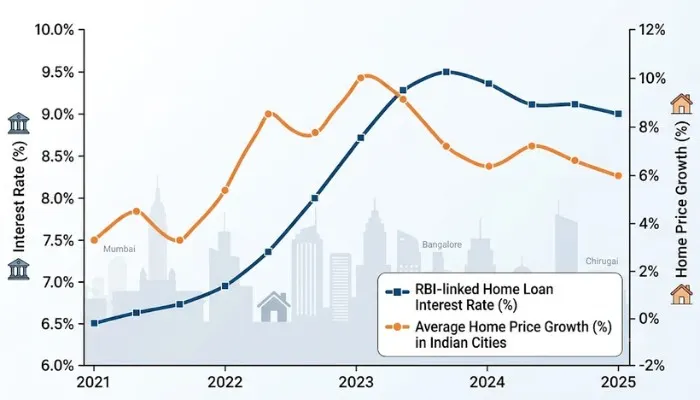
Interest Rates vs Home Prices Chart
Many people believe that when interest rates go up, home prices automatically fall. That is not fully true. In India, the relationship is slower and more complicated. Still, there is a clear pattern.
Let us look at a simple interest rates vs home prices chart based on Indian data from the last five years.
| Year | Average Home Loan Rate (RBI linked) | Average Home Price Change (Top 8 Cities) |
|---|---|---|
| 2021 | 6.7% to 7% | +3% to +5% (post covid recovery) |
| 2022 | 7% to 8.5% | +6% to +8% (high demand, late effect) |
| 2023 | 8.5% to 9.15% | +4% to +6% (growth slows down) |
| 2024 | 9% to 9.4% | +2% to +4% (affordability pressure) |
| 2025 | Expected 8.5% to 9% (if cuts happen) | Stable to +3% (demand may pick up) |
What does this interest rates vs home prices chart tell us? It tells us that home prices do not fall immediately when rates rise. But the speed of price rise becomes slower. This is called price growth moderation. Builders cannot increase prices as fast as before because fewer people can afford high EMIs.
So the real effect is not a crash. The real effect is a slowdown in price increase. For a middle class family in India, that slowdown is important. Because even a 2% extra price on a 1 crore flat means 2 lakh more. That is a lot of money.
How Do Interest Rates Affect Mortgages ?
Now let us answer the question how do interest rates affect mortgages in full detail. A mortgage is just another name for home loan. In India, most home loans are taken for 15 to 30 years. The interest rate decides almost everything.
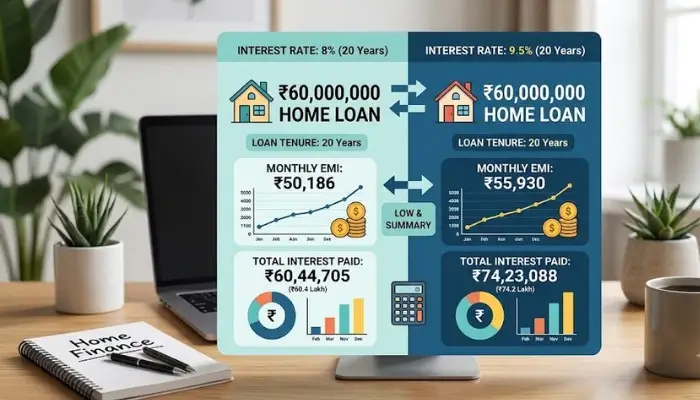
Here is a real example. Suppose you want to buy a flat worth 75 lakh in Noida or Thane or Ahmedabad. You have 15 lakh as down payment. You take a loan of 60 lakh for 20 years.
Case 1 – Interest rate is 8%
- Monthly EMI – 50,186
- Total interest paid in 20 years – 60,44,640
- Total amount paid to bank – 1,20,44,640
Case 2 – Interest rate rises to 9.5%
- Monthly EMI – 55,928
- Total interest paid in 20 years – 74,22,720
- Total amount paid to bank – 1,34,22,720
The difference is shocking. You pay 5,742 more every month. And over 20 years, you pay nearly 14 lakh extra only as interest. That 14 lakh could have bought a small car, paid for two years of college, or furnished your entire home.
This is how do interest rates affect mortgages in real life. It makes your loan much more expensive without giving you any extra benefit. The same house. The same flat. But much higher total cost.
Also, banks check your monthly income before giving a loan. They say your EMI cannot be more than 40% to 50% of your monthly take home salary. When interest rates rise, your EMI rises. That means for the same salary, you now qualify for a smaller loan amount. So you cannot buy the flat you wanted. You have to settle for a smaller flat or a cheaper location.
Interest Rates Impact on Housing Market – What Changes in Real Life
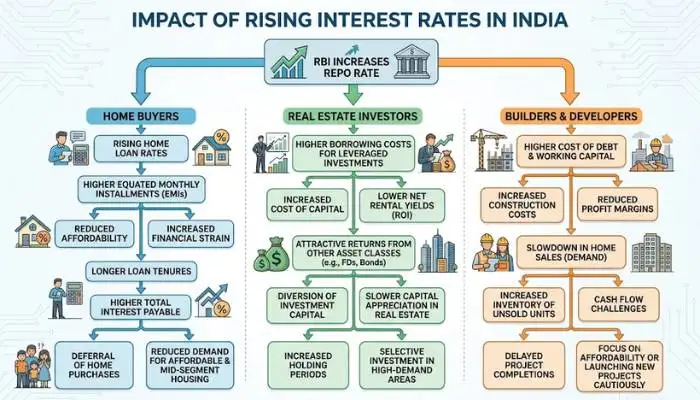
Let us now look at the full interest rates impact on housing market in India. This impact is not just one thing. It changes behaviour of three different groups – home buyers, investors, and builders.
Effect on Home Buyers
The first group is common people like you and me. When interest rates rise, many people delay their buying decision. They say – let me wait for rates to fall. Some people cancel their booking. Others try to put a bigger down payment to reduce loan amount. But most salaried people do not have extra lakhs lying around. So they simply wait. And waiting slows down the entire market.
Effect on Real Estate Investors
In India, many people buy property not to live but to sell later at higher price. These are investors. When interest rates rise, investors become very careful. Their cost of holding a property goes up. If they also took a loan, their EMI eats into any possible profit. Many investors leave the market and put money in fixed deposis instead. This reduces the number of buyers. Lower demand means prices do not rise fast.
Effect on Builders and Developers
Builders also take huge loans to construct buildings. When interest rates rise, their construction cost goes up. They have to pay more interest to their banks. They cannot easily increase flat prices because buyers are already struggling. So their profit margin falls. Many small builders stop new projects. Some builders offer discounts, free parking, or reduced registration fees to attract buyers. This is good for buyers but bad for the builder.
So the interest rates impact on housing market is a chain reaction. Higher rates → lower demand → slower price growth → less new supply → market becomes slow for one or two years.
But India Is Different – Why Rates Are Not Everything
Here is something important. In India, interest rates are not the only thing that decides real estate prices. Unlike America or Europe, Indian real estate is driven by many local factors.
First, in Indian cities, a large part of home buying happens with black money or unaccounted cash. Those buyers are less affected by interest rates because they pay less loan amount.
Second, many Indian families buy homes for marriage, parents, or children’s schooling. These are emotional buys. Even if interest rates are high, some families still buy because they have no other option.
Third, the cost of construction materials like cement and steel keeps rising. Even if interest rates go up, builders cannot reduce prices much because their own cost is high.
Fourth, in cities like Mumbai and Bengaluru, land cost is already very high. Interest rates do not change land cost. So final flat price stays high.
This means rising interest rates do not crash the Indian real estate market. They only slow it down. They make it harder for middle class families. But luxury homes in good locations still sell.
You May Also Read: Best Real Estate Investment Advice for Beginners in India (With Little Money)
Should You Buy a Home When Interest Rates Are Rising?
This is the final question every reader has. Should you buy now or wait?
You should consider buying if –
- You have a stable job with regular income increases.
- You can put a down payment of 25% to 30% to reduce your loan.
- You find a ready to move in flat from a good builder.
- You plan to stay in that home for at least 10 to 15 years.
You should wait if –
- Your job is not very secure.
- You are taking a loan near your maximum limit.
- You are buying only as an investment, not for living.
- You see that prices are already too high in your city.
One good strategy is to buy when interest rates are near their peak. Because after the peak, RBI slowly reduces rates. When rates fall, your EMI falls. And property prices start rising again. So you buy at a slower price, then benefit from lower EMI later.
Final Summary
Rising interest rates affect real estate in many ways. Your EMI goes up. Your loan eligibility goes down. Builders become careful. Investors step back. Prices stop rising fast. But the Indian market does not crash easily because of emotional buying, cash deals, and high construction costs.
The best time to buy is when you have stable income, good down payment, and a long term plan. Do not try to time the market perfectly. Instead, focus on what you can afford every month.
If you are confused, talk to a local bank manager. Get a loan eligibility letter. Calculate your EMI at current rates. Then decide.
Understanding how do rising interest rates affect real estate is not difficult. Just remember one number – your monthly EMI. That number decides everything. Keep it within your comfort, and you will be safe.
FAQs
Does rising interest rate reduce property value?
Not directly. But it reduces how much buyers can pay. So sellers cannot ask very high prices.
Which Indian city is most affected by interest rate rise?
Cities with high prices like Mumbai, Delhi, Bengaluru see more slowdown. Smaller cities like Lucknow, Indore, Nagpur see less effect.
Can I switch my home loan to a lower rate later?
Yes. You can do a balance transfer to another bank. But there are processing fees and legal charges. Calculate carefully before switching.
How long do high interest rates last in India?
Usually 12 to 24 months. Then RBI starts reducing rates when inflation comes under control.
Is it better to take a fixed rate or floating rate home loan?
In India, floating rate is better for most people because fixed rates are very high. But if you cannot handle EMI changes, fixed rate gives peace of mind.