

How to Calculate Corporate Bond Returns in India: A Simple Guide
Corporate bond returns are not just about the interest you receive. Many investors make this mistake. They look at the coupon rate and assume that is their return. But the actual return depends on the price you pay, the time you hold, and the tax you pay.
This guide explains how to calculate corporate bond returns in simple words. You will learn the key formulas. You will also see how to use bond calculators available in India. No complicated jargon. Just clear steps that show you your real return. Read this guide. Know what you actually earn.
The Two Main Measures of Bond Return
When people talk about bond returns, they usually mean one of two things. Current yield or yield to maturity.
- Current Yield is the simplest measure. It tells you the annual income you get compared to the price you paid.
- Formula: Current Yield = (Annual Coupon Payment ÷ Current Market Price) × 100
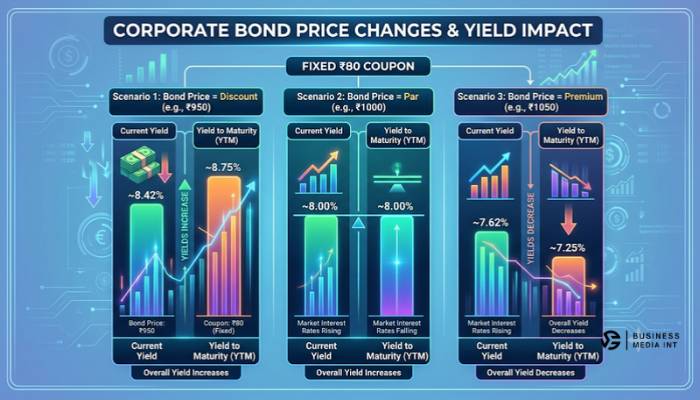
If a bond pays 80 per year and you buy it for 1,000, the current yield is 8%. But if you buy it for 900, the current yield is 8.89%. The coupon did not change. Your price did .
Yield to Maturity (YTM) is the more complete measure. It tells you the total return you will earn if you hold the bond until maturity. It accounts for the coupon payments, the price you paid, and the difference between your purchase price and the face value you get back at maturity .
YTM is what you should compare across different bonds. A high coupon bond bought at a premium may have a lower YTM than a low coupon bond bought at a discount.
Read More: How to Buy Bonds Through a Demat Account: A Beginners Guide
Bond Valuation Formula
To understand YTM, you need the bond valuation formula. This formula calculates the present value of all future cash flows.
Bond Price = Present Value of Coupons + Present Value of Face Value
The formula looks like this:
Price = C × [1 – (1+r)^-n] / r + FV / (1+r)^n
Where:
- C = annual coupon payment
- r = required rate of return (YTM)
- n = number of years to maturity
- FV = face value
You do not need to calculate this by hand. Financial calculators and Excel do it for you. But understanding the formula helps you see why bond prices change when interest rates change.
How to Calculate Corporate Bond Returns in India?
In India, there are some specific points to remember.
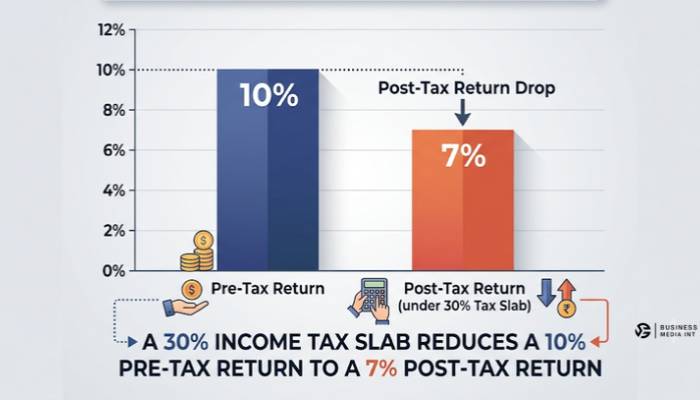
- Tax on interest. The interest you receive from corporate bonds is added to your total income. It is taxed as per your income tax slab. If you are in the 30% bracket, a 10% coupon gives you only 7% after tax. This is a big difference .
- TDS. If your annual interest from a bond exceeds 10,000, the issuer deducts 10% TDS. This is not an extra tax. It is tax paid in advance. You can adjust it when you file your return .
- Capital gains. If you sell the bond before maturity, any profit is taxed as capital gains. For listed bonds held over 12 months, the tax is 12.5%. If held for less than 12 months, it is taxed at your slab rate.
- Day count convention. Indian corporate bonds use the ACT/ACT convention for accrued interest. Government securities use 30/360. This matters when you calculate accrued interest for settlement .
Bond Returns Calculator India
You do not need to build your own spreadsheet. Several free calculators are available for Indian investors.
- IndiaBonds Bond Calculator. This tool is from SBI Cap Securities. It is SEBI-registered. You can search for any bond and calculate price, yield, and settlement amount. It shows a detailed breakup of principal, accrued interest, and total settlement. It is free to use .
- BondLab (bondlab.in). This is an independent calculator built by a former BlackRock analyst. It uses actual Indian market conventions—30/360 for G-secs and ACT/ACT for corporate bonds. It has a YTM calculator, an FD vs bond comparison, and a post-tax yield calculator. It is free with no login required .
- RightBonds Post-Tax Yield Calculator. This tool focuses on what you actually keep after tax. You enter the yield, your tax slab, and the amount. It shows your post-tax yield. It also explains TDS clearly .
Bond Yield Calculator Monthly
Some investors want to know their monthly income from a bond. This is simple if the bond pays monthly. But most corporate bonds in India pay interest semi-annually or annually.
If you want to compare a monthly-paying instrument with a semi-annual bond, you need to convert the yields to the same frequency. The formula for effective annual rate (EAR) is:
EAR = (1 + R/M)^M – 1
- Where R is the nominal rate and M is the number of compounding periods per year. For monthly, M = 12. For semi-annual, M = 2 .
- This lets you compare apples to apples. A 10% monthly-paying deposit is not the same as a 10% semi-annual bond.
You May Also Read: How Bond Maturity Value Is Calculated: A Simple Guide
Quick Summary Table
| Measure | Formula | What It Tells You |
|---|---|---|
| Current Yield | (Annual Coupon ÷ Price) × 100 | Annual income relative to price |
| YTM | Discount rate that equates price to future cash flows | Total return if held to maturity |
| Post-Tax Yield | YTM × (1 – Tax Slab) | What you actually keep |
| EAR | (1 + R/M)^M – 1 | Comparable yield across frequencies |
FAQs
1. What is the difference between coupon rate and yield?
Coupon rate is the fixed interest rate on the face value. Yield is the return based on the price you actually pay. If you buy at a discount, your yield is higher than the coupon. If you buy at a premium, your yield is lower .
2. How do I calculate YTM for a corporate bond?
Use the bond valuation formula: Price = C × [1 – (1+r)^-n] / r + FV / (1+r)^n. Solve for r. Or use an online calculator like IndiaBonds or BondLab .
3. How are corporate bond returns taxed in India?
Interest is added to your income and taxed at your slab rate. TDS at 1% applies if annual interest exceeds 10,000. Capital gains on listed bonds held over 12 months are taxed at 12.5% .
4. What is a good YTM for a corporate bond in India?
It depends on the credit rating. AAA-rated corporate bonds typically yield 7-8%. AA-rated bonds yield 8-9%. Lower-rated bonds yield higher but carry more risk. Compare YTM, not coupon, across bonds.
5. Can I use Excel to calculate bond returns?
Yes. Excel has built-in functions like YIELD and PRICE. You can also build your own formula using the bond valuation equation. This is useful if you want to compare many bonds quickly.
6. What is accrued interest and why does it matter?
Accrued interest is the interest that has built up since the last coupon payment. When you buy a bond, you pay the market price plus accrued interest. This ensures the seller gets their share of the interest earned so far. Indian corporate bonds use ACT/ACT for this calculation .
7. How do I compare a monthly-paying bond with a semi-annual bond?
Convert both to effective annual rate (EAR). Use EAR = (1 + R/M)^M – 1. This lets you compare them on the same basis .
8. Are there free bond calculators for Indian investors?
Yes. IndiaBonds has a free bond calculator. BondLab (bondlab.in) is an independent free calculator built for Indian market conventions. RightBonds has a post-tax yield calculator .