

What Is the Best Trading Strategy for Beginners? A Complete Guide
The first thing every new trader in India wonders is what's the best trading strategy for beginners? It's not a single "magic trick". It's all about a simple plan that checks out for your time and objectives. A lot of individuals believe trading is hard.
They think that it takes an expert to begin. The reality is quite different, however. A good strategy is a road map. It offers you the timing when to buy, when to sell, and when to wait. This map is a must have if you're not going to guess. The quickest way to lose your hard earned money is to guess. This guide will get you familiar with simple and safe steps to start your trading journey in India.
What is a Trading Strategy?
A trading strategy is like a recipe. It tells you exactly what to do. When to buy. When to sell. How much to risk. When to stay away. Without a strategy, you are just guessing. That is not trading. That is gambling.
Knowing your risk to reward ratio before entering a trade. This is the loss that you can take versus the profit that you can achieve. Here's the thinking behind it. When preparing a new food item, a recipe is followed. You are not going to throw things in a pan and hope they turn out. It's the same with trading. The right approach eliminates confusion. It assists you with decision making on RULES not feelings.
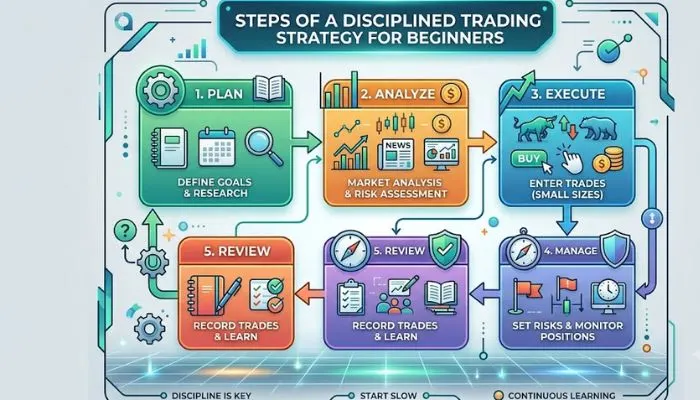
Why Beginners Need a Strategy?
Most new traders lose money. This is not because they are unlucky. It is because they do not have a plan. When you have no plan, fear and greed take over. You buy when prices are high because everyone is buying. You sell when prices are low because you are scared. This is the fastest way to lose your money.
A strategy protects you from yourself. It gives you a system to follow. Even when the market is crazy, you stick to your rules.
Trading is Legal in India, But You Must Follow the Rules
Before we talk about strategies, let's clear this up. Yes, you can trade forex in India. But there are strict rules. The Reserve Bank of India (RBI) and SEBI control how trading works in our country.
In India, you can only trade certain currency pairs. These include USD/INR, EUR/INR, GBP/INR, and JPY/INR. You must use a SEBI-registered broker. You cannot trade on foreign platforms that are not approved in India. This is very important. Many people have lost money using illegal brokers.
Read More: How to Avoid Emotional Trading: Simple Guide for Traders
Best Trading Strategies for Beginners
These are some of the basic tips that are effective for new traders. These have been selected as being easy to understand and follow.
1. Trend Trading
This is the simplest strategy. The idea is simple. When the price is going up, you buy. When the price is going down, you sell. You follow the direction of the market.
Think of it like sailing. If the wind is blowing one way, you sail that way. You do not fight the wind. In trading, you do not fight the trend.
How to use trend trading:
- Look at the daily chart.
- Look at the daily chart.
- Look for higher highs and higher lows in the price.
- If it is yes, then it's an uptrend. Consider buying.
- Use a moving average to help you see the trend clearly.
2. Swing Trading
Swing trading is perfect for people who cannot watch the market all day. Maybe you are a student. Maybe you have a job. You can still make money with swing trading.
Swing traders hold positions for a few days to a few weeks. They try to catch the "swing" or the movement within a trend. This strategy does not need your full attention all day. You can check the charts once or twice a day.
Why swing trading works for beginners:
- You do not need to be glued to your screen.
- You have time to think before making decisions.
- Transaction costs are lower because you trade less often.
- It is less stressful than day trading.
3. Range Trading
Sometimes the market does not go up or down. It moves sideways. This is called a ranging market. Range trading works well here.
In a range, the price bounces between two levels. The top level is called resistance. The bottom level is called support. You buy near the support and sell near the resistance. This is like buying low and selling high within a box.
Range trading is good for beginners because:
- It is easy to see the support and resistance levels.
- You have clear entry and exit points.
- It works well in markets that are not moving up or down strongly.
4. Breakout Trading
Breakout trading is about catching big moves. Sometimes the price breaks out of its range. It moves past resistance and keeps going up. Or it falls below support and keeps going down. Breakout traders try to catch these moves early.
The key to breakout trading is to wait for confirmation. Do not jump in as soon as the price crosses a level. Wait for a strong move with high volume. This helps avoid false breakouts where the price goes back inside the range.

Which Strategy Should You Choose?
This is the big question. How do you pick the best trading strategy for you? Here is how to decide.
Think About Your Time
How much time do you have?
- If you work full-time: Swing trading is good. You can check charts in the evening.
- If you are a student: You may have more flexible time. You could try trend trading.
- If you want to trade full-time: You can look at day trading or scalping. But these are harder for beginners.
Think About Your Personality
Are you patient? Do you like to wait for the right moment? Then swing trading or trend trading may suit you. Do you like action and fast decisions? Maybe you will enjoy breakout trading. Be honest with yourself. Choose a strategy that fits who you are.
Start Simple
Do not try to do everything. Pick one strategy. Learn it well. Practice it on a demo account. Then test it with small money. Once you have mastered one strategy, you can try others. Most professional traders are experts in just one or two approaches.
How to Build Your Own Trading System?
Making your own trading system sounds hard. But it is not. Here are simple steps to build a system that works for you.
Step 1: Set Your Goals
What do you want from trading? More pocket money? A new career? Your goals will shape your strategy. Be realistic. Do not expect to get rich overnight. Trading is a skill. It takes time to learn.
Step 2: Choose Your Market and Timeframe
For Indian traders, USD/INR is a good starting point. It is the most traded pair in India. It has good liquidity and clear price movements.
For timeframe, start with the daily chart. It is less noisy than smaller timeframes. You will not see as many false signals.
Step 3: Create Clear Entry Rules
Your entry rules should be crystal clear. If two traders look at the same chart, they should see the same signal. Here are examples of clear entry rules:
- "Buy when price goes above the 50-day moving average."
- "Sell when price breaks below support level."
Avoid vague rules like "the price looks like it will go up." That is not a rule. That is a guess.
Step 4: Define Your Exit Rules
This is where most beginners fail. They focus on when to enter. They forget about when to exit. Your exit rules are just as important.
Your exit rules should cover:
- Where to place your stop-loss (the point where you will accept a loss).
- Where to place your take-profit (the point where you will take your profit).
- When to exit if the trade does not move.
Step 5: Set Your Risk Per Trade
Risk management is the most important part of trading. Even the best strategy will fail without good risk management.
Here is a simple rule. Risk no more than 1% of your trading capital on each trade. If you have 50,000, your maximum loss per trade is 500. This might seem small. But it protects you. If you have a losing streak, you still have money to continue trading.
Step 6: Test Your System
Before you use real money, test your system. Most brokers offer demo accounts. These let you trade with virtual money. Use this to see if your strategy works.
Test at least 50 to 100 trades. See how many are winners. How many are losers. What is your average profit versus your average loss. This data will tell you if your strategy has an edge.
Risk Management: The Key to Survival
We have mentioned risk management several times. That is because it is the most important thing in trading. Good risk management is the difference between winning and losing over time.
Use Stop-Loss Orders
A stop-loss is your safety net. It is an order that automatically sells your position if the price moves against you. Always use a stop-loss. Never trade without one.
The 1% Rule
Do not risk more than 1% of your capital on a single trade. This is the golden rule of trading. It protects you from big losses.
Risk-to-Reward Ratio
Have a risk to reward ratio in mind before entering a trade. This is how much you can lose before making any profit. The general guideline is to have a 1:2 risk-to-reward ratio. If you risk 100, you aim to make 200. That's a 50% win rate and you can still make money.
Common Mistakes New Traders Make
Let us look at the most common mistakes. Avoid these, and you will be ahead of most beginners.
1. Using Too Much Leverage
Leverage is borrowed money. It can increase your profits. But it also increases your losses. Many new traders use too much leverage. One bad trade wipes out their account. Start with low leverage. Or better yet, trade without leverage at first.
2. Trading Without a Stop-Loss
Some beginners think they can just wait for the price to come back. This is a disaster. The price may never come back. You could lose everything. Always set a stop-loss.
3. Overtrading
Overtrading happens when you take too many trades. Sometimes you trade because you are bored. Or you want revenge after a loss. This leads to poor decisions and big losses. Stick to your plan. Only trade when your rules tell you to.
4. Revenge Trading
After a loss, you want to get your money back fast. You take a big risk. This is called revenge trading. It is dangerous. It often leads to even bigger losses. Accept losses as a cost of doing business. Move on. Stay disciplined.
5. Following Tips
Do not buy stocks or currencies just because someone recommended them. You need to do your own research. When you follow tips, you have no plan. You do not know when to exit. This leads to losses.
6. Not Keeping a Trading Journal
A trading journal is a record of all your trades. Write down why you entered, why you exited, and what you learned. Review your journal every week. It helps you see patterns and improve.
You May Also Read: Best trading app India for beginners: Top 5 apps
How to Start Trading as a Student in India?
Students have a special advantage. You have time to learn. You can start small. You are not under pressure to make money to survive. This is the best time to learn trading.
Start with a Small Amount
Do not invest your entire savings. Use a small amount that you can afford to lose. Think of it as school fees. You are paying to learn. Many sources suggest starting with 500 to 1000 to understand the market dynamics, but actual trading potential comes with a larger capital base.
Focus on Learning, Not Profits
Do not expect to make money right away. Focus on learning the process. Can you follow your rules? Can you manage your emotions? These skills are more important than profits early on.
Use a Demo Account
Most brokers offer demo accounts. This is virtual money. You can practice without any risk. Spend at least a few weeks on a demo account before using real money.
Manage Your Time
If you are a student, your studies come first. Choose a strategy that fits your schedule. Swing trading is a good choice. You only need to check charts once a day.
Stay Away from Illegal Platforms
There are many platforms that promise easy money. They are not legal in India. Do not use them. You could lose all your money. And you will not have any protection from Indian regulators. Use only SEBI-registered brokers.
Step-by-Step Guide to Your First Trade in India
Here is exactly what you need to do to start trading in India.
Step 1: Learn the Basics
Learn the basic terms. What is a pip? What is a spread? What is leverage? What is a stop-loss? You can find many free resources online. Understand these before you do anything else.
Step 2: Choose a SEBI-Registered Broker
Find a broker that is registered with SEBI. They must provide access to currency derivatives on the NSE or BSE. Do not trust a broker just because they have a good website. Check their registration on the SEBI website.
Step 3: Open Your Account and Complete KYC
You will need to provide your identity proof (PAN card, Aadhaar) and address proof. This is standard for all regulated brokers. After verification, you will get your trading account.
Step 4: Practice on a Demo Account
Before you put in real money, practice on a demo account. Learn how the platform works. Place some trades. See how to set stop-loss and take-profit. This is essential practice.
Step 5: Start Small
When you are ready, start with a small amount. Do not go all in. Start with an amount you are comfortable losing. As you gain experience, you can increase your capital.
Step 6: Follow Your Rules
Now it is time to trade. But stick to your plan. Follow your entry rules. Follow your exit rules. Never break your own rules. This is the hardest part of trading.
Best Forex Strategy for Consistent Profits

People often ask "what is the best forex strategy for consistent profits?" The honest answer is that there is no magic strategy. But there is a way to be consistent.
Consistency comes from discipline. It comes from risk management. It comes from following your plan even when it is hard.
A simple trend-following strategy with good risk management can be your best forex strategy for consistent profits. Here is what it looks like:
- Identify the trend using a moving average.
- Enter the trade in the direction of the trend.
- Place your stop-loss at a sensible level.
- Set a target of at least 1.5 to 2 times your risk.
- Take the trade. Do not move your stop-loss.
- Close the trade when your target is hit or your stop-loss is triggered.
This is not complex. But it works. Why? Because it removes emotion. It forces discipline. That is how you get consistency.
What is the Best Trading Strategy for Beginners? Final Answer
The best trading strategy for beginners is not about complicated indicators. It is not about fancy charts. The best trading strategy is a simple one that you understand. One that fits your personality and time. One that you can follow without stress.
For most beginners, swing trading or trend trading are the best choices. They are simple. They do not require constant screen time. They are less stressful.
Combine these with a strong focus on risk management. Always use stop-loss. Never risk more than 1% of your capital on a trade. Keep a trading journal. Learn from your mistakes.
Key Points to Remember
| Key Point | Why It Matters |
|---|---|
| Always Use a Stop-Loss | It protects your money. Limits losses in bad trades. |
| Start with a Demo Account | You can practice without risking money. Build confidence first. |
| Use the 1% Risk Rule | You can survive losing streaks. It keeps you in the game. |
| Choose One Strategy | Mastering one approach is better than knowing many poorly. |
| Trade Legally in India | Avoid illegal platforms. Use only SEBI-registered brokers. |
| Focus on Learning First | Profits will come after you build skills and discipline. |
Final Thoughts
Trading is a journey. No one becomes an expert overnight. There will be losses. There will be difficult days. But if you stick to a simple strategy and manage your risk, you will learn and improve over time.
The most important thing is to start small, keep learning, and never give up. The market will always have opportunities. Your job is to be ready when they come.
Take the first step today. Open a demo account. Start learning. The best time to start is now.