

Best Money Management Tips for Traders – Indian Guide for Small Accounts
If you trade in stock market or forex, you must know one thing. Money management is more important than finding the right entry. Many Indian traders lose money not because they picked wrong direction. They lose because they did not manage their money well.
In this article I will give you the best money management tips for traders. These tips work for small accounts. Even if you have only 100 dollars. Even if you trade from a small city in India. I will also talk about trading money management calculator and how to use it. I will also give you risk and money management in trading pdf at the end. You can download it and read it daily.
Why Indian Traders Need Money Management Most?
Indian traders face some unique problems. First problem is small capital. Many start with 10,000 rupees or 20,000 rupees. That is about 120 dollars to 240 dollars. Second problem is high leverage. Brokers give high leverage but that kills small accounts fast. Third problem is no formal training. Most traders learn from YouTube or Telegram. No one teaches real money management.
Because of these three problems, 9 out of 10 traders lose money in first six months. Not because market is rigged. Not because they are unlucky. Simply because they do not follow money management rules.
So the best money management tips for traders are not complicated. They are simple. But following them is hard. Let me give you those tips one by one.
Read More: How to Use Moving Averages for Trading in Indian Market A Simple Guide
Tip Number One – Never Risk More Than One Percent Per Trade
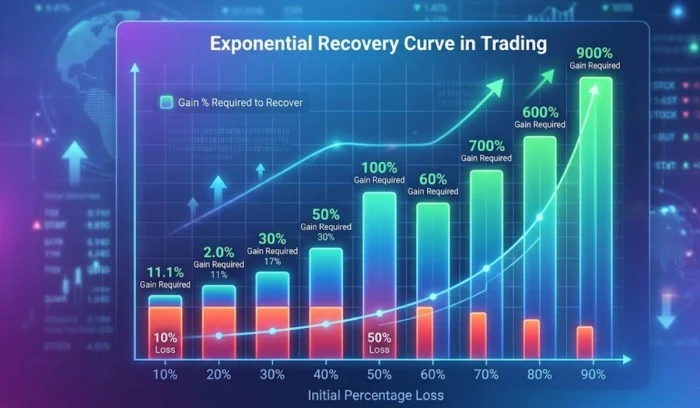
This is the most important rule. In every trade you take, your loss should not be more than one percent of your total money.
Suppose you have 1,00,000 rupees in your trading account. One percent of that is 1,000 rupees. So if you enter a trade, you must set your stop loss such that if market hits your stop loss, you lose only 1,000 rupees. Not 2,000. Not 5,000. Only 1,000.
Why one percent? Because if you lose one percent, you can make it back easily. But if you lose ten percent in one trade, now you need to make eleven percent to come back. That becomes hard. If you lose fifty percent, you need hundred percent gain. That is almost impossible for most traders.
So the best money management tips for traders always start with this one percent rule.
Tip Number Two – Use Trading Money Management Calculator Before Every Trade
Many traders guess their position size. They think "I will buy two lots" or "I will put 10,000 rupees here". This is wrong. You should never guess. You should calculate.
A trading tells you exactly how many shares or lots you can buy based on your account size and your stop loss distance.
For example, you have 1,00,000 rupees. You want to buy a stock at 100 rupees. Your stop loss is at 95 rupees. That means your loss per share is 5 rupees. You are allowed to lose only 1,000 rupees as per one percent rule. So you divide 1,000 by 5. You get 200 shares. That is your correct position size.
Without a traders make mistake. They buy 1000 shares because they feel confident. Then stop loss hits and they lose 5,000 rupees. Account damaged.
You can find many free trading money management calculators online. Some are excel sheets and some are websites. Keep one open when you trade.
Tip Number Three – For Forex Traders with 100 Dollars, Use Micro Lots
Now I come to your specific keyword money management forex 100. Many Indian forex traders start with exactly 100 dollars. That is about 8300 rupees. With such small money, you cannot trade standard lots. Standard lot in forex is 100,000 units. That is too big.
For money management forex 100, you must trade only micro lots. One micro lot is 1,000 units. One pip movement in micro lot is about 10 cents. So if you have 100 dollars, your one percent risk is 1 dollar. That means your stop loss can be only 10 pips if you trade one micro lot. That is very tight. So many traders with 100 dollars use 0.5 micro lot or 0.2 micro lot.
Let me give example. You have money management forex 100 account. You want to trade USDINR. You find a trade setup. Your stop loss needs 20 pips. If you take one micro lot, 20 pips loss is 2 dollars. That is two percent of your account. That breaks the one percent rule. So you take only 0.5 micro lot. Then 20 pips loss is only 1 dollar. Now you follow the rule.
This is the reality of money management forex 100. You cannot make fast money. You can only survive and grow slowly.
Tip Number Four – Risk to Reward Ratio Must Be One to Two
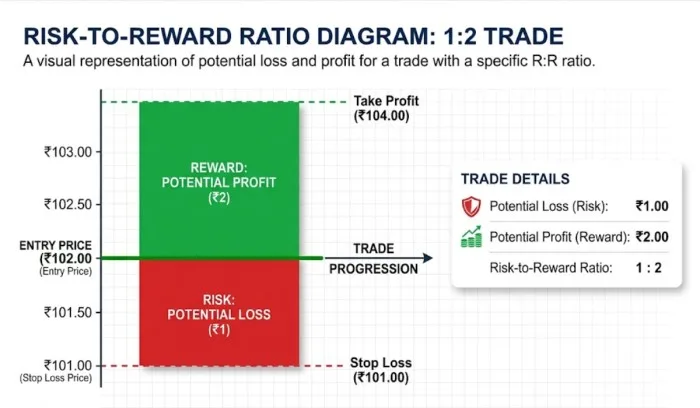
Risk to reward means how much you can lose versus how much you can make. If you risk 1 rupee to make 2 rupees, that is good. If you risk 1 rupee to make 0.50 paise, that is bad.
The best money management tips for traders say you should never take a trade where your possible profit is less than double your possible loss. So one to two is minimum. One to three is better.
Why is this important? Because even if you are wrong half the time, you still make money. Suppose you take ten trades. Five trades lose 1 rupee each. That is 5 rupees loss. Five trades win 2 rupees each. That is 10 rupees profit. Net profit is 5 rupees. You made money even with fifty percent win rate.
Most traders ignore this. They take small profits and big losses. That is opposite of what works always check risk reward before clicking buy or sell.
Tip Number Five – Keep a Separate Journal for Every Trade
You cannot improve what you do not measure. So you must write down every trade. Not in your mind. On paper or on computer.
In your journal, write these things before you enter trade:
- What is your entry price
- Where is your stop loss
- How much money you will lose if stop loss hits (in rupees or dollars)
- What is your target price
- What is your risk to reward ratio
After trade closes, write:
- Did you follow your plan
- What emotion you felt
- What you learned
After twenty trades, read your journal. You will see your mistakes clearly. Most traders never do this. That is why they repeat same mistake for years.
The best money management tips for traders are useless if you do not track your own behavior. Journal is your mirror.
Tip Number Six – Do Not Add to Losing Trade
This is a very common mistake in India. Trader buys something. Price goes down. Trader thinks "price is now cheap, I will buy more to lower my average price". Then price goes down more. Trader buys even more. Finally price goes down so much that trader has huge loss. Account is empty.
This is called averaging down. It kills small accounts fast. Why? Because you break your money management rule. Your position becomes too big. One small move against you causes big loss.
The correct way is opposite. Add only to winning trades. If price goes up after you buy, and your analysis still looks good, then you can add. But adding to losing trades is like giving water to a dead plant. It does not help.
Tip Number Seven – Use Stop Loss on Every Trade, No Exception
Some traders think stop loss is for weak people. They say "I will watch the trade myself. If market turns, I will exit manually." This never works. Market can move very fast. In forex, price can move fifty pips in one minute during news. In stocks, circuit filters can stop you from exiting.
Stop loss is your seat belt. You wear seat belt not because you plan to crash. You wear it because crash can happen without warning.
So always put stop loss order in the system. Not mental stop loss. Not stop loss on paper. Real stop loss order with your broker. This is one of the simplest best money management tips for traders but most people skip it.
What is a Trading Money Management Calculator and How to Use It?
Let me explain trading money management calculator in more detail because this is important. A trading money management calculator is a simple tool. It has three inputs.
- First input is your account size. How much total money you have.
- Second input is your risk percent. Most people put 1 or 2 percent here.
- Third input is your stop loss distance. How many rupees or pips or points away is your stop loss.
The calculator then tells you your correct position size. That is all. Very simple.
You do not need expensive software. You can make your own trading money management calculator in Excel. Just three cells. Account size in cell A1. Risk percent in cell A2. Stop loss in pips in cell A3. Then formula is (A1 * A2/100) divided by (A3 * value per pip). That is your lot size.
If you do not like Excel, many websites have free trading money management calculator. Search on Google. Bookmark one. Use it before every trade. It takes ten seconds but saves you thousands of rupees.

Risk and Money Management in Trading PDF – Why You Need It
I will give you risk and money management in trading pdf. This pdf will contain all the rules I explained above in one page. Plus one page for daily checklist.
Why pdf is important? Because when market is moving fast, your emotions take over. You forget rules. You take big risk. You feel overconfident after two wins. Then one loss wipes out everything.
If you have a risk and money management in trading pdf on your desktop, you can open it before every trading session. Read the rules slowly. Then start trading. This small habit changes everything.
I have seen many successful traders. They all have a written set of rules. They do not keep rules in mind. They keep rules on paper. Mind forgets. Paper does not forget.
So I suggest you download the risk and money management in trading pdf below. Print it if possible. Keep it next to your monitor.
Common Indian Mistakes in Money Management
Let me tell you some mistakes I see daily on Indian trading Telegram groups.
First mistake is trading with money you cannot afford to lose. Some traders take personal loan. Some use credit card. Some borrow from family. Then they trade with tension. When you trade with tension, you make bad decisions. Only trade with extra money. If you lose it, your life should not change.
Second mistake is overtrading. After one loss, trader wants to recover fast. So he takes another trade immediately. Then another. Then another. Each trade has less thought. More emotion. Loss becomes bigger. Best money management tips for traders include a rule – after two losses in one day, stop trading. Come back tomorrow.
Third mistake is using too much leverage. Indian brokers give leverage up to 10 times or even 100 times. That means with 10,000 rupees you can trade like you have 10 lakh rupees. This sounds good but one small move against you and your account is zero. Use low leverage. Maximum 3 to 5 times. Or even better, trade only with your own money without leverage.
A Sample Day of Trader Following Best Money Management Tips for Traders
Let me give you a realistic example so you understand how these rules work in real life.
Rajesh lives in Indore. He has 50,000 rupees in his trading account. He trades Nifty futures. His one percent risk is 500 rupees per trade. He always uses trading money management calculator before entry. He never takes trade without one to two risk reward. He always puts stop loss order.
One morning Rajesh sees a setup. Nifty is at 22,000. He thinks Nifty will go to 22,200. His stop loss is at 21,950. That is 50 points loss. One point in Nifty is 75 rupees for one lot. So 50 points loss is 3,750 rupees. That is more than his 500 rupees risk. So he cannot take one lot.
He uses his trading money management calculator. He puts account size 50,000, risk percent 1, stop loss in points 50, value per point 75. Calculator says his lot size is 0.13. But he cannot buy 0.13 lot. So he does not take this trade. He waits for another setup.
After one hour, he sees another setup. Stop loss is only 10 points away. Now 10 points loss is 750 rupees. Still more than his 500 rupee risk. So still no trade.
Finally he finds a setup with 6 points stop loss. 6 points loss is 450 rupees. That is within his 500 rupee risk. Now his trading money management calculator says he can take one full lot. He enters. Price goes up. He makes 12 points profit. That is 900 rupees profit. Risk reward was one to two. Good trade.
This is how a disciplined trader works. He did not trade for three hours. He took only one trade. But that one trade was correct. Most Indian traders would have taken the first trade with 3,750 rupee risk. Then if loss happens, they lose 7.5 percent of account in one trade. Then they take revenge trade. Then account is finished.
You May Also Read: What is F&O Trading in Nifty and Bank Nifty | Simple Guide
Download Your Risk and Money Management in Trading PDF
As promised, here is your risk and money management in trading pdf. This pdf has two pages.
First page has the seven rules of money management. Print it and read it every morning.
Second page has a daily checklist. Before you open your trading software, answer these yes or no questions:
- Do I have my stop loss set before entry?
- Is my risk per trade less than one percent?
- Did I use trading money management calculator?
- Is my risk to reward at least one to two?
- Am I trading with money I can afford to lose?
- Have I taken more than two losses today? (if yes, stop)
If you answer no to any question, do not trade that day. Simple.
You can save this pdf on your phone also. Read it whenever you feel like breaking rules.
Final Words
I have given you the best money management tips for traders. These are not new or fancy. These are old rules that work. The problem is not knowing these rules. The problem is following them when market is moving and your heart is beating fast.
You will face days when you feel like taking big risk. You will feel like skipping stop loss. You will feel like averaging down. In those moments, open your risk and money management in trading pdf. Read the rules. Take a deep breath. Then trade only if rules allow.
For money management forex 100 traders, remember that 100 dollars is very small. Do not expect to make 50 dollars per day. Expect to make 1 or 2 dollars per day. That is realistic. With compounding, 100 dollars can become 200 dollars in a few months. Then 400. Then 800. Slow is fast in trading.
Always use trading money management calculator. Do not guess, guessing is gambling and calculating is trading.
If you follow these rules for six months, you will still be in the game. And that is the biggest victory most traders quit in six months. You will not. You will survive. Then you will learn and grow.