

How to Automate ETF Investing for Consistent Growth
You want your money to grow. But you are busy you have a job, a family, bills to pay. You cannot watch the stock market every day. You cannot guess when to buy and when to sell. That is where automation helps.
When you automate your ETF investing, you tell your bank and your broker to do the same thing every month. You do not think. You do not panic. You just stay in the game.
In this article, I will show you step by step how to automate ETF investing for consistent growth. I will also talk about ETFs for income and growth, how to use an ETF growth calculator, and how to buy ETFs for foreign stocks from India.
What is an ETF? A Very Simple Answer
ETF full form is Exchange Traded Fund. Think of it like a basket. In one basket, you get many shares. For example, one Nifty ETF basket has shares of 50 companies. When you buy one unit of that ETF, you own a tiny part of all 50 companies. You do not have to pick winning shares.
The basket does that for you.ETF is like a mutual fund but it trades on the stock exchange like a share. You can buy and sell it anytime the market is open.
Read More: Difference Between Active and Passive ETF Management A Simple Guide for Indian Investors

Step by Step – How to Automate ETF Investing in India
Step 1 – Open a Demat and Trading Account
You need a demat account to hold your ETFs. You also need a trading account to buy them.
In India, you can use:
- Zerodha
- Groww
- Angel One
- Upstox
- ICICI Direct
- HDFC Securities
Most of these let you open an account online in ten minutes. You need your PAN card, Aadhaar card, and a bank account.
Step 2 – Pick the Right ETF for Your Goal
You cannot automate if you do not know what you want.
For consistent growth, pick a broad market ETF. For example:
- Nippon India ETF Nifty50
- UTI Nifty Index ETF
- Bharat 22 ETF (government companies)
If you also want income (regular money in your bank), then you need ETFs for income and growth. These are usually balanced ETFs or debt plus equity ETFs. One example is ICICI Prudential Nifty ETF. It gives some growth and some dividend income.
But remember – in India, most growth ETFs do not give high dividends. If you want regular income, you may need to sell a small part every three months. That is also okay.
Step 3 – Use a Platform That Supports Automatic Buying
Not every app lets you automate ETF buys. Many apps only let you buy manually.
But here are platforms that support automatic ETF investing in India:
- Zerodha Coin – You can set a monthly SIP in ETFs.
- Groww – You can set a monthly automatic buy for selected ETFs.
- Kuvera – Very good for automation and rebalancing.
- Smallcase – Not exactly ETF but ETF-like baskets. You can automate.
What Does Automatic Mean?
You tell the app on the 5th of every month, buy Rs 5000 worth of Nippon India ETF Nifty50. The app takes money from your bank account on that day and buys the ETF.

Step 4 – Decide the Amount and Date
Do not pick a random amount.
Open your bank statement. See how much you save every month after all expenses. Take 50 percent of that saved amount for ETF investing. Keep the rest in fixed deposit or emergency fund. Pick a date right after your salary comes. For most people, 3rd or 4th of the month works well.
Example – salary on 1st. Automate buying on 4th. That way money leaves before you spend it.
Step 5 – Start Small and Increase Every Year
In the beginning, do not put a big amount. Start with Rs 3000 or Rs 5000 per month. Do this for six months. See if you feel comfortable.
After one year, increase by 10 percent. If you were doing Rs 5000, do Rs 5500 next year. This is called step up. It helps your growth stay ahead of inflation.
Step 6 – Forget About Market Highs and Lows
This is the most important part. When you automate, you buy every month. Some months the market will be high. Some months it will be low. Over time, your average buying price becomes fair. You do not need to time the market.
Do not stop the automatic buy when market falls. That is the best time to buy more units for the same money. Do not increase too much when market is rising. Stay calm. Stay consistent.
ETFs for Income and Growth – Which Ones to Pick in India
Many Indian investors think ETFs are only for growth. That is not fully correct. Some ETFs give you both – some income as dividend and some growth as price increase.
Here are simple options for ETFs for income and growth in India:
| ETF Name | What it has | Income style |
|---|---|---|
| Bharat 22 ETF | 22 government companies | Gives dividend once or twice a year |
| CPSE ETF | Public sector companies | Good dividend history |
| Nippon India ETF Dividend Opportunities | Companies that pay regular dividend | Better for regular income |
| ICICI Prudential Nifty Low Vol 30 ETF | Stable companies | Low risk, slow but steady growth |
If you need money every month, do this take the dividend that comes once or twice a year and divide it by 12. That becomes your monthly mental income. Do not expect ETF dividends like a salary. That does not happen in India.
For most people, focus on growth first. After five to seven years, move some money to income ETFs.
ETF Growth Calculator – How to See Your Future Money
An ETF growth calculator is a simple tool. You put three numbers:
- How much you invest every month
- For how many years
- Expected yearly return
Then it shows you how much total money you will have at the end.
Example with Indian Numbers
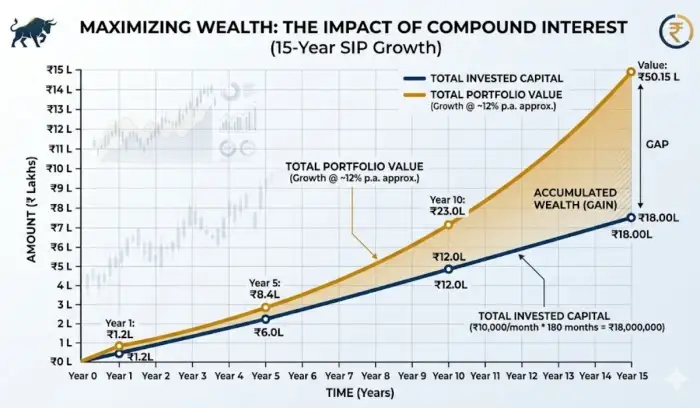
Let us say you invest Rs 5000 every month in a Nifty ETF. Historically, Nifty has given around 12 to 14 percent return over long time. But to be safe, we take 12 percent.
You do this for 15 years.
Here is what an ETF growth calculator will show:
- Total money you put – Rs 9,00,000 (5000 x 12 months x 15 years)
- Total value at the end – around Rs 25,00,000 to Rs 28,00,000
- Your growth – nearly three times your own money
If you increase your monthly amount by 10 percent every year, the final number becomes even bigger – around 40 to 45 lakh rupees.
Where to Find a Good ETF Growth Calculator in India?
You do not need a paid tool. Use these free ones:
- ET Money (app or website) – Has a simple calculator for ETFs and mutual funds.
- Groww – In their tools section.
- Zerodha Varsity – Has a spreadsheet style calculator.
- Excel – You can also make your own. Formula is FV (future value).
But remember – a calculator shows an estimate. Not a promise. Markets can go down for two to three years also. Do not panic if actual returns are less than calculator number for one or two years.
ETF Investing in Foreign Stocks from India – Is It Possible?
Yes. But there are some limits.
As an Indian resident, you cannot directly buy US ETFs like VOO or QQQ easily. RBI has rules. You can send money abroad under LRS (Liberalised Remittance Scheme) but that is a long process for small investors. But there is a simple way Indian mutual funds and Indian ETFs that hold foreign stocks.
Best Indian ETFs for Foreign Stocks
| ETF Name | What foreign stocks it holds |
|---|---|
| Motilal Oswal S&P 500 Index ETF | Top 500 US companies like Apple, Microsoft, Amazon |
| Nippon India ETF Hang Seng BeES | Hong Kong and China stocks |
| MON100 ETF | US tech stocks (Nasdaq 100) |
| ICICI Prudential US Bluechip ETF | Big US companies |
You can buy these ETFs on Zerodha or Groww exactly like a Nifty ETF. You pay in rupees. No foreign bank account needed. No LRS paperwork for small amounts.
Can You Automate Foreign Stock ETFs?
Yes.
You can set up a monthly automatic buy for Motilal Oswal S&P 500 ETF on Zerodha Coin or Groww. The process is exactly the same as a normal ETF.
But keep one thing in mind – these ETFs have slightly higher expense ratio. That means every year, the fund house takes a little more money as fees. For Indian ETFs, expense ratio is 0.1 to 0.3 percent. For foreign stock ETFs, it can be 0.5 to 1 percent. Still okay for long term.
Do not put all your money in foreign stocks. Keep 70 percent in Indian ETFs and 30 percent in foreign stock ETFs. That gives you safety. If India market falls, US market may rise. Balance helps.
How to Use an ETF Growth Calculator for Foreign Stocks?
When you use an ETF growth calculator for foreign stocks, do not take 12 percent return. US market gives around 8 to 10 percent over long time. Be realistic.
Example – You invest Rs 2000 per month in Motilal Oswal S&P 500 ETF for 15 years at 9 percent return.
- Your total invested – Rs 3,60,000
- Final value – around Rs 7,50,000 to Rs 8,00,000
Not as high as Indian equities but still good. And you get safety of a different country's economy.
Common Mistakes People Make in Automatic ETF Investing
Mistake 1 – Stopping When Market Falls
This is the biggest mistake. When Nifty falls 10 percent, people get scared and stop their automatic buy. That is the wrong time to stop. You should actually buy more.
Solution – Do not check your portfolio every day. Check once every three months.
Mistake 2 – Automating Without Reviewing
Automation does not mean forget completely. Once a year, sit down. See if your ETF is performing okay. See if a better ETF has come in the market. See if your risk level has changed.
Mistake 3 – Putting All Money in One ETF
Even a Nifty ETF is diversified. But still, put money in two different ETFs. One broad market ETF like Nifty50. One sector ETF like banking or IT. That gives extra safety.
Mistake 4 – Not Using a Calculator Before Starting
Many people start investing without knowing what they will get after 10 years. That is like driving without a map. Always use an ETF growth calculator before deciding your monthly amount.
Mistake 5 – Choosing Wrong Date
If you automate on the 1st, sometimes salary is not credited yet. Then the buy fails. Pick 3rd, 4th, or 5th date of the month. Never pick weekends because markets are closed.
Tax on ETFs in India – Keep This in Mind
When you sell your ETF after one year, profit up to Rs 1 lakh in a financial year is tax free. Profit above 1 lakh is taxed at 10 percent. This is called LTCG tax.
If you sell before one year, profit is added to your income and taxed as per your income tax slab. Dividend from ETFs is also added to your income and taxed.
But here is a good thing – when you automate your ETF investing and hold for many years, you do not sell every year. So you do not pay tax every year. You only pay tax when you finally sell.
That is much better than fixed deposit where you pay tax every year on interest.
Simple Action Plan for a New Investor in India
If you are starting today, do this exact list:
Week 1 – Open a Zerodha or Groww account. Complete KYC.
Week 2 – Pick one ETF. For most people, Nippon India ETF Nifty50 is best.
Week 3 – Use an ETF growth calculator. Put Rs 3000 per month for 10 years at 12 percent. See the final number. If it looks good, proceed.
Week 4 – Go to your app. Find the SIP or automatic buy option. Set date as 5th of every month. Set amount as Rs 3000. Confirm.
Month 2 to Month 12 – Do nothing. Do not check daily. Do not stop.
After 1 year – Increase amount by 10 percent. Add one more ETF – maybe a foreign stock ETF like MON100.
After 3 years – Start learning about ETFs for income and growth. You will not need income now, but good to know for future.
Final Words
You do not need to be a stock market expert. You do not need to watch business news. You do not need to predict what will happen tomorrow. You just need three things a good ETF, an automatic monthly buy, and patience.
Set it and forget it. That is the real meaning of automating ETF investing for consistent growth. The first year will feel slow. The second year you will see small growth. The third year you will start believing. The tenth year you will thank yourself.
Start today. Even Rs 1000 per month is enough to begin. The most important step is the first one.