
Is Investing Better Than Saving Money in India? Complete Guide
Every month, after you get your salary, you think one thing. What to do with the extra money? Should you put it in your bank savings account? Or should you try investing in something like mutual funds or gold?
This question is common in every Indian home. From a young office worker in Mumbai to a small shop owner in Lucknow, everyone wants to grow their money. But they also fear losing it.
So let us settle this once and for all. Is investing truly better than saving money? Or is saving the smarter and safer choice?
To answer this, we must first understand a very basic thing. What is the real difference between saving and investment? And why do experts keep talking about savings vs investment ratio?
Let me explain everything step by step with real Indian examples. No tricky words. No English speaking class type language. Just pure, simple, useful talk.
What is Saving?
Saving means you keep your money aside for future use. You do not take any risk. The money stays safe. You can take it out anytime you want.
In India, saving usually means:
- Keeping money in a savings bank account
- Putting money in a fixed deposit (FD)
- Using a recurring deposit (RD)
- Keeping cash at home (though not recommended)
Real Indian Example of Saving
Take Ramesh. He lives in Jaipur. Every month he puts 5000 in his savings bank account. After one year, he has 60,000 plus some small interest. The bank gives him around 2.5% to 3% interest per year.
His money is totally safe. He can withdraw it anytime for an emergency. But his money did not grow much. Because of inflation, the things he could buy with 60,000 today may cost 63,000 next year. So in real terms, his money lost some value.
Still, saving gave him safety and peace of mind. That is the main benefit.
Read More: Best Investments for Retirement in India: Top Plans 2026

What is Investment?
Investment means you use your money to buy something that can grow in value over time. You take some risk. But your money has the chance to grow much more than a savings account.
In India, common investments are:
- Mutual funds (especially SIP in large cap or index funds)
- Shares (stocks) of companies
- Gold (physical or digital)
- Real estate
- Public Provident Fund (PPF)
- National Pension System (NPS)
Real Indian Example of Investment
Take Priya. She lives in Pune. Every month she puts 5000 in a good large cap mutual fund through SIP. After one year, the market went up and down. But on average, her money grew by 12%.
So her 60,000 became around 67,200. She made 7,200 more than Ramesh. But in some months, her investment value went down. She had to stay calm and not remove her money in fear.
So Priya took some risk and got more return. That is the main benefit of investing.

Difference Between Saving and Investment with Example
Let me write the difference in very simple words. No fancy terms.
| Point | Saving | Investment |
|---|---|---|
| Risk | No risk | Small to medium risk |
| Return | Very low (2-4% per year) | Medium to high (8-15% or more per year) |
| When to use money | Any time | Better to keep for 3+ years |
| Main purpose | Emergency, short term needs | Growing wealth for big future goals |
| Effect of inflation | Money loses value slowly | Money beats inflation usually |
| Example | Bank FD, savings account | Mutual fund SIP, gold, stocks |
Example to Make it Crystal Clear
You have 1,00,000 today.
-
If you save it in bank FD at 6% for 5 years, you get around 1,33,800.
-
If you invest it in a good balanced mutual fund at 11% for 5 years, you get around 1,68,500.
That extra 34,700 is the cost of being too safe. But remember, the investment could also go down some years. So do not invest money you need next month.
Savings vs Investment Ratio – How Much to Do What
Now comes the most useful question. What should be your savings vs investment ratio?
There is no single number for everyone. It depends on your age, income, family needs, and risk comfort. But here is a simple Indian rule of thumb.
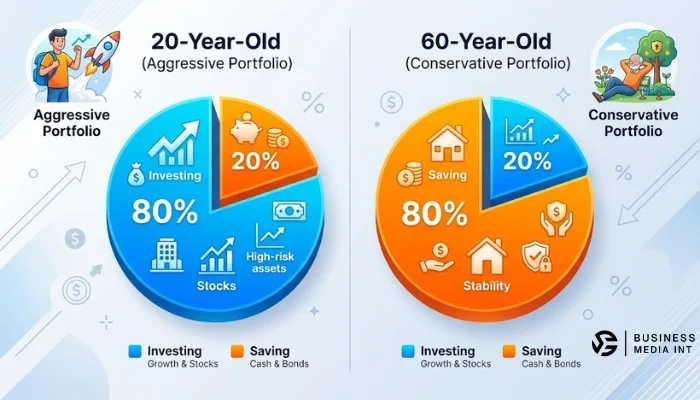
General Guideline for Savings vs Investment Ratio
| Your Age | Saving % | Investment % |
|---|---|---|
| 20 to 30 years | 20% | 80% |
| 31 to 40 years | 30% | 70% |
| 41 to 50 years | 40% | 60% |
| 51 to 60 years | 60% | 40% |
| Above 60 years | 80% | 20% |
Why this ratio? Because when you are young, you can take more risk. If you lose some money, you have time to earn it back. When you are older, you need safety because you may need the money soon.
Indian Real Life Example of Ratio
Neha is 28 years old. She works in Bengaluru. She saves 10,000 every month in total.
As per the ratio above, she should:
- Save 2000 (20% of 10,000) in FD or savings account for emergency
- Invest 8000 (80% of 10,000) in mutual funds or gold for long term growth
Her father Mr. Sharma is 58 years old. He saves 10,000 every month.
He should:
- Save 6000 (60% of 10,000) in fixed deposits and senior citizen saving scheme
- Invest 4000 (40% of 10,000) only in very safe options like PPF or debt funds
See how the same amount of money is used differently based on age and goal.
Savings and Investment in Economics (Simple View)
In economics, saving and investment have a very basic meaning.
- Saving means you do not spend all your income today. You keep some for later.
- Investment meansyou use that saved money to buy things that produce more income or value in the future.
For a country like India, when people save more, banks get more money. When people invest more, companies get more money to grow and create jobs.
But in personal finance, the idea is different. For you and me, saving protects us from sudden problems. Investment helps us become richer over time.
A good financial life needs both. Only saving makes you safe but not rich. Only investing makes you rich but not safe. The smart way is to mix both.
Is Investing Better Than Saving Money? The Final Answer
Now the main question. Is investing better than saving money?
The honest answer is – it depends on your goal.
When Saving is Better
- You need money in next 6 months
- You have no emergency fund (at least 6 months of expenses)
- You are above 60 years old
- You cannot sleep if your money value goes down for few months
- You are saving for a fixed short term goal like a trip or a wedding next year
When Investing is Better
- You have 3 or more years before you need the money
- You already have a good emergency saving
- You want to beat inflation and grow your wealth
- You are young and have stable income
- You want to build a big corpus for retirement or children's higher education
Simple Rule
If you ask me directly – for most Indian people who are between 20 and 50 years old, with a stable job, and already have some emergency saving – investing is better than saving for long term goals.
Because inflation quietly eats your saved money. And only investing can fight inflation properly.
But never do only investing without any saving. That is like driving a car with no brakes. And never do only saving without any investing. That is like walking when you could be riding a bike.
You May Also Read: Growth Investing vs Dividend Investing: Which Strategy Is Better for Indian Investors?
Practical Steps for Indian Beginners
If you have never invested before, do not be scared. Start small and simple.
Step 1 – Build your saving first
Save at least 20,000 to 50,000 in a separate bank account or FD. This is your “don’t touch” emergency money.
Step 2 – Start a small SIP
Open an account with a good Indian mutual fund platform like Coin by Zerodha, Groww, or direct from AMC like SBI Mutual Fund or HDFC Mutual Fund.
Put just 1000 or 2000 per month in a large cap index fund or balanced advantage fund. These are safe for new investors.
Step 3 – Increase slowly
Every 6 months, increase your SIP by 10%. After 2 years, you will be surprised how much your money grew.
Step 4 – Do not check daily
Investing is not a daily game. Do not check your investment value every day. That creates fear. Check once every 3 months.
Step 5 – Keep saving also going
Never stop your monthly saving completely. Keep at least some money in your savings account or FD. This keeps you safe from life’s sudden problems.

Common Indian Mistakes to Avoid
I see many people in India making these mistakes. Please avoid them.
Mistake 1 – Keeping all money in savings account only
You will never grow your wealth. Inflation will slowly eat your purchasing power.
Mistake 2 – Investing all money with no saving
What if you lose your job and the stock market is down? You will have to sell your investments at a loss.
Mistake 3 – Investing in things you don’t understand
Do not put money in crypto, options trading, or tips from WhatsApp groups until you fully understand.
Mistake 4 – Removing money when market falls
Market falls are normal. If you remove your money at that time, you lock in the loss. Stay patient.
Mistake 5 – No clear goal
Do not invest just because someone said so. Have a goal – house down payment, daughter’s college, retirement. Then invest for that goal.
Conclusion – The Balanced Indian View
So let me close this with a very simple answer.
Is investing better than saving money?
- For long term goals – Yes.
- For short term needs and safety – No.
Do not choose one. Use both. Keep a proper savings vs investment ratio based on your age and needs. Understand the difference between saving and investment with real examples like we did above. And remember what economics teaches us – saving without investment is safety without growth. Investment without saving is growth without safety.
You are an Indian earner. You work hard for your money. Do not let that money sit idle. Do not also risk it foolishly. Find your balance. Start small. Stay regular. And over time, you will see your money grow while you sleep peacefully.
FAQs
1. Is investing really safer than saving money in a bank?
No, investing is not safer than saving. Saving in a bank is very safe. Your money does not go down. But investing can go up and down. Some days your money becomes less. Some days it becomes more. So for safety, saving is better. For growth over many years, investing is better. Do not mix both things.
2. What is the best savings vs investment ratio for a common Indian family?
There is no one number for all. But a good starting point is 50 percent saving and 50 percent investment. If you are young, you can do 30 percent saving and 70 percent investment. If you are near retirement, do 80 percent saving and 20 percent investment. The right ratio depends on your age and your family goals.
3. Can you give one simple example to understand difference between saving and investment?
Yes. You have 20,000 rupees. You keep it in a bank fixed deposit for three years. You get around 22,500 rupees. This is saving. Now you take the same 20,000 rupees and put it in a good mutual fund for three years. You may get 26,000 rupees or you may get 18,000 rupees. This is investment. Saving gives less but sure money. Investment gives more but not sure money.
4. Why is savings and investment in economics important for common people?
In simple words, when you save, banks get money. Banks give that money to people for home loans or business loans. When you invest, companies get money directly. Companies use that money to grow and make more products. Both help the country grow. But for your own pocket, you need to do both. Only saving makes you lose to price rise. Only investment gives risk for short term needs.
5. What should a middle class Indian do first – save or invest?
First save. Build an emergency fund. Keep three to six months of your family expenses in a savings account. This is for sudden needs like hospital or job loss. After that, start investing for long term goals like reirement or children marriage. Never invest your emergency money. Never save all your long term money. Do both in the right order.