

Active vs Passive ETFs: Which Investment Wins in 2026?
When you start putting money in the market, you hear two names again and again. One is active ETF. Other is passive ETF. Both look same on outside. Both trade on exchange like a stock. But what happens inside is very different. This article will tell you the real difference between active and passive ETFs. We will also check active vs passive ETF performance.
We will see how both behave with S&P 500. And we will also look at Vanguard funds because many Indian investors ask about them.
What is an ETF in Simple Words?
ETF full form is Exchange Traded Fund. It is a basket of stocks, bonds, or gold. You buy one unit of ETF. That one unit holds many small pieces of different companies. For example, one ETF unit may have a little bit of Reliance, a little bit of HDFC Bank, and a little bit of Infosys. So you do not need to buy each share separately. ETF does that for you. And you can buy and sell it during market hours just like a stock. That is why common people like ETFs. Low cost. Easy to use. No big paperwork.
But here the main question comes. Who decides which company goes inside that basket? That answer divides ETFs into two types. Active and passive.
Read More: Best Low-Cost Index ETFs for Retirement Planning

What is an Active ETF?
In active ETF, there is a fund manager. That manager is a real person or a small team. Their job is to pick companies they think will grow more than others. They do research. They read company reports. They watch news. They decide when to buy a stock and when to sell it. They want to give you more return than the market average. That is why it is called active. Because someone is actively doing something.
But active work means active cost. You pay higher fees to the fund manager for their time and thinking. In India, active ETF expense ratio can be 0.5 percent to 1 percent or even more. It does not look big. But on long run, it cuts your final money.
Another thing about active ETF. The manager can make mistake. They are human. They may get too excited about a trendy stock. They may sell a good stock too early. So active ETF performance goes up and down not just because of market, but also because of manager choice.
What is a Passive ETF?
Passive ETF does not try to beat the market. It tries to copy the market. For example, there is a list called Nifty 50. It has top 50 companies of India. A passive ETF on Nifty 50 will buy all 50 companies in same ratio as Nifty. Nothing more. Nothing less. If a company falls out of Nifty, the passive ETF sells it. If a new company enters Nifty, the passive ETF buys it. No extra thinking. No extra research. Just follow the list.
Because there is no active manager making daily decisions, the cost is very low. In India, you get passive ETFs at 0.05 percent to 0.2 percent expense ratio. That is almost free compared to active.
Passive ETF performance is not spectacular. It will never give you double return than market. But it will never fall much below market either. It gives you exactly what market gives. Minus a very small fee.
Difference Between Active and Passive ETFs – Point by Point
Now let us see the clear difference. This is the heart of your search.
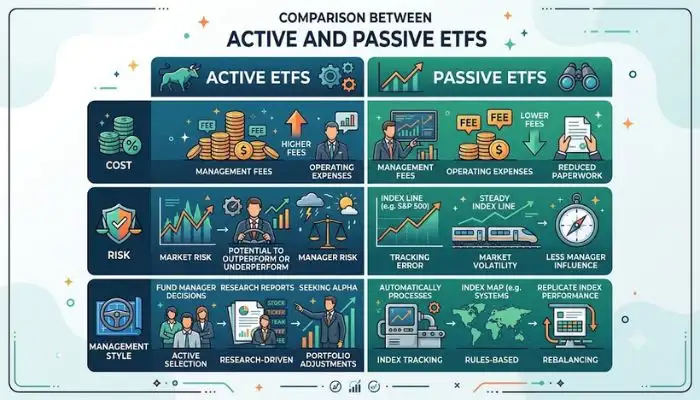
Who decides the stocks
In active ETF, a fund manager decides. In passive ETF, a fixed index decides like Nifty 50 or S&P 500.
Trying to do what
Active ETF tries to beat the market. Passive ETF tries to match the market.
Cost
Active ETF cost is high. Passive ETF cost is low.
Risk of human error
Active ETF has high human error risk. Passive ETF has almost zero human error.
Return
Active ETF may give high return sometimes. It may also give very low return sometimes. Passive ETF gives steady return close to market.
Transparency
Active ETF does not tell you every day which stocks they hold. They tell after some days. Passive ETF tells you clearly because they follow a public index.
Tax in India
Both active and passive ETFs are taxed same way if they are equity ETFs. But active ETFs do more buying and selling. That can create short term capital gains inside the fund. That does not affect you directly but it affects fund performance.
Active vs Passive ETF Performance – Which One Gives Better Return
This is the most searched part. People want to know who wins in real life. So let us talk with straight numbers.
In America, they have studied this for many years. S&P Dow Jones Indices puts out a report every year. That report says most active funds cannot beat their passive benchmark after ten years. More than 85 percent active managers fail to beat S&P 500 over long time.
Same story in India. Many active large cap funds tried to beat Nifty 50. Over ten years, very few could do it consistently. Some did well for two three years. Then they fell behind. Because market is not easy to predict. Even very smart people get it wrong.
So if you look at active vs passive ETF performance over long time like ten or fifteen years, passive ETF wins most of the time. Not because passive is great. But because active costs are high and human decisions are shaky.
But there is one place where active ETFs can do better. That is small cap or sector funds. If you take a passive ETF on small cap, it will buy all small companies. Some will be bad. Some will be good. Active manager can skip the bad ones. So in very specific areas, active may work. But for most common people putting money in plain large cap, passive is better.
Difference Between Active and Passive ETFs S&P 500
S&P 500 is a list of five hundred largest companies of America. Many Indian investors put money in S&P 500 ETFs through international options. So you must know the difference here too.
- An active ETF on S&P 500 will not buy all five hundred companies. Manager will pick maybe fifty or hundred from that list. They think those fifty will grow faster. Sometimes they win. Sometimes they lose.
- A passive ETF on S&P 500 will buy all five hundred companies. In same ratio as the index. So when Apple goes up, your passive ETF goes up. When Apple goes down, your ETF goes down. No filter. No selection.
Historically, very few active managers have beaten S&P 500 passive ETF over twenty years. Warren Buffett himself made a famous bet. He bet one million dollars that passive S&P 500 ETF would beat a group of active hedge funds. He won that bet easily. That tells you everything.
So for S&P 500, passive is the smarter choice for most people.
Difference Between Active and Passive ETFs Vanguard – What Indian Investors Should Know
Vanguard is a big name in America. They started the passive fund revolution. Many Indian investors ask about Vanguard because they see YouTube videos and finance blogs. But here is the truth.
Vanguard is famous for passive ETFs. Their whole philosophy is low cost and index tracking. They have one of the cheapest S&P 500 passive ETFs in the world. Its expense ratio is near zero.
Vanguard also has some active ETFs. But that is not their main strength. So when someone says Vanguard, mostly they mean passive. So if you are an Indian investor trying to buy Vanguard ETFs, you will need an international trading account. You can use IndMoney, Vested, or direct account with brokerage like Interactive Brokers. Then you can buy Vanguard S&P 500 passive ETF. That is a solid choice.
But do not think Vanguard active ETFs will give you magic return. Even at Vanguard, active underperforms passive over long time. So difference between active and passive ETFs Vanguard style is same as anywhere else. Passive gives steady market return. Active gives hope but often less money.
You May Also Read: How to Automate ETF Investing for Consistent Growth
Cost Difference in Indian Rupees – Real Example
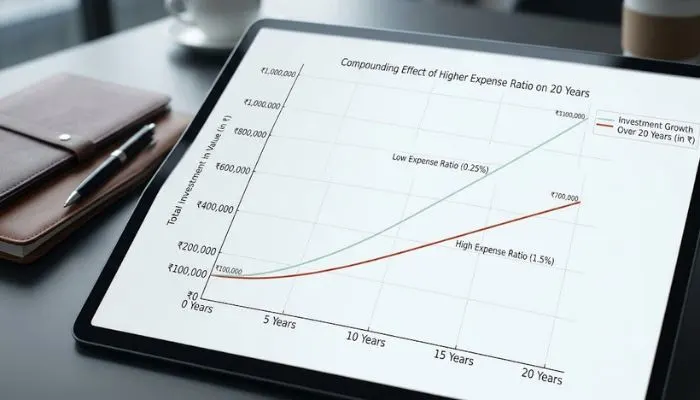
Let me show you with numbers so you feel the difference.
Suppose you put one lakh rupees in an active ETF. Expense ratio is 0.8 percent. You put same one lakh in a passive ETF. Expense ratio is 0.1 percent.
After one year, market gives 10 percent return. So both funds get 10 percent from market before cost.
- Active ETF after cost: 10 percent minus 0.8 percent equals 9.2 percent return. Your money becomes 1,09,200 rupees.
- Passive ETF after cost: 10 percent minus 0.1 percent equals 9.9 percent return. Your money becomes 1,09,900 rupees.
Difference is only 700 rupees in one year. Not big.
But after twenty years, that small difference becomes huge. Because cost compounds against you. On one lakh over twenty years, the active ETF will cost you nearly forty thousand rupees extra in fees. That money stays with fund manager. Not with you. That is why small cost matters a lot.
Which One is Better for Indian Investors – Active or Passive ETF
Now the final answer. It depends on what kind of person you are.
Choose active ETF if
- You believe some managers are truly smarter than market
- You are okay with higher cost
- You do not get scared when your fund falls more than market sometimes
- You have time to check fund performance every year
Choose passive ETF if
- You want simple low cost solution
- You do not want to check who is managing your money
- You accept that market return is enough for you
- You want to keep your money for ten plus years without tension
For most salaried people in India, passive ETF is better. You do not need to be a hero. You do not need to find the next multibagger. You just need to not lose to inflation and grow steadily. Passive ETF does that quietly.
But if you have extra money and you like some excitement, you can put a small part in active ETF. Maybe 10 or 20 percent of your total. That way you get chance of higher return. And if active fails, your main money in passive is still safe.
Final Take
Difference between active and passive ETFs is simple. Active tries to beat the market. Passive tries to be the market. Active has higher cost. Passive has lower cost. Active performance depends on manager skill. Passive performance depends on market movement.
If you are new to investing, start with passive ETF. Put money every month. Do not stop. Do not get distracted by high return stories. Over ten years, you will beat most active fund users without doing anything special. That is the quiet power of passive.
And if you still want active, keep it small. Keep it for fun. But keep your main money in passive. Your future self will thank you.
FAQs
Can I buy Vanguard ETFs from India
Yes. But you need international brokerage account. You cannot buy Vanguard directly from Indian demat account like Zerodha or Groww. You use platforms like IndMoney, Vested, or direct foreign brokerage.
Do active ETFs give better return in falling market
Not always. Some active managers keep cash. That helps in falling market. But many active managers also fall because they hold similar stocks. So do not assume active will save you in crash.
Is there any tax difference in India
No. Both equity ETFs are taxed same. Long term holding over one year gives 10 percent tax above one lakh gain. Short term gives 15 percent.
Which passive ETF is best for S&P 500 from India
You can look at Navi US Total Stock Market ETF or Motilal Oswal S&P 500 Index Fund. These are passive. They track American market.