

Short Term vs Long Term Bonds India – Which One is Better for You?
When you start saving money in India, you will hear two names again and again – short term bonds and long term bonds. But which one gives more return? Which one is safer? Which one saves more tax? The answer is not the same for everyone. That is why understanding short term vs long term bonds India is very important before you put your hard earned money anywhere.
In this article, we will look at both options in very simple Indian terms. We will also tell you about the best short term bonds in India, check current long term bonds interest rates, and show you step by step how to invest in short-term bonds. No complex English. No confusing words. Just straight talk for common Indian people.
What Are Short Term Bonds?
Short term bonds are those bonds where you get your money back in a short time. In India, short term bonds usually have a time period of 1 year to 3 years. Some people even call bonds up to 5 years as short term. But mostly, 1 to 3 years is called short term.
When you buy a short term bond, you are giving your money to a company or the government for a short time. They pay you interest every few months. And when time finishes, they return your full money.
Why Do People Pick Short Term Bonds?
People pick short term bonds because they do not want to wait too long. If you need money after 2 years for your child school fees or a family function, short term bonds are good. Also, if interest rates are rising in India, short term bonds do not fall in value too much. That is a big safety for common people.
Read More: How to Buy Bonds on Paytm Money India Full Guide for Beginners
Best Short Term Bonds in India
Let us look at some of the best short term bonds in India that common people can buy.
-
Nippon India Short Term Fund – This fund puts your money in company bonds that have 1 to 3 years left. It gives steady returns.
-
ICICI Prudential Short Term Bond Fund – This is a very trusted name in India. It mostly buys bonds from good companies and government related groups.
-
SBI Short Term Debt Fund – SBI is India's largest bank. Their short term bond fund is very safe for new investors.
-
HDFC Short Term Debt Fund – HDFC is also very popular. Their fund gives returns a little higher than fixed deposits.
-
Axis Short Term Fund – This fund is good if you want to stay for 2 to 3 years. Axis is a well known name in Indian mutual funds.
These are some of the best short term bonds in India that you can buy through mutual funds. You do not need a big amount to start. Some funds start with just 500 rupees per month.
What Are Long Term Bonds?
Long term bonds are bonds where your money stays for a long time. In India, long term bonds are usually for 7 years, 10 years, or even 20 years. The government of India sells something called Government Securities or G-Sec. Some of these G-Sec are for 10 years or 30 years. Companies also sell long term bonds.
When you put money in long term bonds, you get a fixed interest rate for many years. This interest is often higher than short term bonds. But there is a risk. If interest rates in India go up after you buy the bond, your bond value will fall. That means if you want to sell it before time, you may get less money.
Long Term Bonds Interest Rates in India Right Now
As of today, long term bonds interest rates in India are between 7% to 8% for government bonds. Company bonds give a little more. For example:
- 10 year Government bond gives around 7.1% to 7.2%
- 15 year Government bond gives around 7.3%
- Good company long term bonds give 8% to 8.5%
But remember, these long term bonds interest rates keep changing. When RBI increases the repo rate, new bonds give higher interest. And old bonds become less valuable. That is the main risk of long term bonds.
Who Should Pick Long Term Bonds?
If you do not need money for 7 to 10 years, long term bonds can be good. For example, if you are saving for your retirement or for your child higher education after 10 years. Also, long term bonds give a special tax benefit in India. If you hold a bond for more than 3 years, you pay less tax because of indexation. That is a big saving for people in higher tax brackets.
Short Term vs Long Term Bonds India – Main Differences
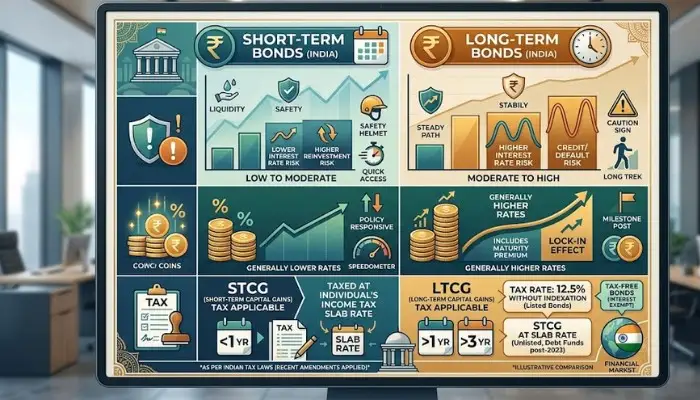
Now let us compare short term and long term bonds in a simple way. No complex table. Just straight points.
Time Period
Short term bonds keep your money for 1 to 3 years. Long term bonds keep your money for 7 to 20 years.
Risk Level
Short term bonds have low risk. Because you get your money back soon. Even if interest rates rise, your bond value does not fall too much. Long term bonds have higher risk. If you need money early or if interest rates go up, you can lose some of your original money.
Interest Rate
Short term bonds give lower interest. In India, short term bonds give around 6% to 7.5%. Long term bonds give higher interest. Between 7% to 8.5% for good bonds. Sometimes even more for company bonds.
Tax Rules in India
Short term bonds: If you sell before 3 years, profit is added to your income and you pay tax as per your slab. That can be 5%, 20%, or 30%.
Long term bonds: If you hold for more than 3 years, you pay 20% tax after indexation. Indexation means inflation is reduced from your profit. That makes your tax very low. So for rich people, long term bonds are better for tax saving.
Lock In
Short term bonds have no lock in. You can sell anytime. But if you sell early, you may get less price. Long term bonds also have no lock in, but selling early can cause a big loss because of interest rate changes.
Who Gives These Bonds?
Short term bonds come from companies who need money for 1 to 3 years. Also from banks and financial groups. Long term bonds come from government and big companies who need money for big projects like roads, power plants, or new factories.
How to Invest in Short-Term Bonds in India
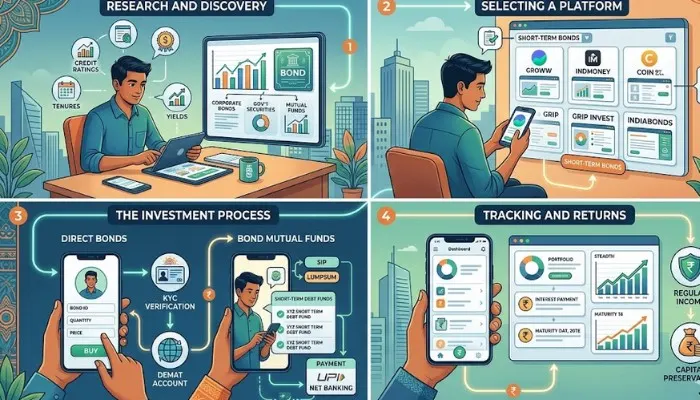
Many people ask: how to invest in short-term bonds easily? In India, you have three simple ways. Let me explain each one.
First Way – Short Term Bond Mutual Funds
This is the easiest way for common people. You do not buy one single bond. You buy a fund that holds many short term bonds. The fund manager chooses good bonds for you.
Steps to invest:
- Open an account with any mutual fund company like SBI, HDFC, ICICI, Nippon, or Axis.
- Or open an account on Coin by Zerodha, Groww, or Paytm Money.
- Search for short term bond fund.
- Put your money as one time or monthly.
- You can take out money anytime.
Minimum amount: 500 rupees or 1000 rupees in most funds.
This is the best answer for how to invest in short-term bonds if you are a new person.
Second Way – RBI Retail Direct
The government of India made a portal called RBI Retail Direct. You can open a free account there. Then you can directly buy government short term bonds. Government bonds are called G-Sec and T-Bills. T-Bills are for 91 days, 182 days, and 364 days. These are very safe.
Steps:
- Go to RBI Retail Direct website.
- Register with your PAN, Aadhaar, and bank account.
- Add money.
- Choose short term government bonds and buy.
This is very safe but you need to understand a little more than mutual funds.
Third Way – Bond Trading Platforms
In India, there are new apps that let you buy company bonds directly. For example, IndiaBonds, Wint Wealth, and Grip. On these platforms, you can see exactly how much interest you will get and for how many months.
Steps:
- Download IndiaBonds or Wint Wealth app.
- Complete your KYC with PAN and Aadhaar.
- Look for bonds with 12 months, 18 months, or 24 months left.
- Buy directly.
These platforms are good if you want to know exactly which bond you own.
So now you know how to invest in short-term bonds in three different ways. Choose the way that feels easiest to you.
You May Also Read: How to Buy Bonds on Upstox Online A Complete Guide for Indian Investors
What Happens When RBI Changes Interest Rates?
This is a very important point for short term vs long term bonds India. RBI is the Reserve Bank of India. They control interest rates in our country. When inflation becomes high, RBI increases the repo rate. When economy becomes slow, RBI decreases the repo rate.
If RBI increases interest rates:
- New bonds give higher interest.
- Old bonds become less attractive.
- Short term bond prices fall a little.
- Long term bond prices fall a lot.
If RBI decreases interest rates:
- New bonds give lower interest.
- Old bonds become more valuable.
- Both short and long term bond prices go up.
- Long term bonds go up more.
So if you think RBI will increase rates in the future, stay with short term bonds. If you think RBI will decrease rates, long term bonds will give you extra profit.
Which One Should You Choose – Short Term or Long Term?
Let me give you simple rules for Indian people.
Pick Short Term Bonds If:
- You need money in 1 to 3 years.
- You are saving for a car, marriage, or down payment for a house.
- You do not want any risk to your original money.
- You think RBI will increase interest rates.
- You are new to bonds and want to learn first.
Pick Long Term Bonds If:
- You do not need money for 7 to 10 years.
- You are saving for retirement or for young child higher studies.
- You are in a high tax slab (30%) and want to save tax using indexation.
- You think RBI will reduce interest rates in future.
- You can handle a little up and down in your bond value.
Pick Both If:
Many smart people do one more thing. They put some money in short term bonds for their near future needs. And they put some money in long term bonds for their far future needs. This is called diversification. It is a good habit.
Common Mistakes Indian People Make With Bonds
Let me tell you some mistakes so you can avoid them.
Mistake Number 1 – Thinking Bonds Are Exactly Like Fixed Deposits
Bonds are not fixed deposits. In fixed deposits, you get a fixed return and no price change. In bonds, the price can go up and down. If you sell early, you may get less money.
Mistake Number 2 – Putting All Money In Long Term Bonds Without Understanding Risk
Some people see that long term bonds give higher interest. So they put all their savings in 10 year bonds. Then after 2 years, they need money for emergency. But interest rates went up. So they have to sell at a loss. This hurts.
Mistake Number 3 – Ignoring Tax
Many people do not know that short term bonds are taxed as per their income slab. That can eat a big part of their profit. Long term bonds with indexation are much better for tax saving.
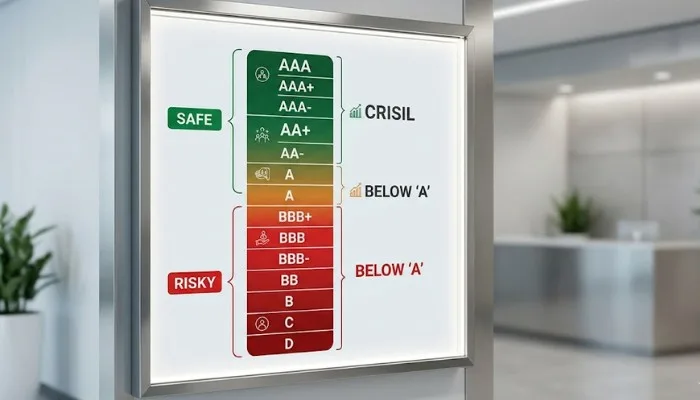
Mistake Number 4 – Not Checking Credit Rating
In India, not all bonds are safe. Some company bonds have low credit rating. That means the company may not be able to pay you back. Always check CRISIL or ICRA rating. AAA and AA are safe. Anything below A is risky.
Final Words
Choosing between short term vs long term bonds India is not difficult if you know your own needs. Ask yourself three simple questions. When do I need the money? How much risk can I take? Do I want to save tax or not?
If your answer is 1 to 3 years and low risk, pick short term bonds. If your answer is 7 to 10 years and higher return with tax saving, pick long term bonds.
And now you also know how to invest in short-term bonds through mutual funds, RBI Retail Direct, or bond apps. You have seen the best short term bonds in India. And you have checked long term bonds interest rates.
Start small. Put a little money in a short term bond fund for 1 year. See how it works. Then slowly add more. That is the best way to learn.
FAQs
Are short term bonds safe in India?
Yes, short term bonds are generally safe if you buy government bonds or AAA rated company bonds. Short term bond mutual funds are also safe for 1 to 3 year time period.
Which gives more return – short term or long term bonds?
Usually long term bonds give more interest. But they also have more risk. In some years, short term bonds can give better returns if RBI increases rates.
Can I lose money in bonds?
Yes. If you sell a bond before its time and interest rates have gone up, you can get less money than what you put in. But if you hold till the end date, you get your full money back.
How to check long term bonds interest rates today?
You can check on RBI website or on trading apps like Groww, Zerodha, or IndiaBonds. Search for G-Sec 10 year or 15 year.
What is the best short term bonds in India for 2 years?
The best short term bonds in India for 2 years are usually from SBI Short Term Debt Fund, ICICI Short Term Fund, or direct T-Bills from RBI Retail Direct.
Is it good to buy bonds in 2025 in India?
Yes, if RBI starts reducing interest rates, bonds will give good returns. Many experts believe 2025 and 2026 will be good for bonds. But always talk to a financial advisor before putting big money.