

RBI Bonds for Senior Citizens: How to Buy the Floating Rate Savings Bond
RBI bonds are a safe savings option issued by the Reserve Bank of India. Unlike company stocks, these bonds resemble government savings certificates that offer regular interest payments.
For older adults, the RBI Floating Rate Savings Bonds (RFRSB) are especially popular. They suit those seeking low-risk, steady income. Your principal is government-backed, and interest is disbursed every six months. These bonds are simple to buy through bank branches or online and provide a dependable source of periodic income.
This article explains RBI bonds in straightforward language: what they are, who’s eligible to buy them, how seniors can purchase RBI bonds, steps to buy the RBI Floating Rate Bond, and the current interest rate applicable to senior citizens.
What are RBI Bonds for Senior Citizens?
RBI bonds for senior citizens are savings instruments issued under the government framework and backed by sovereign credit. For retirees, the appeal is straightforward: the money stays relatively safe, and interest comes at fixed intervals instead of depending on market movement.
The most common version is the Floating Rate Savings Bond, which does not promise one fixed rate for the full term. Instead, its coupon moves in line with the National Savings Certificate rate plus 0.35%, and the interest is paid every six months.
Read More: Municipal Bonds India: How to Buy and Interest Rate Guide

RBI Bonds Interest Rate for Senior Citizens
The RBI Floating Rate Savings Bond does not give a fixed 7% or 8% for the whole 7 years. Instead, the interest rate “floats” around the National Savings Certificate (NSC) rate.
As of 2026, the current practice is:
- The bond interest rate is NSC rate plus 0.35%.
- The rate is reset every six months.
- Interest is paid twice a year (semiannually).
For example, if the NSC rate is 7.7%, then the RBI Floating Rate Savings Bond will pay about 8.05% per year for that halfyear. This small plus of 0.35% makes these bonds slightly better than plain NSC for many senior citizens.
Important points about the interest:
- The interest is taxable under Income Tax as per your slab.
- No TDS is deducted by RBI or banks, but you have to show interest income in your return.
- Interest is not compounded; it is paid in cash every six months.
Because of this, RBI bonds are more suitable for people who want regular cash flow instead of longterm growth.
Who Can Buy RBI Bonds for Senior Citizens?
Not everyone can directly buy these bonds. There are clear eligibility rules set by RBI. For senior citizens, the main points are:
- Indian residents only (not NRI).
- Minimum age 60 years to get the seniorcitizen benefits.
- Can be held in single name or joint names (usually with spouse or family member).
- Hindu Undivided Family (HUF) cannot open separate bonds; only individuals or joint holders.
If you are below 60 but buying for a parent or spouse, the bond should be opened in their name (the seniorcitizen’s name). The account supporting documents (PAN, Aadhaar, bank links) will be in their name.
Also note:
- No nomination is mandatory, but it is strongly advised for senior citizens.
- A PAN card is compulsory for investing in RBI bonds.
- You must have a bank account in India (linked to your PAN and Aadhaar).
These rules make RBI bonds very orderly and safe but also a bit strict compared to normal bank deposits.
How to Buy RBI Bonds for Senior Citizens?
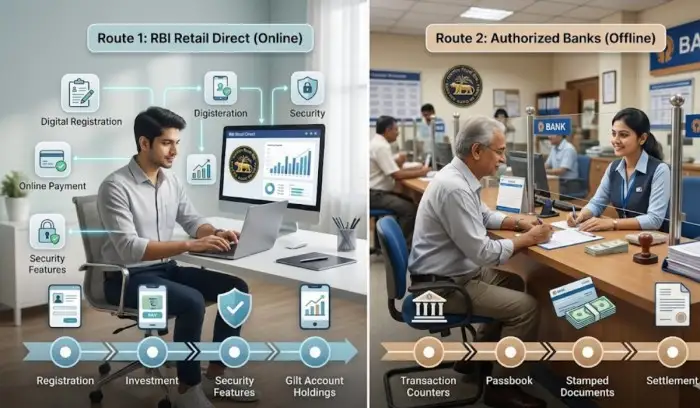
Now let us see how to buy RBI bonds for senior citizens in practical steps. You can buy them in two main ways:
1. Through RBI Retail Direct (Online)
RBI Retail Direct is the official government portal to buy government bonds, including RBI Floating Rate Savings Bonds. The steps are simple:
- Create an account on the RBI Retail Direct website.
- Link your PAN and bank account and complete KYC.
- Look for the RBI Floating Rate Savings Bond under the “Government Bonds” section.
- Choose the amount (minimum 1,000; in multiples of 1,000).
- Confirm the tenure (currently 7 years for these bonds).
- Pay the amount from your linked bank account.
- The bonds will appear in your Retail Direct demat/ebonds account.
This method is best for techsavvy seniors or family members who manage online banking. There is no extra fee for buying through RBI Retail Direct.
2. Through Banks (Branch or Online)
Many retired people still prefer going to a bank branch or using bank netbanking. The process is almost the same, but managed by the bank.
Steps to buy through a bank:
-
Visit your SBI, HDFC, ICICI, or other authorised bank branch that sells RBI bonds.
-
Ask the relationship manager or customer service for RBI Floating Rate Savings Bond for senior citizens.
-
Fill the application form and submit:
-
PAN copy
-
Aadhaar copy
-
Age proof (if required)
-
Passportsize photo and signature
-
-
The bank will open a bond account in your name and link it to your savings account.
-
Pay the amount in the bank, and the bond will be registered in your favour.
Some banks also allow you to apply online through netbanking or mobile banking, but the exact path depends on the bank. If you are not comfortable with online, the branch route is still safe and common.
How to Buy RBI Floating Rate Bond (StepbyStep)
Let us focus specifically on how to buy RBI Floating Rate Bond in a clear, stepbystep way. This is the exact product you will see when searching for “RBI bonds for senior citizens”.
Step-by-step process
- First, confirm that the investor is eligible and has the required documents ready. PAN, Aadhaar, and an Indian bank account are the core requirements, and the investor must be a resident individual for the main RBI route.
- Next, decide the amount you want to invest. The minimum investment is generally 1,000 and in multiples of 1,000, while there is no practical upper limit stated on the mainstream bank product pages.
- Then choose the route that suits the senior citizen better. RBI Retail Direct is cleaner for people who are comfortable online, while the bank route is better for those who want staff assistance and paper support.
- After that, finish KYC, complete payment, and save the bond record or statement. Interest will then be credited according to the semi-annual schedule, so it helps to keep a note of the payout dates.
Lockin Period and Early Withdrawal Rules
RBI Floating Rate Savings Bonds are not like normal fixed deposits that you can break after 1 year. These bonds have a lockin period, and early withdrawal is allowed only with certain conditions.
Normal Lockin
- The standard tenure of RBI Floating Rate Savings Bonds is 7 years.
- You cannot withdraw the full amount before 7 years without penalty.
This lockin is intentional: RBI wants people to treat this as a longterm savings instrument, not as a shortterm parking option.
Early Withdrawal for Senior Citizens
For senior citizens, there are special rules for early withdrawal, but they are not very flexible:
- If you are 60–69 years old, you can withdraw after 4 years with a small penalty.
- If you are 70 years or above, you can withdraw after 3 years with a slightly lower penalty.
The exact percentage of penalty and the procedure may change over time, so it is important to check the latest RBI circular or ask your bank before breaking the bond.
Because of this, it is wise to treat RBI bonds as a “donottouch” corpus for at least 4–7 years.
You May Also Read: How to Buy Government Tax Free NRI Bonds: Zero Tax, Step-by-Step 2026 Guide
Tax Treatment of RBI Bonds for Senior Citizens
One of the most confusing parts for seniors is tax. Let us break it down in simple words.
Is Interest Taxable?
Yes, the interest from RBI bonds is taxable. It is added to your total income and taxed according to your slab:
- If you are in the 5% slab, interest is taxed at 5%.
- If you are in the 20% slab, interest is taxed at 20%, and so on.
There is no tax exemption like some other seniorcitizen schemes.
Is TDS Deducted?
For RBI bonds, no TDS is deducted at the time of interest payment. This means:
- The bank or RBI does not cut tax at source.
- You still have to show this interest in your income tax return.
Because there is no TDS, many seniors forget to include this income. You should keep a yearly record of interest received and show it under “Income from Other Sources”.
How to Show in ITR?
When you file your income tax return:
- Use the interest statement from RBI Retail Direct or your bank.
- Add the total interest to your other income.
- Pay tax as per your slab.
If you are above 60 and below 80, you still get the basic exemption limit higher than normal, but RBI bond interest is not taxfree.
Pros and Cons of RBI Bonds for Senior Citizens
Before you decide to buy RBI bonds, it is important to see both the good and the bad sides.
Advantages
- Very safe – backed by the Government of India.
- Regular interest – you get cash every 6 months, which helps with monthly expenses.
- No TDS – easier cash flow, but you have to remember to pay tax yourself.
- Floating rate slightly better than NSC – RBI Floating Rate Bonds are usually NSC + 0.35%, which is a bit higher than plain NSC.
- Good for riskaverse people – ideal if you do not want to invest in stocks or mutual funds.
Disadvantages
- No tax benefit – interest is fully taxable, unlike some other schemes.
- Lockin period – you cannot withdraw easily before 4–7 years without penalty.
- No capital growth – only fixed interest, no upside if markets go up.
- Limited flexibility – once you put money, you get only fixed interest; you cannot change the rate or tenure.
Because of these points, RBI bonds are best taken as part of a mixed portfolio, not as the only investment.
Where RBI Bonds Fit in a SeniorCitizen Portfolio?
Many senior citizens in India hold only bank FDs and postoffice savings. RBI bonds can be a third pillar in such a portfolio.
A simple practical idea is:
- 30–40% in safe fixed deposits (banks, postoffice, SCSS).
- 30–40% in RBI Floating Rate Savings Bonds for steady income.
- 10–20% in lowrisk mutual funds or debt funds (if you are comfortable with small risk).
This mix keeps your money safe overall, gives you regular interest, and still allows a small part for better returns.
If you are very conservative, you can increase RBI bonds and bank FDs and keep mutual funds at zero. The choice depends on how much risk you can handle and how much monthly income you need.
Conclusion
RBI bonds for senior citizens are a safe choice for retired people who want regular interest without market risk. These bonds are backed by the government, pay interest every six months, and can be bought through RBI Retail Direct or banks.
If you are 60 or above, have PAN, Aadhaar and a bank account, you can buy RBI bonds for senior citizens and also understand how to buy RBI Floating Rate Bond in a simple way. Just keep the lockin period, tax rules and the current RBI bonds interest rate for senior citizens in mind before you invest.
FAQs
What happens if the senior citizen dies before 7 years?
If the bond holder dies, the nominee or legal heir can claim the amount after following the bank/RBI procedure. You should clearly record the nominee details when opening the bond.
Can I get monthly interest?
No. RBI Floating Rate Savings Bonds pay interest every 6 months, not every month. If you want monthly income, you may need to combine RBI bonds with monthlyincome schemes or bank FDs.
Can I withdraw RBI Floating Rate Bond before 7 years as a senior citizen?
Yes, but with rules and charges. If you are 60–69 years, you can usually withdraw after 4 years, and if you are 70 or above, you may be allowed to withdraw after 3 years. The exact rules for how to buy RBI Floating Rate Bond and then withdraw early depend on RBI’s latest circular, so always confirm with RBI Retail Direct or your bank before breaking the bond.
Are RBI bonds for senior citizens tax free?
No, RBI bonds for senior citizens are not tax free. The interest is added to your income and taxed as per your slab. No TDS is cut at source, so you must show this interest under “Income from Other Sources” in your income tax return and pay tax as per your slab.