

How to Build a Bond Portfolio Strategy in India (2026 Guide)
If you have been looking for safe investment options in India, bank fixed deposits might have been your first choice for years. They are simple. They feel secure. But here is a question more and more investors are asking today - are FDs still enough to build real wealth? With inflation eating into your returns and taxes taking a big bite, the answer is becoming clear. Relying only on fixed deposits may no longer be enough in a rising inflation and high-tax environment .
This is where bonds come in. A well-planned bond portfolio strategy can give you steady income, protect your capital, and even beat inflation. But building such a portfolio requires a clear plan. You cannot just buy any bond and hope for the best. You need a strategy that matches your goals, your risk appetite, and the current market situation.
In this article, we will walk you through exactly how to build a bond portfolio strategy in 2026. We will cover everything from the basics of bond investing to advanced strategies like laddering and barbell approaches. By the end, you will have a clear roadmap to create a bond portfolio that works for you.
Understanding Bond Portfolio Basics
What is a Bond Portfolio?
A bond portfolio is simply a collection of bonds that you hold as investments. Think of it like a basket where you keep different bonds instead of just one. Each bond is essentially a loan you give to a government or company. They promise to pay you interest regularly and return your principal when the bond matures.
But why do you need a portfolio instead of just buying one bond? The answer is simple - safety and returns. When you spread your money across different bonds, you reduce your risk. If one bond performs poorly, others may do well. This is called diversification, and it is the foundation of smart investing.
Read More: Top Treasury Bonds for 2026 Investors: Best Bond Picks
Why Build a Strategic Bond Portfolio?
Building a strategic bond portfolio is not just about buying bonds randomly. It is about creating a system that works for you. Here is why this matters:
Steady Income: Bonds give you regular interest payments. This can be especially helpful if you are retired or need predictable cash flow.
Capital Protection: Good quality bonds protect your principal. Unlike stocks, where you can lose money, bonds give you your money back at maturity.
Inflation Protection: The right bond strategy can help you stay ahead of inflation. While FDs often fail to beat inflation after tax, bonds can offer better returns .
Risk Management: A well-planned portfolio helps you manage different types of risks. These include interest rate risk, credit risk, and reinvestment risk.
Portfolio Balance: Bonds act as a stabiliser in your overall investment portfolio. When stocks go down, bonds often hold steady or even go up.
The Current Market Situation in 2026
Right now, the Indian bond market is going through an interesting phase. After two strong years of bond market rally, 2026 is bringing a shift. Experts suggest that investors should move away from aggressive duration bets and instead focus on generating stable returns through attractive yields .
The 10-year government bond yield is trading near 6.4% to 6.5%, while short-to-mid maturities in the 3-5 year range are offering around 5.8% to 6.2% . This creates opportunities for smart investors.
What is different this year? The Reserve Bank of India has already cut rates significantly. Many experts believe we are close to the end of the rate-cut cycle. This means the strategy that worked in the last two years may not work as well going forward .
Step-by-Step Guide to Build Your Bond Portfolio
Step 1: Define Your Investment Goals
Before you buy any bond, ask yourself these questions:
- What is my time horizon? Are you investing for 1 year, 5 years, or 10 years? Your answer will shape your strategy.
- What income do I need? Do you want regular interest payments or are you okay with waiting until maturity?
- What is my risk appetite? Are you comfortable with some risk for higher returns, or do you want maximum safety?
- What is my tax bracket? Your tax rate matters because bond interest is taxed differently based on your income slab.
Step 2: Understand Different Types of Bonds Available in India
Indian investors have many bond options today. Here are the main categories:
Government Securities (G-Secs): These are bonds issued by the central government. They are the safest option because they are backed by the government. The interest rate is called the coupon rate, and it is paid twice a year.
State Development Loans (SDLs): These are issued by state governments. They offer slightly higher interest than central government bonds but carry similar safety. In 2026, SDL spreads are looking attractive, with some experts watching for spreads to reach nearly 100 basis points .
Corporate Bonds: Companies issue these to raise money. They can offer higher returns than government bonds but come with credit risk. Bonds are rated by agencies like CRISIL and ICRA. AAA is the highest rating, indicating the lowest risk. AA and A rated bonds offer higher interest but more risk.
Non-Convertible Debentures (NCDs): These are corporate bonds that cannot be converted into shares. They have been gaining popularity in India as a middle path between FDs and stocks . Retail participation has risen, with secondary market trades jumping to 28.42 lakh in FY26 from 11.91 lakh in FY25 .
Tax-Free Bonds: These are issued by government entities and the interest is tax-free. They are great for investors in higher tax brackets.
Step 3: Choose Your Core Bond Strategy
There are three main strategies for building a bond portfolio. Let us look at each one:
Strategy 1: Bond Laddering
This is the most popular strategy for individual investors. Think of it like a ladder where each rung is a bond maturing in a different year.
How it works: Instead of putting all your money into one bond that matures in 5 years, you divide it across bonds that mature in 1 year, 2 years, 3 years, 4 years, and 5 years. When the 1-year bond matures, you reinvest that money into a new 5-year bond. This keeps your ladder going .
Why it works:
- Consistent Cash Flow: You get money back every year as bonds mature
- Less Interest Rate Risk: You are not locked into one rate for a long time
- Reinvestment Opportunities: You can take advantage of changing interest rates
- Flexibility: You can adjust your strategy as your needs change
The Indian context: Earlier, this strategy was mostly for wealthy investors and institutions. But now, with SEBI-regulated online bond platform providers, Indian retail investors can buy bonds in smaller amounts, starting as low as 1000 .
Strategy 2: The Barbell Strategy
<>This is another popular approach, especially in today's market. The name comes from the shape of a barbell - heavy at both ends and light in the middle .How it works: You put most of your money in short-term bonds (1-3 years) and some money in long-term bonds (10+ years). You keep very little in the middle maturities.
Why this works in 2026:
- Short-term side: Gives you steady income with low risk. Corporate bond spreads at the shorter end are attractive right now
- Long-term side: Gives you the potential for capital gains if interest rates fall further
- Flexibility: The cash from short-term bonds lets you reinvest when opportunities appear
Strategy 3: The Carry and Credit Strategy
This strategy focuses on earning income from interest and taking limited credit risk.
How it works: You invest in bonds that offer good interest income (carry) and selectively add bonds from companies with good fundamentals but higher yields (credit).
Why it fits 2026: Experts believe 2026 will be a year of consolidation, not sharp moves. This makes income-focused strategies attractive .
Step 4: Decide Between Active and Passive Management
You have two ways to build your bond portfolio:
Active Management: You pick individual bonds yourself. This gives you complete control. You can choose exactly which bonds to buy and when to sell. However, it requires time, knowledge, and effort.
Passive Management: You invest through mutual funds or exchange-traded funds (ETFs). This is simpler. Professional fund managers handle the complex decisions. Target maturity funds are a good passive option that mimics bond laddering .
For most investors: A combination works well. Use passive funds for the core of your portfolio and actively manage a smaller portion.
Step 5: Calculate Your Allocation
How much should you put in each type of bond? There is no one-size-fits-all answer. It depends on your age, goals, and risk appetite .
For younger investors (20-40): You can take more risk because you have time to recover from any losses. You might put 30-40% in corporate bonds and 60-70% in government bonds.
For middle-aged investors (40-60): Balance is key. Consider 40-50% in government bonds, 30-40% in good quality corporate bonds, and 10-20% in higher-yield options.
For retirees: Safety is most important. Put 60-70% in government bonds and SDLs. Keep 20-30% in high-rated corporate bonds. Limit exposure to riskier bonds.
Step 6: Understand and Manage Risks
Bond investing comes with several risks. Here is how to manage them:
Interest Rate Risk: When interest rates rise, bond prices fall. This is a big risk for long-term bonds. You can manage this by keeping your average maturity short (under 5 years) or using laddering .
Credit Risk: This is the risk that the bond issuer fails to pay. Always check credit ratings. Stick to AAA and AA rated bonds unless you understand the risks well. Remember that ratings can sometimes lag reality, as seen in cases like IL&FS .
Reinvestment Risk: This is the risk that you cannot reinvest your money at the same rate when bonds mature. Laddering helps manage this because bonds mature at different times.
Liquidity Risk: Some bonds are hard to sell before maturity. This is especially true for corporate bonds and NCDs. Stick to listed bonds and understand that exiting early may lead to losses .
Inflation Risk: The risk that inflation eats into your returns. For this, you need to earn returns above inflation. Bonds with higher yields can help.
Step 7: Tax Planning for Your Bond Portfolio
Taxes can significantly impact your returns. Here is what you need to know:
Interest Income: Interest from bonds is added to your income and taxed at your income tax slab rate. For NCDs, TDS of 10% applies if annual interest exceeds 10,000 .
Capital Gains: If you sell bonds before maturity, you pay capital gains tax. For bonds held more than 12 months, the gain is long-term and taxed at 12.5% without indexation. For bonds held 12 months or less, it is short-term and taxed at your slab rate .
Tax-Efficient Options: Consider debt mutual funds for better tax efficiency. Income + arbitrage funds offer equity taxation at 12.5% for long-term capital gains beyond 2 years, which is much better than income tax slab rates .
For higher tax brackets: Tax-free bonds and debt mutual funds can be more tax-efficient than FDs or direct bonds.
Step 8: Diversify Across Issuers and Sectors
Never put all your money in one bond or one type of issuer. Diversify across:
- Government and corporate bonds: Mix for safety and better returns
- Different sectors: Banks, PSUs, NBFCs, manufacturing companies
- Different ratings: Mostly AAA and AA, with small exposure to A-rated for higher returns
- Different maturities: Use laddering to spread across time
You May Also Read: Best Bonds for Conservative Investors in India (2026 Guide)
Advanced Strategies for 2026
The Current Opportunity
2026 brings some unique opportunities for bond investors. The bond market setup is unusually favourable, with stable growth and subdued inflation .
The term premium: The spread between the 10-year yield and the repo rate is around 135 basis points. This offers an attractive entry point. Experts believe downside risk is limited, with perhaps only a 10-basis-point adverse move possible in a worst-case scenario .
Attractive corporate spreads: Corporate bond spreads have widened to nearly 100 basis points over government bonds. This means investors can earn close to 100 basis points over government securities in AAA PSU bonds in the 2-3 year segment, while duration risk remains low .
State Development Loans: With nearly 5 lakh crore of SDL issuances expected in the January-March quarter, spreads have widened. If they move closer to 100 basis points, these levels are quite attractive .
The Barbell Strategy for 2026
Given the current market, many experts are recommending a barbell approach for 2026. Here is why :
Short-term side (1-3 years):
- Corporate bonds in this segment offer attractive spreads
- Low duration risk means interest rate movements have less impact
- You earn steady income while staying flexible
Long-term side (10+ years):
- Government securities at 7.4-7.5% offer good value
- Potential for capital gains if yields fall further
- Supported by structural demand and expected global index inflows
The Role of Target Maturity Funds
Target maturity funds are a simple way to build a bond ladder. These are mutual funds that hold bonds until a specific target date .
How they work: You choose a fund with a target maturity year that matches your goal. For example, if you need money in 2030, you invest in a 2030 target maturity fund. The fund buys bonds that mature around that time.
Benefits:
- Simple and easy to manage
- Professional management handles bond selection
- Good for goal-based investing
- Low cost compared to active funds
Building Your Portfolio Step-by-Step
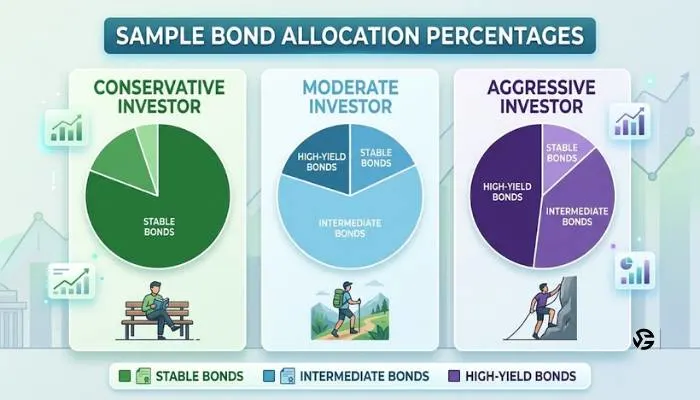
Sample Portfolio for Different Investor Types
Conservative Investor (Retiree):
- 50% Government Securities
- 30% State Development Loans
- 20% AAA Corporate Bonds (1-3 years)
- Use bond laddering across 1-5 years
- Average maturity: 3 years
Moderate Investor (Working Professional):
- 30% Government Securities
- 30% AAA Corporate Bonds
- 20% AA Corporate Bonds
- 20% Debt Mutual Funds / Target Maturity Funds
- Use barbell strategy: 50% short-term, 50% long-term
- Average maturity: 5 years
Aggressive Investor (Young Professional):
- 20% Government Securities
- 30% Corporate Bonds (AAA and AA)
- 20% A-rated Corporate Bonds (selectively)
- 30% Debt Mutual Funds with some credit risk
- Target returns: 8-9% per year
- Average maturity: 7 years
Where to Buy Bonds in India
Today, Indian investors have many options:
Online Bond Platforms: SEBI-regulated platforms like Indiabonds.com, Bondbay, and others allow you to buy bonds in small amounts. They provide credit insights, documentation, and tracking tools .
Bank Branches: Many banks sell government bonds and NCDs. This is the traditional way but may have higher costs.
Stock Exchanges: You can buy and sell bonds through your trading account. This gives you liquidity but requires some market knowledge.
Mutual Funds: The simplest option for most investors. You get professional management and diversification.
Practical Tips for Success
- Start Small: Begin with a small amount and learn as you go. You can always increase your investment later.
- Check Credit Ratings: Always check ratings from agencies like CRISIL and ICRA. AAA is safest. Avoid anything below BBB unless you understand the risks well .
- Read the Fine Print: Understand whether the bond is secured (backed by collateral) or unsecured. Secured bonds are safer .
- Match Coupon to Needs: If you need monthly income, choose bonds with monthly coupons. If you are investing for growth, choose cumulative options .
- Avoid Concentration: Do not put more than 10-15% of your bond portfolio in a single issuer .
- Hold to Maturity: If you buy individual bonds, plan to hold them to maturity. Selling early can lead to losses .
- Regular Review: Review your portfolio at least once a year. Your needs and the market situation may change.
Common Mistakes to Avoid
- Chasing High Yields: Higher yields usually mean higher risk. Do not get tempted by yields that seem too good to be true .
- Ignoring Inflation: If your returns do not beat inflation after tax, you are actually losing money. Keep this in mind when choosing investments .
- Locking In for Too Long: Long-term bonds are risky if interest rates rise. Unless you are sure, keep average maturity reasonable.
- Not Diversifying: Putting all your money in one bond or one issuer is risky. Spread your investments.
- Forgetting Taxes: Always consider the tax impact of your investments. Debt mutual funds can be more tax-efficient than direct bonds for higher tax brackets.
Overlooking Liquidity: Some bonds are hard to sell. Make sure you have some liquid investments for emergencies.
Conclusion
Building a bond portfolio strategy does not have to be complicated. Start with clear goals, choose quality bonds, diversify your holdings, and stay disciplined. Whether you use laddering, a barbell strategy, or target maturity funds, the key is to have a plan and stick to it.
The Indian bond market in 2026 offers some unique opportunities. Yields are attractive, and experts believe the risk-reward ratio is favourable . The shift from a duration-driven rally to a balanced accrual-and-barbell strategy means investors need to adapt their approach .
Remember, the goal is not to chase high returns but to build predictable wealth. With the right strategy, bonds can give you steady income, protect your capital, and help you achieve your financial goals.
Start today. Even a small investment in quality bonds can grow into a solid portfolio over time. The best time to start building your bond portfolio strategy was yesterday. The next best time is now.
FAQs
How much should I invest in bonds?
This depends on your age and goals. As a rule, your bond allocation should increase with age. A common guideline is to keep your age as the percentage in bonds. For example, if you are 40, keep 40% in bonds.
Are bonds better than FDs?
Bonds can offer better returns than FDs, especially after tax. However, they come with slightly more risk. For most investors, a mix of both works well .
Can I build a bond portfolio with a small amount?
Yes. Online bond platforms allow you to buy bonds starting from 1000. Mutual funds and ETFs are even cheaper.
What is the safest bond investment?
Government securities are the safest. They are backed by the government of India. However, they offer lower returns than corporate bonds.
How do I know if a bond is good?
Check the credit rating, read about the issuer, understand the coupon and maturity, and compare with other options. Good bonds have high ratings, clear financials, and reasonable returns.
Should I invest in bonds now?
Current yields are attractive. Experts believe 2026 offers good opportunities, especially in short-term corporate bonds and selective long-term government bonds .