

Best Low-Cost Index ETFs for Retirement Planning
When you think about retirement, you think about peace. You think about not worrying about money after you stop working. For many people in India, retirement planning feels heavy. They think it means locking money in fixed deposits or buying gold. But there is another way. A simple and low-cost way. That way is index ETFs.
Index ETFs are like baskets. You put your money in one basket, and that basket holds many company shares. You do not need to pick which company will win. You just buy the whole market. For retirement, this works very well. Why? Because retirement is long. You have twenty, thirty, even forty years before you retire. In that long time, the market usually grows. Not every year, but over many years, it grows.
In this article, we will look at the best low-cost index ETFs for retirement planning in India. We will also see which index funds work best for Indian people, which are the top five index funds in India, and which funds charge the lowest expense ratio.
Why Low-Cost Index ETFs Are Good for Retirement?
Let us understand cost first. When you buy a mutual fund or an ETF, the fund company takes a small fee every year. This fee is called expense ratio. If your fund charges one percent per year, then every year one percent of your money goes to the fund company. Over thirty years, that one percent eats a big part of your returns.
Now think of low-cost index ETFs. They charge very little. Some charge only 0.1 percent or 0.2 percent per year. That means more of your money stays with you. For retirement, this is very important. Because retirement money grows for decades. Even a small difference in cost becomes a big difference in your final corpus.
Index ETFs are also easy to buy and sell. They trade on the stock exchange just like a share. You need a demat account. You can buy one unit or many units. There is no minimum amount. You can buy for five hundred rupees also. This makes index ETFs good for small savers.
Another good thing is transparency. An index ETF always shows what it holds. If it tracks Nifty 50, you know it holds the top fifty companies in India. You do not have to guess. You do not have to trust a fund manager’s secret formula. You see everything.
Read More: How to Automate ETF Investing for Consistent Growth

Best Low-Cost Index ETFs for Retirement Planning in India?
Now we come to the main question. Which index ETFs should you pick for your retirement? Here are the best ones that are low cost, easy to buy, and trusted by Indian investors.
1. Nippon India ETF Nifty 50
This is one of the most popular index ETFs in India. It tracks the Nifty 50 index. Nifty 50 has the fifty biggest companies in India. These companies are in banking, software, cars, oil, and many other areas. When you buy this ETF, you own a small piece of all these fifty companies.
The expense ratio is very low. It is around 0.05 percent. That means for every one lakh rupees you invest, you pay only fifty rupees per year. For retirement, this is excellent. You can keep your money here for thirty years without worrying about high costs.
You can buy this ETF on NSE and BSE. The trading volume is good, so you will always find a buyer when you want to sell.
2. UTI Nifty Index Fund (ETF variant)
UTI is a trusted name in India. Many older investors know UTI from the UTI Master Share days. Their Nifty Index ETF is very good for retirement. It also tracks Nifty 50. The expense ratio is around 0.1 percent. Slightly higher than Nippon, but still very low.
The good thing about UTI is trust. Many Indian people feel safe with UTI. If you are someone who wants a very well known fund house, UTI is a good choice.
3. Bharat 22 ETF
This is a different kind of index ETF. It is made by the government of India. It holds twenty two companies. Many of them are government companies like Coal India, ONGC, and SBI. But it also has some private companies like ITC and Axis Bank.
The expense ratio of Bharat 22 ETF is very low, around 0.05 percent. For retirement, this ETF gives you a mix of government and private companies. Government companies often pay good dividends. For a retired person, dividends can be a source of regular income.
4. Motilal Oswal S&P 500 Index ETF
Do you want to put some of your retirement money outside India? Then this ETF is for you. It tracks the American S&P 500 index. That index has the five hundred biggest companies in America. Companies like Apple, Microsoft, Amazon, Google, and Facebook.
This ETF is in Indian rupees. You can buy it from your Indian demat account. The expense ratio is around 0.2 percent. For an international fund, that is very low. Putting some money in this ETF is good for retirement because it spreads your risk. If India does badly for a few years, America might do well.
5. HDFC Nifty 50 ETF
HDFC is another big name in Indian finance. Their Nifty 50 ETF is very similar to Nippon and UTI. The expense ratio is around 0.05 percent. The difference is the fund house. Some people prefer HDFC because of their customer service and reputation.
For retirement, you cannot go wrong with HDFC Nifty 50 ETF. It gives you the same fifty companies. The cost is low. The liquidity is good.
Best Index Funds ETF in India
People often ask what is the difference between an index fund and an index ETF. Both track the same index. Both have low costs. But there is one small difference.
An index ETF trades on the stock exchange. You buy it during market hours. The price keeps changing during the day. You need a demat account.
An index fund is a mutual fund. You buy it at the end of the day at one price. You do not need a demat account. You can buy it directly from the fund house or from a mutual fund distributor.
For retirement, both are fine. But ETFs are usually cheaper. Their expense ratio is slightly lower than index funds. Also, ETFs do not have exit load in most cases. Some index funds have exit load if you sell before a certain time.
If you already have a demat account, buying index ETFs is very easy. If you do not have a demat account, you can open one for free with many brokers like Zerodha, Groww, or Angel One.
Here are the best index fund ETFs in India for retirement:
- Nippon India ETF Nifty 50
- UTI Nifty Index ETF
- HDFC Nifty 50 ETF
- ICICI Prudential Nifty 50 ETF
- Motilal Oswal S&P 500 Index ETF

Top 5 Index Funds in India
Now let us list the top five index funds in India. These are not just ETFs. These include regular index funds also. For retirement, you can pick any of these. They are all low cost, well managed, and easy to buy.
- UTI Nifty Index Fund – This is the oldest index fund in India. It has a very good track record. The expense ratio is around 0.3 percent for the regular plan and even lower for the direct plan.
- Nippon India Index Fund Nifty 50 – Very low cost. Very popular. Good for long term retirement saving.
- HDFC Index Fund Nifty 50 – Trusted fund house. Consistent returns. Low expense ratio.
- Motilal Oswal Nifty 50 Index Fund – A newer fund but very competitive. The direct plan has an expense ratio below 0.2 percent.
- ICICI Prudential Nifty 50 Index Fund – Good for people who already have an ICICI relationship. The fund performance matches the index very closely.
Remember, when we say top five, we do not mean which one gives the highest return. All index funds tracking the same index give almost the same return. The small difference comes from expense ratio and tracking error. Tracking error means how closely the fund follows the index. Lower tracking error is better.
Best Index Funds in India with Lowest Expense Ratio
If you want the absolute lowest cost, here are the best index funds in India with the lowest expense ratio. These are all direct plans. Direct plans have lower expense ratio because you do not pay a distributor commission.
| Fund Name | Expense Ratio (Direct Plan) | Type |
|---|---|---|
| Nippon India ETF Nifty 50 | 0.05% | ETF |
| HDFC Nifty 50 ETF | 0.05% | ETF |
| Motilal Oswal Nifty 50 Index Fund | 0.10% | Index Fund |
| UTI Nifty Index Fund Direct | 0.15% | Index Fund |
| ICICI Nifty 50 Index Fund Direct | 0.12% | Index Fund |
For retirement, every small saving in expense ratio helps. But do not pick a fund only on expense ratio. Also see tracking error and how easy it is to buy and sell. For most people, Nippon India ETF Nifty 50 or UTI Nifty Index Fund are very good starting points.
How to Start Investing in Index ETFs for Retirement?
Starting is simple. You do not need a lot of money. You do not need a finance degree. Here is a step by step way.
Step One: Open a Demat Account
You need a demat account to buy ETFs. You can open one online with Zerodha, Groww, Paytm Money, or Angel One. Most of them open the account in one day. They do not charge anything for opening. Some have yearly fees, but many offer free accounts now.
Step Two: Link Your Bank Account
Your demat account needs to be linked to your bank account. This is called a three in one account. Your bank, your demat, and your trading account are linked. Then you can move money easily.
Step Three: Decide How Much You Want to Invest Each Month
Retirement planning works best when you invest small amounts regularly. This is called a Systematic Investment Plan or SIP. But for ETFs, you cannot do a SIP directly. You have to buy every month by yourself. Some brokers like Groww let you set a reminder. Every month on a fixed date, you log in and buy the ETF.
If you do not want to buy every month, you can buy once every three months. The important thing is to keep buying regularly. Do not try to guess the market low. Do not wait for prices to fall. Just keep buying.
Step Four: Buy the ETF
On your trading app, search for the ETF name. For example, search for Nippon India ETF Nifty 50. You will see the current price. Decide how many units you want to buy. Then click buy. It is as simple as buying a mobile recharge.
Step Five: Hold for Long
Do not sell when prices fall. Do not get excited when prices rise. Just keep holding. For retirement, you need to hold for at least ten to fifteen years. If you can hold for twenty or thirty years, even better.
Mistakes to Avoid in Index ETF Retirement Planning
Even simple things have mistakes. Here are common mistakes Indian investors make when using index ETFs for retirement.
Mistake One: Checking Everyday
You bought an ETF for retirement. That is a long term goal. But then you open your app every day to see the price. Some days it is up. You feel good. Some days it is down. You feel bad. This is waste of time and peace. For retirement, check once every three months. Or once every six months.
Mistake Two: Stopping When Market Falls
The market will fall many times before you retire. In 2008, it fell a lot. In 2020 during Covid, it fell a lot. In 2022, it fell some. People who stopped buying during these falls missed the best buying opportunities. When prices are low, you should buy more, not less.
Mistake Three: Picking Too Many Funds
Some people buy five different Nifty 50 ETFs. That is not useful. All Nifty 50 ETFs hold the same fifty companies. You do not need more than one. Pick one good low cost Nifty 50 ETF. That is enough. If you want diversification, add one international ETF like Motilal Oswal S&P 500 ETF. That is two funds. No need for more.
Mistake Four: Forgetting About Taxes
When you sell your ETF after retirement, you have to pay tax. In India, if you hold for more than one year, it is long term capital gain. Up to one lakh rupees profit in a year is tax free. Above that, you pay 10 percent. If you sell before one year, you pay 15 percent short term tax. Keep this in mind when you plan how much to sell after retirement.
How Index ETFs Fit in a Retirement Portfolio?
You do not have to put all your retirement money in index ETFs. That would be too risky for some people. A good simple plan for Indian retirees looks like this.
For someone who is thirty years old today and will retire at sixty:
-
60 percent in a low cost Nifty 50 ETF (like Nippon or UTI)
-
20 percent in an international ETF (like Motilal Oswal S&P 500)
-
20 percent in fixed deposits or debt funds
For someone who is fifty years old and will retire at sixty:
-
30 percent in a Nifty 50 ETF
-
10 percent in international ETF
-
60 percent in fixed deposits, PPF, or debt funds
As you get closer to retirement, you move money from ETFs to safer things like fixed deposits. This way, if the market falls just before you retire, your money is safe.
Example of Retirement Growth with Low Cost Index ETF
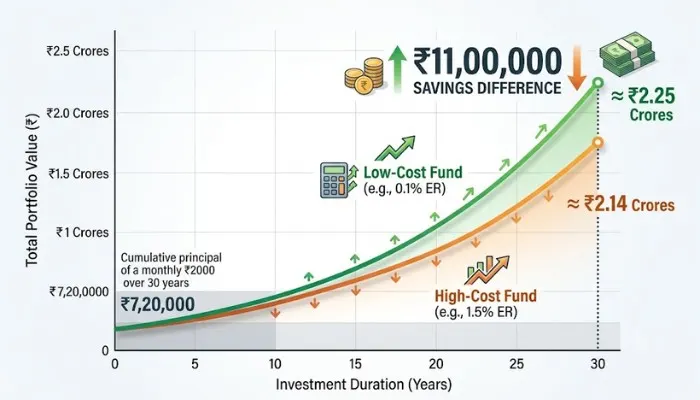
Let us take an example. Suppose you are twenty five years old. You start investing two thousand rupees every month in a Nifty 50 ETF. The ETF gives average return of 12 percent per year. This is close to what Nifty has given over long time.
After thirty years, when you are fifty five, your two thousand rupees per month becomes about fifty eight lakh rupees. That is the power of regular investing and low cost compounding.
If you had put the same money in a high cost fund charging 1.5 percent per year, your final amount would be about forty seven lakh rupees. That difference of eleven lakh rupees is the cost you saved by choosing a low cost index ETF.
For retirement, eleven lakh rupees is a lot of money. It can pay for your medical bills. It can pay for a small car. It can pay for your grandchild’s school fees.
FAQs
Is it safe to put retirement money in index ETFs?
Yes, it is safe for long term. Index ETFs hold shares of many companies. If one company fails, other companies still work. For retirement of ten years or more, index ETFs are safer than picking individual s hares.
Can I lose all my money in an index ETF?
No. You can lose money if the whole market falls. But you cannot lose all money. For you to lose all money, every single company in the index would have to become zero. That will not happen. The market always comes back after falls.
Do I need a financial advisor to buy index ETFs?
No. Index ETFs are made for simple investing. You do not need anyone to tell you which shares to pick. You just buy the whole market. If you feel confused, you can take help from a fee only advisor. But for most people, buying a Nifty 50 ETF is enough.
How is index ETF different from EPF or PPF for retirement?
EPF and PPF are debt products. They give fixed returns. They are very safe. Index ETFs are equity products. They give higher returns over long time but returns are not fixed. A good retirement plan uses both. EPF and PPF for safety. Index ETFs for growth.
Can I buy index ETFs in my mother’s name?
Yes. You can open a demat account in any family member’s name. But remember that tax is paid by the person who owns the account. If your mother has no other income, selling ETFs in her account may have no tax up to one lakh profit.
Final Words for Your Retirement Journey
Retirement planning does not have to be hard. You do not need to learn complex charts. You do not need to follow market news every day. You just need one simple habit. Put a small amount of money every month in a low cost index ETF. Do this for twenty or thirty years. That is enough.
Do not wait for the perfect time. The perfect time was yesterday. The next best time is today. Open a demat account. Pick one Nifty 50 ETF. Start with five hundred rupees. Then next month do it again. Keep doing it.
Your future self will thank you. When you are sixty years old and you do not have to ask anyone for money, you will remember that you started today. That is the gift of index ETFs. Low cost, Simple and Powerful.