

Difference Between FDs and Bonds in India: Taxation and Calculator
People in India often pick fixed deposits or bonds to grow their hard earned money without much hassle. Fixed deposits from banks like SBI hold your cash for a fixed period and pay interest you know upfront, usually 6 to 8 per cent, with that safe cover up to Rs 5 lakh if anything goes wrong.
Bonds work as loans to government offices or companies, where you get coupon payments plus a shot at extra money if you sell them when prices climb in the market, but you need to watch who issues them.
Try out a Bond vs FD calculator online to match what you earn after FD vs bonds taxation takes its cut both hit your interest as normal income tax, except those special tax-free bonds that skip it for bigger slabs. Go for FDs if you sleep better with no ups and downs, or bonds if you check their strength first and aim higher.
What is a Fixed Deposit?
A fixed deposit or FD is like a savings account with a bank or post office. You give your money for a set time, say one year or five years. The bank pays you interest on it every quarter or at the end.
For example, if you put Rs 1 lakh in an FD at 7 per cent interest for one year, you get back Rs 1,07,000 at the end. Banks like SBI offer FDs from seven days to ten years. Shorter ones give less interest, while longer ones pay more.
Tax saver FDs lock your money for five years. They help reduce your tax under Section 80C up to Rs 1.5 lakh a year. Most FDs let you break early, but you lose some interest as penalty.
Read More: What Is a Bond and How Does It Work for Traders in India?

What is a Bond?
A bond is a loan you give to the government, a company or a public sector unit. They promise to pay back your money after a fixed time with interest called coupon. Bonds come in many types like government bonds or corporate bonds.
You buy bonds when they come out new or from the stock market. In the market, their price can go up or down based on interest rates. If rates fall, bond prices rise, and you can sell early for profit. Government bonds are very safe, but company bonds carry some risk if the company faces problems.

Key Differences Between FDs and Bonds in India
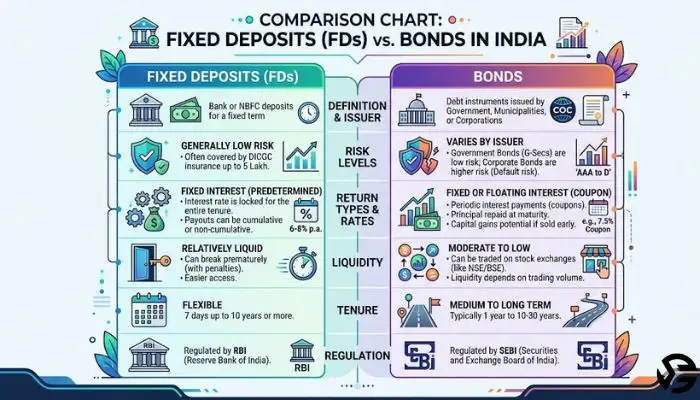
FDs suit people who want no worry and fixed returns. Bonds offer more options but need some market watch. Here is a simple table to see the main points side by side.
| Point | Fixed Deposit (FD) | Bond |
|---|---|---|
| Who Issues | Banks, post office, companies | Government, PSUs, companies |
| Returns | Fixed interest only | Interest plus possible price gain |
| Risk | Very low, insured up to Rs 5 lakh per bank by DICGC | Varies, low for govt, higher for others |
| Liquidity | Break with penalty before time ends | Sell anytime in market, price may change |
| Minimum Amount | Rs 1,000 or so | Rs 10,000 usually |
| Tenure | 7 days to 10 years | Few months to 40 years |
FDs keep your money safe with banks you trust like SBI. Bonds let you trade daily, but you must check the issuer's health.
Returns You Can Expect
FD rates in India hover around 6 to 8 per cent now. SBI gives 6.1 per cent for five-year FDs for general public. Small finance banks pay up to 8-9 per cent but check their safety.
Bonds pay coupon from 6 to 9 per cent. Government bonds like G-Secs yield about 7 per cent. Corporate bonds offer more if rated high like AAA. Plus, if you hold till end, you get full face value back.
Take Rs 1 lakh example. In FD at 7 per cent for five years, you earn about Rs 40,000 interest. Same in a bond at 7.5 per cent coupon, you get Rs 37,500 interest, but price rise could add Rs 5,000 more if sold early.
Use Bond vs FD Calculator
A Bond vs FD calculator helps compare real numbers. You enter amount, time and rates. It shows maturity value for both.
For instance, put Rs 5 lakh for three years. FD at 7 per cent quarterly compound gives Rs 5,89,000. Bond at 7.5 per cent yield gives similar if held full term. Tools on sites like Groww or BondsIndia make this easy. Try one to see after-tax returns too.
FD vs Bonds Taxation in India
Interest from both FDs and bonds adds to your income and gets taxed as per your slab. If you earn under Rs 5 lakh a year after deductions, tax stays low at 5 per cent.
FDs cut 10 per cent TDS if interest tops Rs 40,000 in a year. You claim it back in ITR if tax slab low. Tax saver FDs save tax on investment up to Rs 1.5 lakh under 80C.
Most bonds tax interest same way. Tax-free bonds from PSUs pay no tax on interest, great for high earners. If you sell bonds before one year, short-term gain taxes at slab. After one year, long-term gain at 12.5 per cent without indexation.
New rules from 2025 make listed bonds LTCG at flat 12.5 per cent over 12 months hold. FDs have no capital gain, just interest tax.
Difference Between FDs and Bonds in India SBI Example
SBI leads in FDs with safe rates. Their five-year FD pays 6.1 per cent now. You put Rs 1 lakh, get Rs 1,34,000 after five years before tax.
SBI also issues bonds like infra bonds sometimes. These pay around 7 per cent with market trade option. FD suits if you need money soon with no risk. SBI bond gives better yield but watch price swings. Corporate FDs from SBI linked firms pay more, up to 8 per cent, but less safe than bank FDs.
You May Also Read: RBI Floating Rate Bonds Retail Investor Guide: Safe Way to Grow Your Money
Who Should Choose What?
Salaried people with steady job pick FDs for safety. Seniors get higher senior rates up to 0.5 per cent extra.
If you know markets a bit, bonds beat FDs on returns over time. Young investors mix both. For Rs 10 lakh goal in five years, half FD half bonds balance risk.
Always check ratings from CRISIL or ICRA before buying bonds. Banks share DICGC cover, bonds rely on issuer strength.
Conclusion
The difference between FDs and bonds in India boils down to what suits your daily life and how much worry you want to avoid. Take FDs from places like SBI they keep your cash safe with that Rs 5 lakh cover and pay interest you can count on, just right if you need funds back without any headache.
Bonds give a chance for bigger gains and the option to sell when you like, yet stick to solid names after you look at their ratings yourself. Run numbers through a Bond vs FD calculator to spot the FD vs bonds taxation hit, then put money where it grows steady for you. Build your savings one step at a time from what you hold now.
FAQ
What marks the key difference between FDs and bonds in India?
FDs hold your money tight with banks for set interest payments, but bonds mean lending to government or firms where market prices might shift day to day.
Tell me how FD vs bonds taxation plays out in India?
Interest from both lands in your income slab for tax, though tax-free bonds skip that bill, and FDs hold back TDS once you cross Rs 40,000 a year.
Does a Bond vs FD calculator make picking easier?
Sure, it lays out end amounts next to each other, helping you see clear returns after tax based on your cash and period.
Does SBI FD beat bonds for safety in India?
SBI FDs come with bank backup insurance, so they feel rock solid, unlike bonds that rest on how strong the issuer stands.
Do FDs or bonds bring home more returns?
Bonds pull ahead long term with extra from price jumps, while FDs lock in steady, no-surprise gains that fit most folks just fine.